
(Kopie 1)
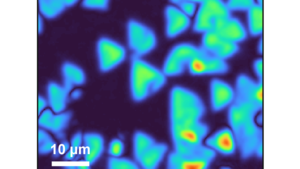
Researchers from the Departments of Physical Chemistry and Theory at the Fritz Haber Institute have developed a new method for imaging layers of boron nitride that are only one atom thick. This material is normally virtually invisible in optical microscopes because it has no optical resonances. Now…
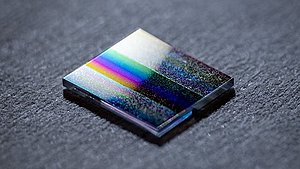
Accurate information is important for farmers in order to use resources efficiently and defy climate change with its extreme weather conditions. Hyperspectral remote sensing with satellites is an essential tool here. The Fraunhofer Institute for Surface Engineering and Thin Films (IST) has developed…
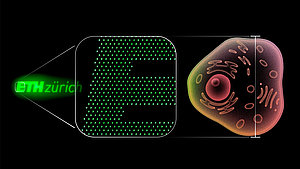
Researchers at ETH Zurich are producing organic light-emitting diodes (OLEDs) on the nanoscale - they are around a hundred times smaller than a human cell. This not only makes ultra-sharp screens and microscopes possible. The pixels are so small that novel wave optics applications are conceivable.
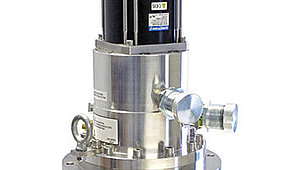
Two new cryocoolers presented
SHI Cryogenics Group has expanded its range of Gifford-McMahon cryocoolers with its most powerful single-stage models to date: the CH-160D3LT for 20 K applications and the CH-160D3 for 77 K applications.
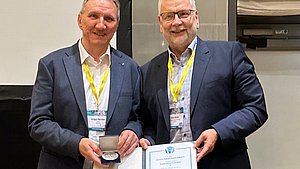
The German Vacuum Society (DVG) has awarded Prof. Holger Kersten from the Institute of Experimental and Applied Physics at Kiel University with the Rudolf Jaeckel Prize 2025. The award was presented at the V2025 "International Conference and Exhibition for Vacuum - Plasma - Surface - Coating" in…
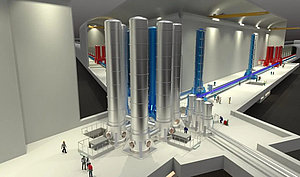
What technical requirements must the devices for the direct search for dark matter, for researching neutrinos, for detecting gravitational waves and for investigating cosmic microwave background radiation meet? Scientists and engineers from the fields of astroparticle physics (APPEC) and related…
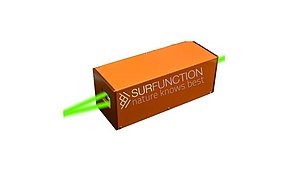
At Blechexpo 2025 in Stuttgart, Surfunction GmbH presented a fully integrated production line for laser-based surface functionalization for the first time.
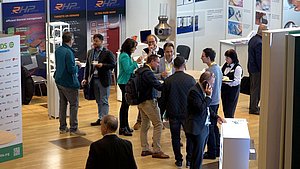
V2025 reaches new dimensions
The 2025 Conference Fair V has managed to set another record: From 13 to 16 October 2026, over 500 participants from 27 countries gathered in Dresden, according to the organizer European Research Society Thin Films e. V. (EFDS).
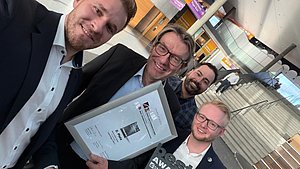
Surfunction was honoured for its fully industrialized technology platform for laser-based surface structuring. The trade fair award was presented on 21.10.2025 at Blechexpo/Schweisstec.
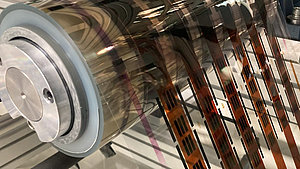
The Pearl consortium draws a positive mid-term balance of its three-year Horizon Europe project: The researchers have made decisive progress towards cost-effective and flexible perovskite solar cells with carbon electrodes and an efficiency of 25 %.