

Snow for Good Connections
CO₂ Snow-Jet Cleaning Prior to Wire Bonding
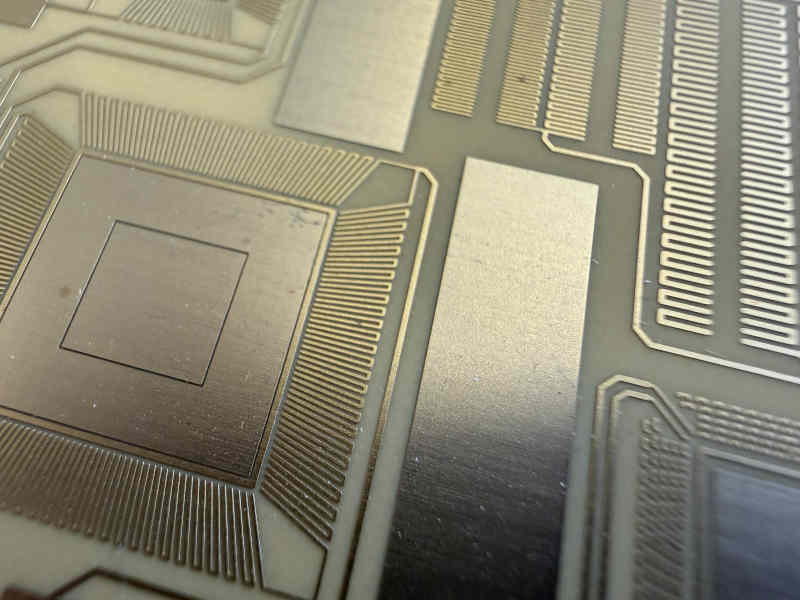
Wire bonding is an established interconnection technology in the semiconductor industry and microelectronics. Whether high-quality, long-lasting bonds are formed depends crucially on the cleanliness of the bonding surfaces. The dry and scalable quattroClean snow-jet technology reliably and cost-effectively ensures the required cleanliness and can be automated as needed.
As a standard method for electrical contacting in assembly and interconnection technology, wire bonding has been established for 70 years across a broad range of applications. Its applications range from semiconductor technology, microelectronics, and optical components to automotive, consumer products, MEMS, and industrial sensors, as well as specialized tasks such as bonding battery cells for electric mobility, cordless tools, and energy storage systems.
“Basically, wire bonding is divided into three major process groups. Two of these are fine-wire processes, in which—depending on the application—wires made of gold, silver, aluminum, or copper with a diameter of 18 to 50 µm are used. The third group involves thick-wire bonding with wire diameters ranging from 100 to 500 µm,” explains Stefan Schmitz, Managing Director of Bond-IQ GmbH. The consulting firm specializing in wire bonding technology is the initiator of the Surf:Guide industry project. The project’s goal is to develop a guideline on the cleanliness and condition of bond surfaces, which will serve as the basis for creating an internationally recognized, industry-standard specification.
Cleanliness—a Critical Factor for Quality
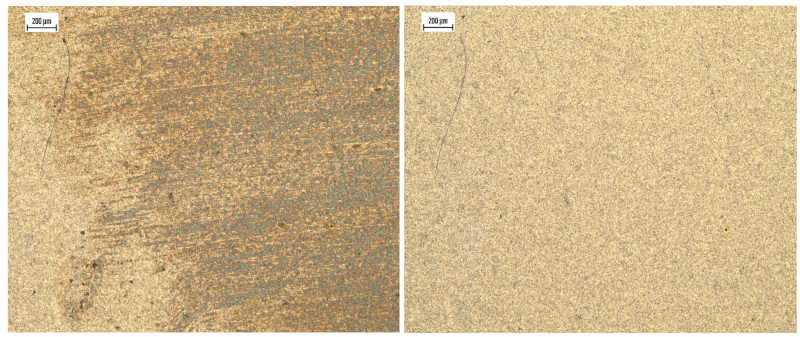
Since bonding occurs at the nanometer scale in both fine-wire and thick-wire bonding, the metals to be bonded must be brought into an atomic state relative to one another. Accordingly, contaminants or interlayers in the range of 5 to 10 µm can already interfere with the bonding process. These include, for example, fingerprints, bleeding adhesives, flux residues, outgassing from adhesives and other polymers, dust, oxides, or residues—particularly from wet-chemical cleaning processes.
“Visually detectable contamination is critical for bonding. If this contamination is no longer visible after cleaning, the bonding surface is normally sufficiently clean. This can usually be determined using a microscope and a visual before-and-after comparison. This alone can increase the success rate three- to fourfold,” explains Stefan Schmitz.
Methods for Cleaning Bond Surfaces
Traditionally, bond surfaces are still cleaned using wet chemical processes with solvents or water-based media, which require energy-intensive drying. Plasma cleaning can be used for thin, known, and very specific types of contamination. Laser cleaning is another alternative. “For highly sensitive surfaces, such as those in microelectronics, however, the costs of a laser system and the appropriate laser technology must first be balanced,” explains Stefan Schmitz. “The industry is currently showing interest in quattroClean snow-jet cleaning, as it can also remove more stubborn, encrusted contaminants.”
Dry, Targeted, and Sustainable Cleaning
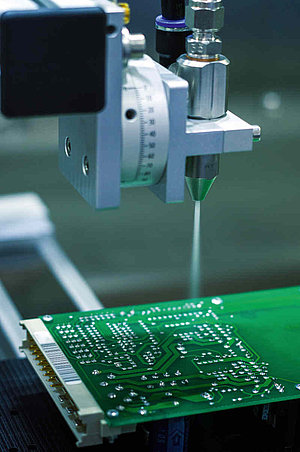
The scalable and cleanroom-compatible quattroClean snow-jet technology is a dry cleaning process for full-surface and localized applications. The process is suitable for reproducibly removing particulate contaminants down to the submicrometer range and film-like contaminants down to nanolayers. The quattroClean technology uses recycled and purified liquid carbon dioxide sourced from chemical production processes and biomass-based energy generation as its cleaning medium. It is channeled through a flexibly adjustable, wear-free dual-component ring nozzle and expands upon exit into fine snow crystals, which are bundled by a separate compressed-air jet and applied to the surface to be cleaned at supersonic speeds. The cleaning effect is based on a combination of thermal, mechanical, solvent, and sublimation effects. Since the crystalline carbon dioxide completely sublimates during the process, the treated surfaces remain dry. Removed contaminants are extracted along with the process gas, preventing recontamination of the surfaces and contamination of the surrounding area. In combination with process gas from Linde, the effective quattroClean process holds the Green Screen certification for cleaners and degreasers from Clean Production Action.
Cleaning Technology for a Wide Range of Applications
The low abrasiveness of the fine snow crystals allows even very sensitive and finely structured surfaces to be cleaned. This opens up a very wide range of applications for quattroClean snow-jet technology. Among other things, the process is used for removing flux and solder residues from PCBs and PCBAs, removing chemical and particulate contaminants from bond pads, and cleaning battery cells prior to contacting.
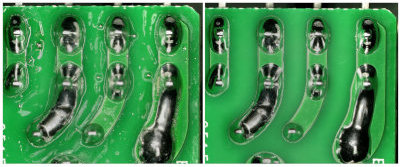
“This process can be used very efficiently on printed circuit boards, which often have a mixture of organic residues such as grease, fingerprints, flux, or residues from wet chemical cleaning processes. We have also achieved excellent results on semiconductors and on housings that have undergone electroplating or other wet chemical processes,” reports Stefan Schmitz.
The relatively straightforward automation of the cleaning process—and its integration into production lines—also contributes to this. “This results in two advantages. For one, automated cleaning ensures reproducible, uniform results. If cleaning is integrated into the manufacturing process, the contamination can be removed immediately after it occurs,” adds Stefan Schmitz.
acp systems – Company Video
acp systems AG
www.acp-systems.com
Bond-IQ GmbH
www.bond-iq.de
www.drahtbonden.de