


Rippert: Teasing out the optimum
Only customised MES production control systems get the maximum performance out of a painting plant
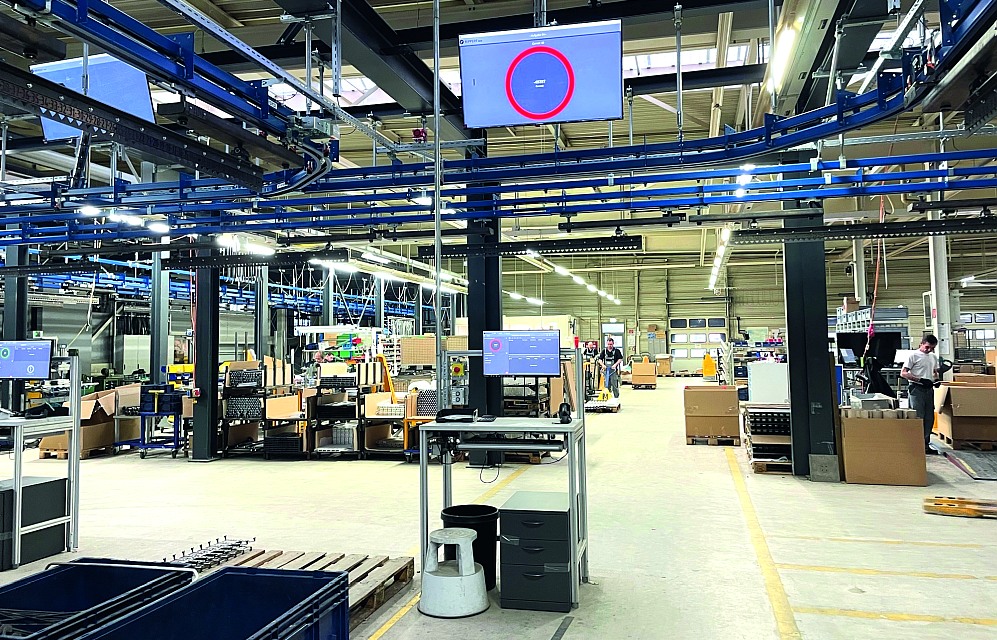
In large and highly automated painting plants, many different process steps and tasks have to be brought into as ideal a sequence as possible. An MES system specially optimized for such plants offers the best prerequisites for this.
Regardless of the target industry and the size of the company, the requirements in terms of flexibility, productivity and availability of the production environment are increasing. In addition, the growing shortage of skilled workers makes it more difficult to eliminate bottlenecks by hiring qualified employees. However, more automation alone can only solve part of the problem. After all, employees can only be relieved to the maximum and the capacities of a coating plant can only be optimally utilized if order management, which according to the state of the art is carried out with an ERP system, can interact with the level of plant control. Only in this way is it possible, without time-consuming manual intermediate steps, to manage current data on orders in real time, to record their status, to control new orders and or to prioritize them. This requires an additional software system that links the control level of the plant with the ERP system - a Manufacturing Execution System (MES). Such a production control system, as it is known in German, thus links the business reporting and production planning levels of a company's ERP with the plant control level. This enables direct steering and control of production in real time - as well as data collection, for example store floor data collection (SFDC), machine data collection (MDC) and personnel data collection, and their processing. A wide range of MES solutions can be found on the market. However, these are usually designed for rather standardized machines whose process control is not very complex - for example, bending or injection molding machines on which orders are usually processed sequentially.
A coating plant that is individually optimized for its field of application is incomparably more complex with its many process steps, which is why subareas of the coating plant often have to be regarded as a "black box" when standardized MES systems are used. It is understandable that such simplifications considerably limit the optimization possibilities offered by the MES.
The plant manufacturer Rippert from Herzebrock- Clarholz has extensive experience in the construction and design of highly automated coating plants for a wide range of industries. In order to optimize the performance of the plants with an increased complexity of the application, the plant manufacturer already used master computers with MES applications in the past, which, however, were individually programmed as special solutions. The requirements for these software solutions ranged from detailed planning, i.e. order sequencing, to active routing interventions in plant logistics, to tools for reports, quality assurance and maintenance.
Even though the systems met all requirements in practical use, it became clear due to the steadily increasing share of more complex coating plants that it was time to develop a dedicated MES system that could be adapted to different applications.
Individualized MES enables full potential
In 2020, the official starting signal was given for the development of the Rippert MES, and the plant manufacturer decided to rely on the SCRUM principle. Here, project work is carried out empirically, incrementally and iteratively. SCRUM is based on the experience that many development projects are too complex to be planned through to the smallest detail in advance. It is accepted that a significant part of the requirements and the solution approaches can only be identified in the course of the development process. This not only speeds up the development of complex products, but also means that the properties achieved are usually much closer to a theoretical optimum. Furthermore, continuous development is part of the SCRUM philosophy. As a result, users regularly participate in functional improvements and further developments. This development concept also enables the relatively short-term implementation of additional functionalities or the elimination of identified weaknesses. Customer acceptance of the developed system is high - ten new coating plants have already been equipped with the Rippert MES in the last three years, and the trend is rising. So far, the Rippert MES has been designed exclusively for coating plants and is also individually adapted to the plant it is to operate. Prerequisite for a possible implementation are certain interfaces common for MES systems - however, it does not necessarily have to be a Rippert plant. Developments are also currently underway to integrate Rippert filter systems into the MES.
Application in the office furniture sector
One of the most recent MES systems in use has been in operation at a powder coating plant at Merkt since February 2023. The company coats a wide variety of sheet steel parts - with a focus on office furniture. Parts are transported by a Power & Free conveyor, and the plant has four feed stations and six discharge stations as well as two automatic booths and one manual booth.
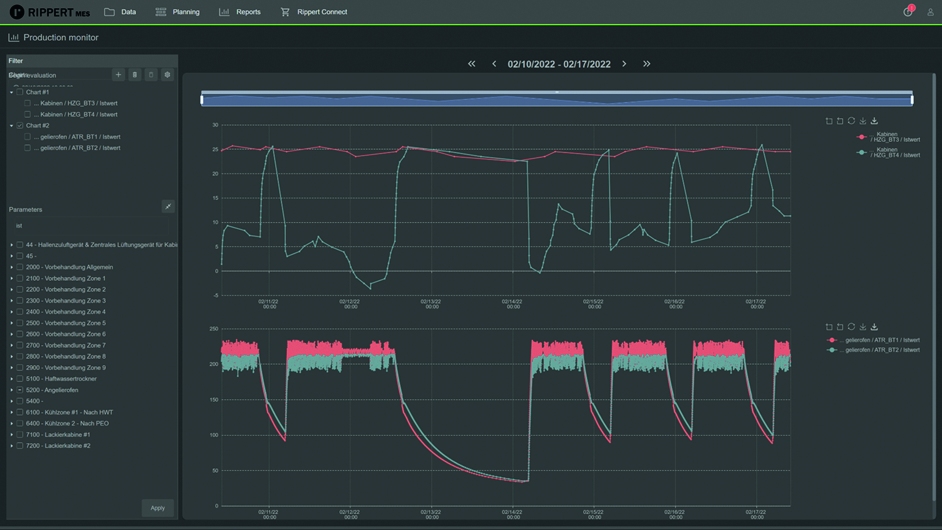
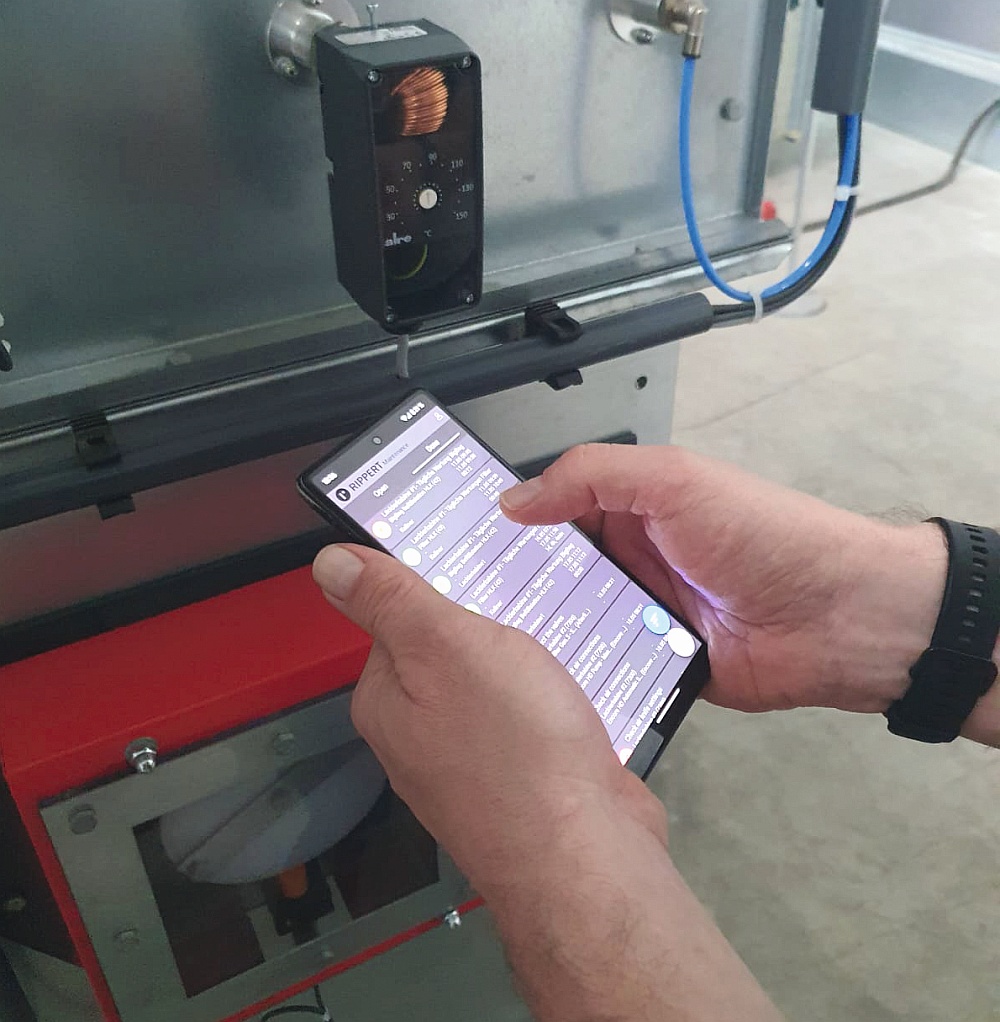
The tasks of the MES include the exchange of master, order and transaction data between the company's ERP system and the production line, as well as the provision of clear and meaningful reports. The system also archives process, machine and logistics data for traceability purposes. In addition, the MES controls the routing of trolleys at significant key points and supports preventive maintenance.
The provision of intuitive, informative as well as workplace-specific plant guidance displayed on screens improves the autonomous action capability of employees and saves ways and time to search for required instructions and documentation. Such assistance is available at the feed and delivery stations, paint booths, masking stations and other relevant positions in the line.

Focus on order sequencing
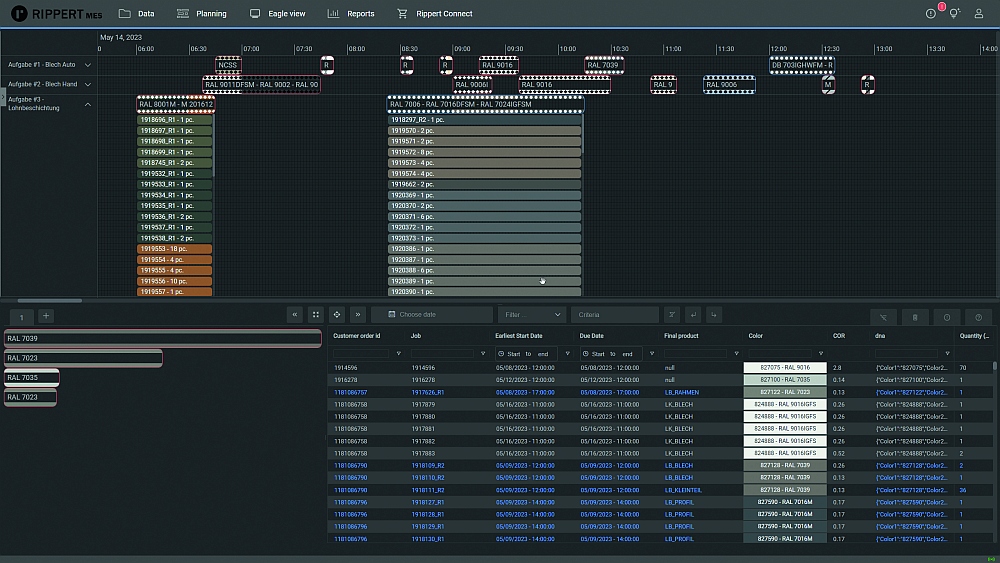
In addition to the above-mentioned tasks, the focus of the Rippert MES at Merkt is on order sequence planning. This involves scheduling the existing order backlog, which has been released for painting, among the feed stations in such a way that classic optimization criteria can be implemented. The aim is to achieve the shortest possible order throughput times, high goods carrier utilization, and homogeneous line utilization with a minimized number of color changes. In short, the capacity of the plant is to be optimally utilized.
The Rippert MES offers various options for this, the central element here being the planning board. It can serve purely as a display for a planning result transferred from a higher-level planning system. On the other hand, it is possible to create suspension sequences independently of other systems, in which orders with the same characteristics such as color and/or wall thickness are grouped, and to schedule them at the various task stations.
The finite resources such as the working time model, the goods carrier capacities and possible hanging area are taken into account, as well as the theoretically possible cycle time. After a plan has been released, the corresponding raw materials are released for pre-picking and displayed in the corresponding plant guides at the workstations. After the completion message of the pre-picking, the materials are ready for dispatch by the system. The hanging up is also carried out via a plant management in the Rippert MES.
Plant management for more effective processes
In the first step, order sequence planning at Merkt is still done manually via the Rippert MES, so the plant is initially planned by hand in the first few months. In this transitional phase, experience is gathered as well as findings for relevant decision criteria. Only then, in the second step, will the development of an optimization algorithm begin, which will then be able to schedule the unplanned order backlog completely independently in the future.
Rippert attaches great importance to parameterization and scalability. Developing the logic of an optimization algorithm is an iterative process, so this step-by-step implementation offers the advantage that users can first get used to the new paint shop and the new planning environment, so that the level of knowledge at the time of algorithm development is much more solid than at the time of the paint shop "go-live". This also minimizes the risks of unexpected errors during operation.
This approach makes it easier to actually get the optimum out of the coating system, even in more complex constellations. Despite the scheduling of the order backlog by the optimization algorithm in the Rippert MES, the user still has the option of manual intervention. In addition, it is possible to compare created planning scenarios with each other. "Our new coating plant offers various challenges, the efficient sequence of feeds at the four different feed stations being one of them," explains Merkt project manager Fabian Lubitz. "For us, it is crucial that we create as homogeneous and coordinated a mode of operation as possible at the four feed stations. This requires not only discipline on the part of the employees, but also detailed planning that is as close to reality as possible, taking into account the available resources."
Phase 1 completed to full satisfaction
For this purpose, Lubitz sees the Rippert MES as exactly the right tool, because it conceptually offers the possibility of seamless traceability and complete transparency. "Currently, in the first step, we are learning how the plant ticks and where bottlenecks occur depending on the situation. These findings are then incorporated into our planning strategy," Lubitz elaborates. "The collected knowledge, i.e. the derived rules, correlations and restrictions, are then used for the planning algorithm, which makes perfect sense given our plant characteristics and the thoroughly short-term events in our production sequence. Because with automated planning, we expect another significant increase in efficiency in planning and ultimately also in the performance of the plant.
"Anyone who has ever had the opportunity to try to create an optimal order sequence planning with several loading and unloading stations as well as several paint booths by hand knows that an unfavorable order sequence can very quickly lead to delays, waiting times and thus a reduction in throughput. An optimization algorithm, on the other hand, which can look at all process steps and planned as well as active jobs, including their duration, with stoic precision down to the second, is always able to ensure an optimum job sequence in the shortest possible time. In this respect, even the first phase of the introduction of an MES system optimized for coating plants with intelligent control algorithms at Merkt underscores the potential of such software solutions.
CB
Rippert GmbH & Co KG www.rippert.de