Thoma Metallveredelung: Coating up to six meters in length
Supplement for hard chrome: Contract coater invests in EHLA laser buildup welding system
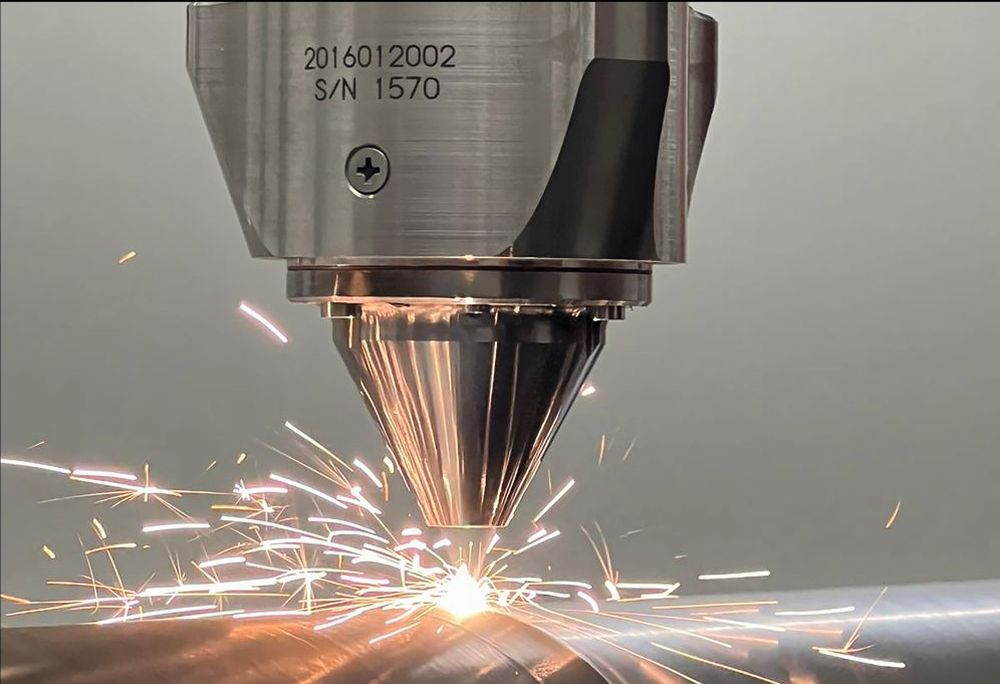
With speeds of up to 200 m/min, extreme high-speed laser buildup welding is now of interest for many industrial applications. In addition, the coating properties can be modeled on a wide scale to suit the specific application. For this reason, a traditional contract coater has now added an EHLA system to its portfolio.
Hard chrome coatings in their combination of wear protection, corrosion protection and economic efficiency cannot be replaced in their broad application so far and also in the foreseeable future. Moreover, they cannot be fully reproduced by any process so far - as is consensus among industry experts. This is why Thoma Metallveredelung GmbH offers its customers long-term planning security for the hard chrome process with an individual authorization application.
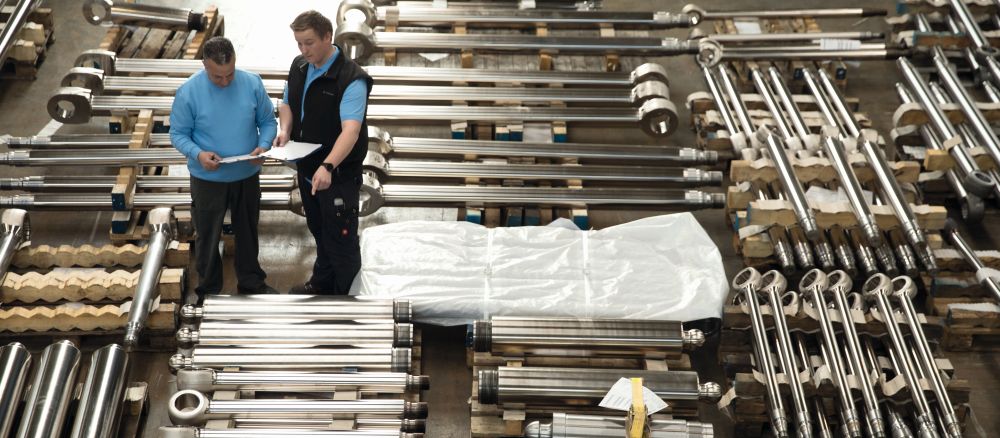
"Currently, our limits for hard chrome are 3.80 meters and for combined layer system 3.20 meters in length. However, our customers also have a demand for larger components, which we have not been able to meet so far," reports Andrea Thoma-Böck, the managing director of Thoma Metallveredelung, who runs the company in the third generation together with her sister Christine Thoma-Kemser. "On the customer side, we were repeatedly asked to invest in a larger hard chrome plant, but in view of the authorization obligations, further investment in this technology is risky and uneconomical."
Thoma has always been open to new, innovative and sustainable technologies throughout its 99-year history. For example, an article about EHLA in a trade journal piqued Thoma's interest back in 2018. Research among customers revealed that they were open to the new process - depending on the application - and were also very interested in it, and that it also offered opportunities to open up new markets, which had often not been possible in the past due to size limitations. Thoma intends to serve this clientele with EHLA coatings in the future.
EHLA - An alternative for XXL parts
Up to 200 meters per minute are currently possible with extreme high-speed laser buildup welding. Fraunhofer ILT began developing extreme high-speed laser buildup welding almost a decade ago, and the researchers succeeded in successively increasing the coating speed from an initial maximum of two meters per minute to several hundred meters per minute. This has made the process interesting for a number of industrial applications.
The formulation of the powder can be adapted within a wide range to the specifications of an application, allowing properties such as anti-corrosion or anti-wear protection to be prioritized specifically according to the target specifications. In addition, by melting the surface by laser, the coating is very dense and cohesive with an extremely high bonding energy to the substrate. In this context, the melting of the substrate by the laser has considerable benefits, compared, for example, with thermal spray coatings, in which the powder is also accelerated onto the substrate with high energy, so that it melts on impact. However, thermal spray coatings exhibit a more or less pronounced porosity, depending on the process. In addition, the EHLA process offers the possibility of coating components close to the final contour, so that coating thicknesses from 25 μm and more can be achieved.
.
Construction of the plant as early as 2021
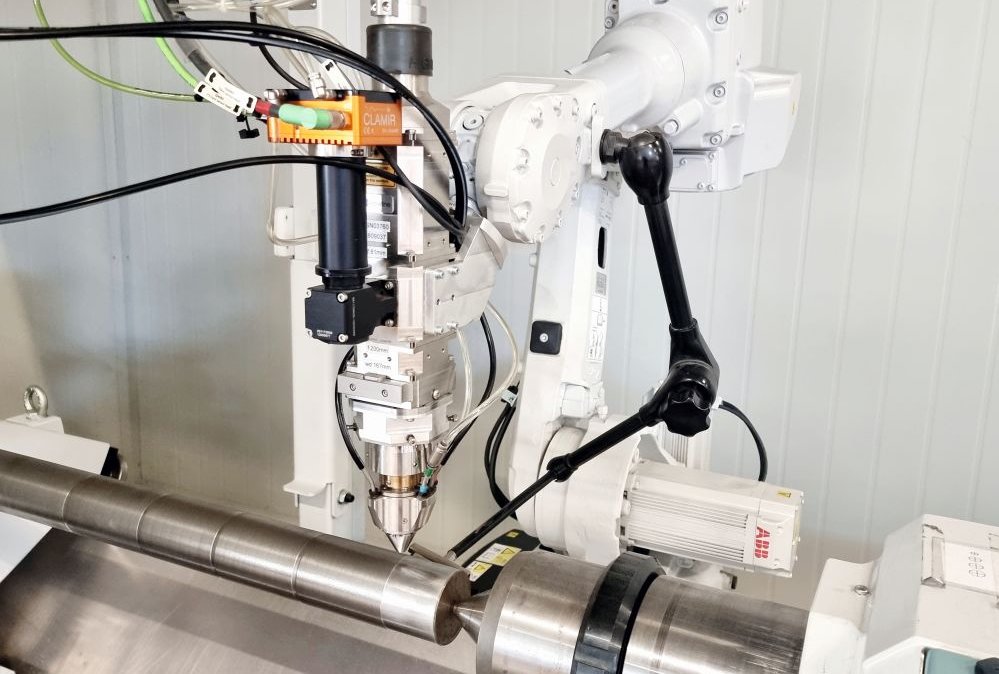
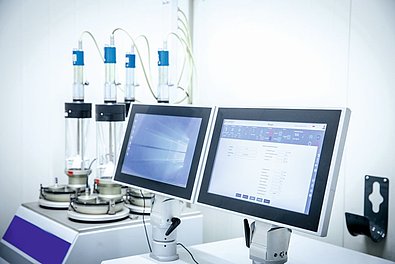
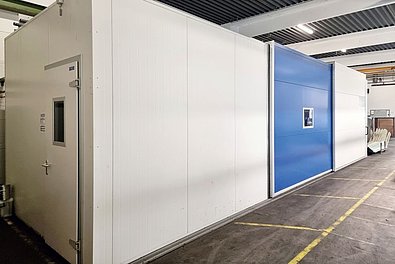
After promising trials at Fraunhofer ILT and after it became clear that potential customers were also already looking into the topic of EHLA coating, the decision was made at Thoma 2020 to invest in their own EHLA coating system, which would be suitable for rotationally symmetrical components up to six meters in length. The part weight can be up to 5,000 kilograms, and the maximum diameter is one meter. It should be emphasized that the guidance of the application unit by a robot was chosen deliberately in order to allow greater geometric flexibility than linear axes would allow. The approximately 4.5 kW laser source is located in an area separate from the coating room and coupled into the applicator via an optical fiber. A periscope camera mounted on the applicator optically analyzes the process in the center of the molten bath continuously and regulates the laser power automatically within certain limits to keep the process conditions constant.
The powder is also supplied from the adjacent room, where four metering units are available for different powders and powder mixtures. In order to be able to lift the components onto the system, which is reminiscent of a lathe, the protective booth is built so that the ceiling is opened together with the front wall, which can be opened and closed, making the system accessible for the overhead crane.
Due to the high laser power, operation is only possible and permitted when the enclosure is closed. The system operator controls the system from a closed adjacent room and monitors the process through a window. A small outside window can also be used to observe the process. It is noticeable that, particularly in contrast to thermal spray processes, the overspray is very low visually. After completion of the coating process, a distinct increase in the temperature of the material is noticeable. The surface has a distinct roughness that cannot be compared with the smoothness of a hard chrome coating, even directly after coating. Especially when it comes to plain bearing applications, such as rods for hydraulic cylinders - a Thoma specialty - mechanical finishing is required.
"When it comes to coating design in the area of hydraulic cylinders, it is crucial to look at the overall system. Here, it doesn't necessarily help to develop enormously stable wear protection coatings for the piston rods; the sealing packages must also be able to withstand this," explains Robert Rohn, master galvanizer and sales manager at Thoma. "You can't lose sight of the overall system here, and we are aware that there is still a lot of development work waiting for us. Nevertheless, the process offers a lot of potential, especially for particularly large parts. Also, the fact that very localized coating is possible offers great application possibilities, both for new parts and for repair coating."
Rohn also emphasizes that the area performance of the EHLA process is nowhere near galvanic processes such as hard chrome plating - and will not be able to achieve that in the further future. This underlines the fact that this is a supplementary process for special applications and not a competing process to hard chrome.
Customer trials completed successfully
"Up to now, we had deliberately held back with publications on the subject because we wanted to gather experience with the new process ourselves before sparking interest among customers on a larger scale," explains Thoma-Böck. "We have since successfully completed a number of customer projects. However, we still expect some development work before we will be coating the first regular series."
"Coating thicknesses are possible from 25 μm, and upwards the coating thickness is arbitrary insofar as several passes can also be run immediately in succession," says Rohn, describing the key points of the process. "When it comes to the powders, there is a wide range of possibilities; for example, one can work with iron, nickel, or cobalt-based powders, depending on which properties one is looking for. Of course, it is also possible to apply several different powder alloys on top of each other. There is still a lot of development potential in the formulation of the powders, however."
Currently, Thoma is investing in a new measurement laboratory in order to be able to perform microsection analyses and evaluations for coatings and coating systems that were applied with EHLA technology in-house and faster. The future challenge is to rapidly advance the development of suitable powder and material combinations with regard to the layer thicknesses, geometries and properties required by the customers. In the long run, a system for the mechanical finishing of the coatings is also envisioned.
All in all, the investment in the EHLA technology is a very future-oriented and far-sighted step towards creating an additional pillar for the well-established company and laying the foundations for providing suitable answers to future customer requirements.