

Quick results in testing corrosion tendency
Quantify corrosion quickly and easily using electrochemical measurement methods
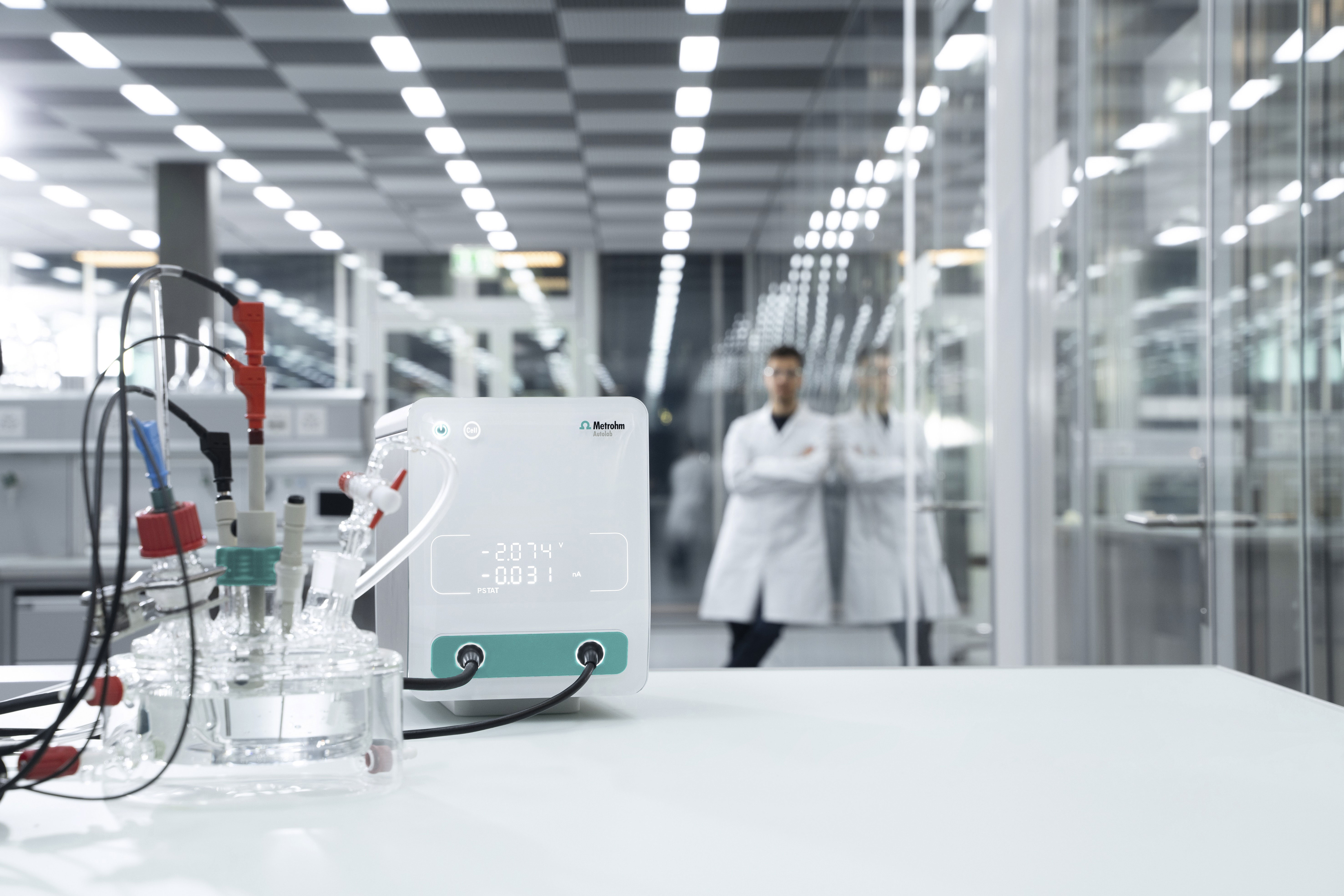
Electrochemical corrosion methods are easy to perform and a fast alternative or good supplement to classical corrosion tests. They allow rapid characterization of the corrosion tendency of a coating system not only in research and development, but also in quality control.
Corrosion tests are indispensable in many areas of surface technology. In many cases, however, classic corrosion tests such as salt spray or climate change tests are used. As indisputable as the necessity of these test procedures is, the relatively long measurement duration, which can range from a few hours to weeks, can permanently delay development and testing processes. In particular, if the replication of a test environment that is as close to reality as possible is not decisive for the test statement and the determination of the corrosion tendency of a coating system is in the foreground, there are significantly faster alternatives: electrochemical corrosion methods. They are easy to perform, provide fast results and are used not only in research and development but also in quality control.
In principle, corrosion processes are of an electrochemical nature, in which metals are mostly attacked oxidatively. The number of electrons released per unit of time is proportional to the corrosion rate. It therefore makes sense to investigate corrosion processes using electrochemical measurement methods. The corrosive properties of the surface can be determined from the measured variables of current, voltage and resistance. The corrosion current corresponds to the material turnover per unit of time, which in turn corresponds to the corrosion rate. Good corrosion protection is thus reflected in small corrosion currents.
The measured values of the polarization or cut-through resistance of a corrosion process are proportional to the corrosion resistance. Passive coatings, for example, have a higher resistance over several decades compared to untreated surfaces. The voltage, i.e. the potential, in turn provides information about the driving force of the corrosion. If the potential is very negative, i.e. the material tends to be base, the probability is high that the material or coating system will corrode easily.
Equipment and implementation

For the measurement, a sample and a measuring device with an electrolyte are required. In the case of large, flat samples such as sheet metal, the measuring cell is placed on top (see Figure 1). If only geometrically smaller samples are available, coupons are made from the material and immersed in the measuring cell with the aid of a sample holder. The selection of the measuring cells to be used is based, among other things, on the sample area. The composition of the electrolyte can be based on the subsequent real ambient conditions; a very commonly used electrolyte is 3% NaCl solution.
In order to investigate the corrosion process based on the parameters current and voltage, a reference and a counter electrode are still necessary. These are connected together with the sample to a potentiostat, which now performs the desired measurement method (see figure above and Fig. 2). The method-specific voltage waveform is applied to the sample, the resulting current is measured and evaluated via the software. This allows corrosion to be determined both qualitatively and quantitatively, even at the surface. Since the measured currents can be in the nA range and the resistances in the gigaohm range, the measurement task places high demands on the accuracy of the measurement equipment.

AC or DC: The measurement methods
Two groups of measurement methods are available, on the one hand the direct current (DC) measurement methods. These are suitable for metallic surfaces or surfaces with passive layers, consequently for layers with low to high resistance. Very often these measurements are destructive, which means that a fresh sample must often be used for further measurements. The measurement time is relatively long, but usually less than one hour.
In comparison, the alternating current (AC) measurement methods for metallic, passivated or coated surfaces offer some advantages. Compared to the DC methods, the range of application is much broader, and in particular, layers with resistances in the gigaohm range, such as paint and varnish layers, can be measured precisely. In addition, the AC methods are non-destructive, which means that random samples can also be taken in series production without generating rejects. Furthermore, the methodology allows long-term measurements on samples. In terms of time, AC measurements take between ten and 20 minutes, depending on the frequency range. Incidentally, the best-known AC measurement method is electrochemical impedance spectroscopy.
Electrochemical measurement techniques are very flexible. For example, corrosion inhibitors are often used as additives in aqueous auxiliary and operating materials. These intervene in the reaction mechanism at the metallic surface and thus reduce the corrosion rate. How fast an inhibitor reacts with the metal surface, what its long-term behavior is and how well the surface is protected can be reliably determined using linear polarization methods and impedance spectroscopy.
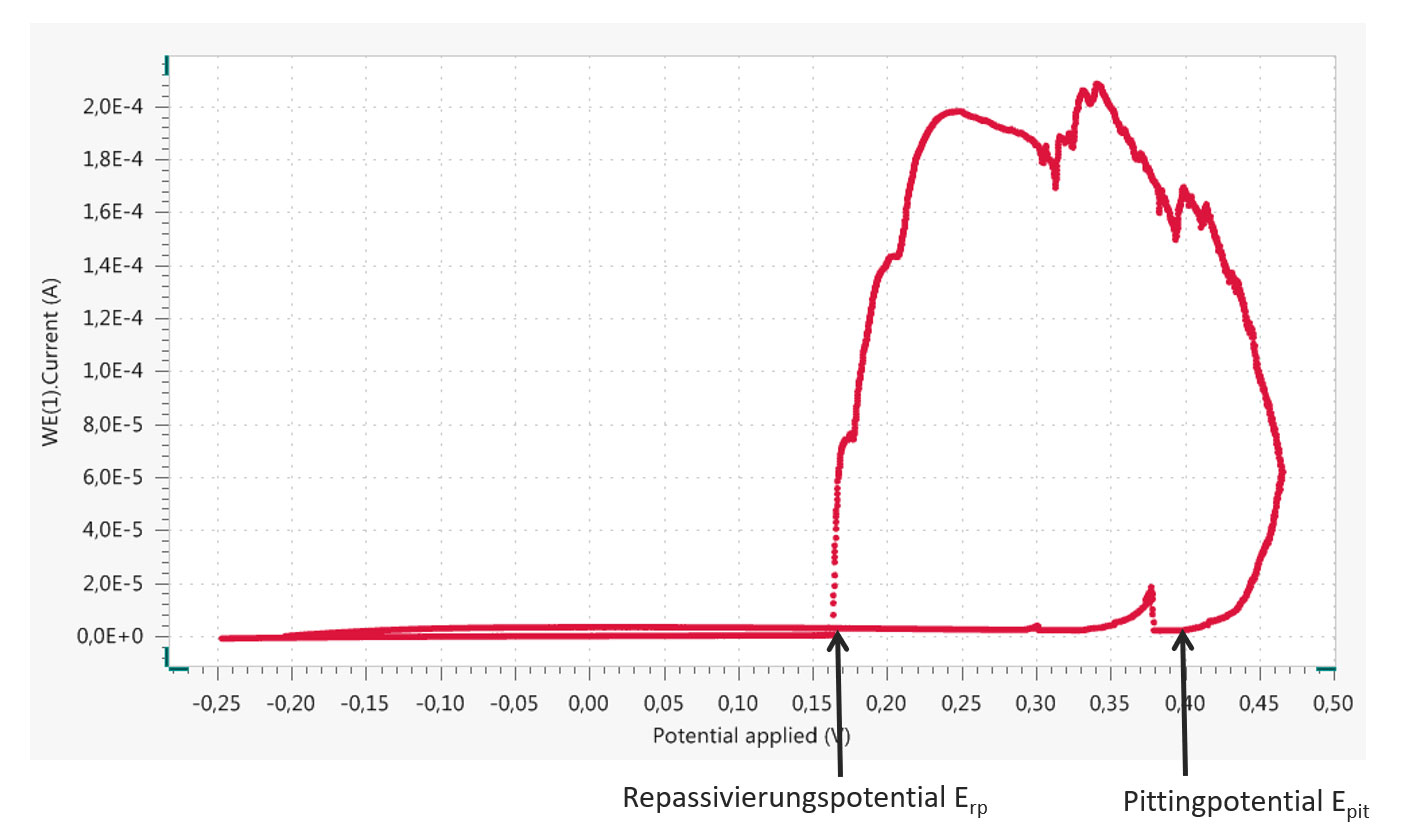
Another important application is the testing of heat-treated, welded chromium steels. This is because heat treatment, such as welding, can make them susceptible to, for example, grain boundary corrosion. According to the Čhihal method, this degree of sensitization can be quantified electrochemically. The stability of a passivation layer can even be determined at once using several electrochemical measurement methods. The passivation potential, depassivation potential, repassivation potential (for self-healing layers such as implants) and the critical pitting temperature (according to ASTM specification G 150) can be determined via the measurements. These values are directly related to the stability of the passive layer.
Check despite high insulating effect
Although paint and varnish layers are usually highly electrically insulating, they can still be investigated using AC measurement methods. In this way, important layer properties can be determined, for example water absorption, i.e. swelling of the paint layer, as well as defects such as pores and blisters in the layer. The adhesion of the paint layer can also be determined in connection with infiltration. Using the AC-DC-AC technique, which is mentioned in DIN EN ISO 17463, even accelerated aging tests can be carried out. Here, the coating is specifically stressed by the cyclic application of voltages. This shows after just a few measurement cycles how well the polymer coating can cope with the corrosion stress and whether it can provide the necessary corrosion protection.
Overall, electrochemical corrosion measurement methods allow the corrosion rate to be determined quickly compared to conventional methods. This is not only advantageous in quality control, but also shortens the test phases in the areas of research and development and can thus make an important contribution to greater cost efficiency and quality.