Laser coating to help reduce particulate matter
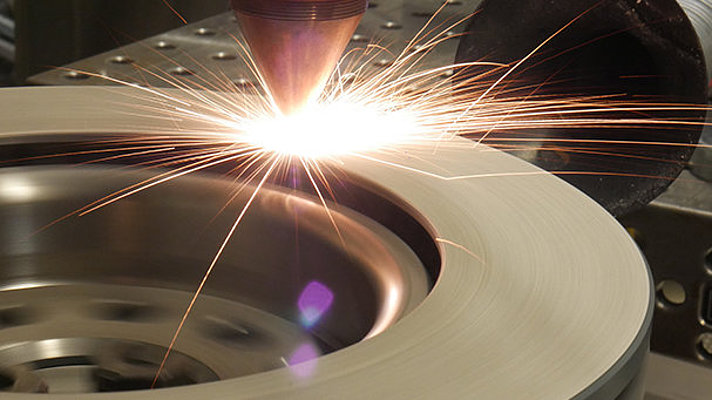
Wear-resistant coatings for automotive brake discs? What was hardly common for a long time could soon become standard. This is because the particulate matter caused by the abrasion of brake discs has become the focus of political attention: Starting with the Euro 7 exhaust emission standard, it is expected that specific limits will also be set for brake dust.
One of the most effective measures for complying with these limits will be the application of anti-wear coatings. They sustainably reduce abrasion and also increase the service life of brake discs. If they have hardly been implemented to date, it is primarily for cost reasons: Thermal spray coatings, which are occasionally used in the premium segment, are too expensive for the mass market and are generally only suitable to a limited extent for the automotive sector due to their impact and shock sensitivity.
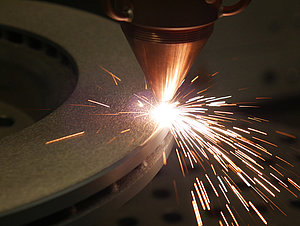
With powder buildup welding using Laserline diode lasers, however, a process is now available that enables profitable series coating of automotive brake discs and scores with convincing results. With the aid of this industrially proven process, commercially available cast iron brake discs can be provided with hard coatings a few tenths of a millimeter thick. These coatings are fusion-metallurgically bonded to the gray cast iron and are therefore far more impact and shock resistant than thermal spray coatings, which adhere solely by mechanical bonding. Due to its outstanding energy and material efficiency, high area rates and low preparation effort, the diode laser-based process is also economically superior to thermal spraying. It is suitable without restriction for mass production in the mass market, so that even small cars or compact class vehicles can be equipped with coated brake discs without any problems. The acquisition costs are somewhat higher than for classic automotive brake discs, but are amortized by the extended service life.
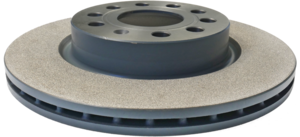
For brake disc coating by laser buildup welding, Laserline has developed a special process setup that enables particularly short process runtimes. The brake disc is moved at high speed under the laser beam and powder nozzle; area rates of between 2.5 and over 3.5 m²/h are achieved. Depending on the size of the disc, the coating material and the desired coating thickness, the process can be completed in less than three minutes. Coating takes place in two steps: First, a buffer layer is welded on, which provides corrosion protection and replaces the usual paint layers. This is followed by the actual wear protection layer. Due to the extremely homogeneous energy input of the Laserline diode laser, which causes uniform melting of the gray cast iron, there is only slight mixing of the coating and base material. The result is highly stable coatings that significantly reduce brake dust and thus contribute to a noticeable improvement in the air we breathe, especially in urban areas. The longer service life also reduces the cost of vehicle maintenance - another advantage that should not be underestimated. For more information on laser coating of automotive brake discs, please click here.
Laserline GmbH
Fraunhofer Straße 5 56218 Mülheim-Kärlich, Germany
Dr.-Ing. Thomas Molitor Senior Technical Sales Tel. +49 2630 964 4000 | Thomas.Molitor(at)laserline.com