

Cleaning and degreasing in Euro grid boxes
Large containers such as the Euro mesh box are widely used in the metalworking industry for storing and transporting components. In order to avoid additional handling costs for the rearrangement of components, there are also applications in the field of parts cleaning.
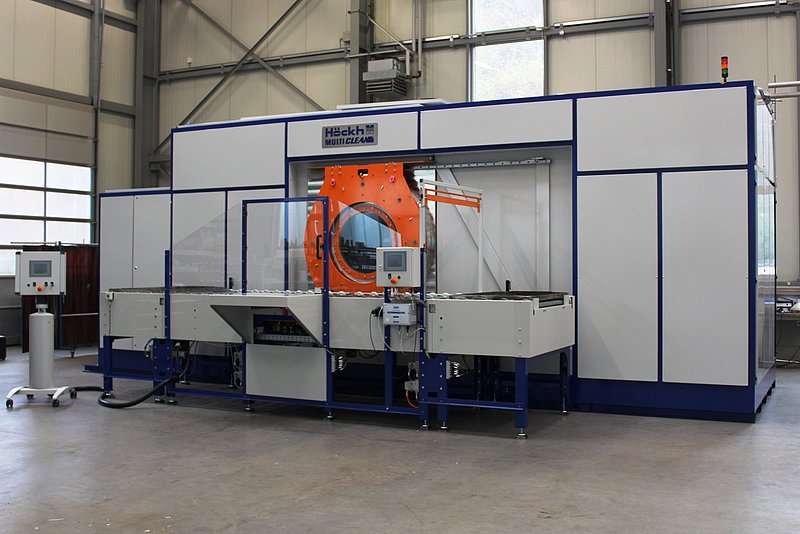
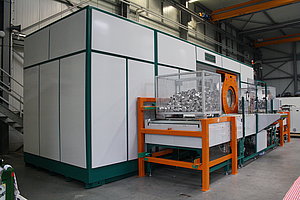
Large containers such as the Euro mesh box are widely used in the metalworking industry for storing and transporting components. In order to avoid additional handling costs for the transfer of components, there are also occasional applications in the field of parts cleaning. In this case, the original grid box is used as a cleaning container and fed directly to a large-scale cleaning system. There are enough application examples for this: Often there are aqueous spray cleaning plants, with the aim of a quick intermediate cleaning of the components before dispatch, or there are solvent plants, with the primary aim of degreasing large-format components such as deep-drawn sheet metal parts.
The plant manufacturer Höckh Metall-Reinigungsanlagen GmbH in Neuenbürg, Württemberg, has realized numerous projects of this nature in recent years. The modular concept of the MULTICLEAN-S-4 PRO plant series ranges from fast degreasing plants with spray cleaning, vapor degreasing and vacuum drying to 3-tank flooding plants for fine cleaning and subsequent preservation. Solvents can be combustible cleaners such as hydrocarbon or modified alcohol, or perchloroethylene - the medium of choice for contract cleaners, for example, who have to cope with a whole range of different oils. The max. batch weight of a full mesh box is 1,500 kg, so that the fully automated systems can treat up to 7.5 to/h of goods at a throughput of 3-5 mesh boxes/h (depending on the program).
Ultrasound for enhanced cleaning
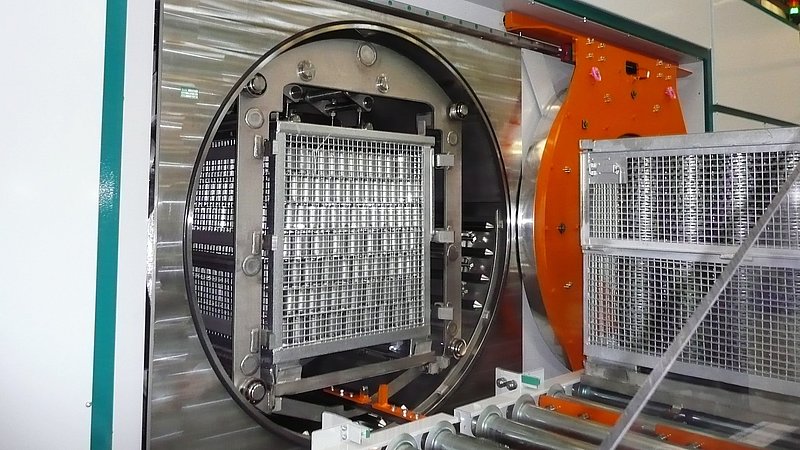
Among other things, lattice box plants were also equipped with ultrasound as part of these projects. Case study from project with ultrasonic equipment:
In addition to the pure degreasing of deep-drawn parts - in this case gauge housings made of stainless steel sheet - the customer's wish was also to remove the fine metal abrasion from the forming process at the same time. At first, Höckh was somewhat reluctant, because the bulk density of fist-sized components in a grid box with a useful volume of just under 1,000 liters seemed borderline for the successful use of ultrasound. However, the test run of the system was already very eye-opening: the abrasion on the component surface was significantly reduced, at an ultrasonic time of 300 sec. even to such an extent that the components passed the wipe test with a white cloth glove.
For this purpose, the working chamber was equipped with a total of 26 kW of ultrasound; this results in a line density in the working chamber of around 10 W/l - a very good value for this size of system. In addition, a "vacuum degassing" program step was integrated in the software, because the technicians at Höckh noticed that air pockets introduced with the bulk material cause a noticeable damping of the ultrasonic field. By varying the working chamber pressure in the flooded state, these air inclusions can now be extracted much more quickly and the ultrasound can develop its full effect.
With this system standard, Höckh underlines its strength in the field of customized large-scale systems for cleaning and degreasing with solvents under full vacuum.
Höckh Metal Cleaning Systems GmbH
www.hoeckh.com