

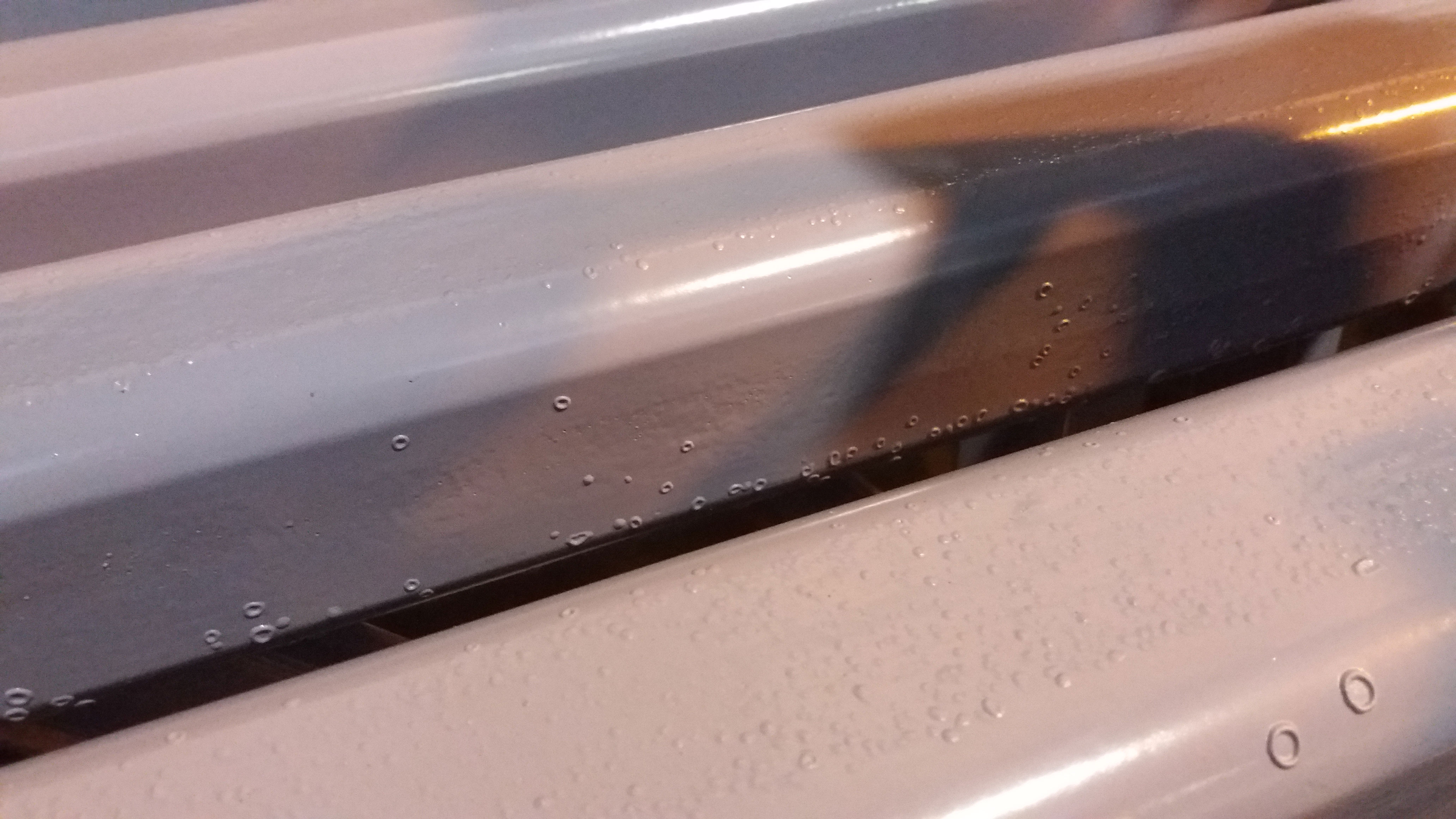
If a substrate tends to outgas excessively, especially at higher temperatures, there is a risk of surface defects in the coating. Typical manifestations are craters, pores and blisters, which not only look unsightly (Fig. 1), but can also significantly reduce corrosion protection in the affected areas. In industrial applications, these problems occur particularly frequently with hot-dip galvanized steel. Although heating the components before powder coating, i.e. so-called annealing, can drive the defect-causing substances out of the base material, this is both energy- and time-intensive, especially in the case of more massive components, which leads to corresponding additional costs. What's more, such an approach is difficult to justify from a sustainability perspective.
Most surface defects can be successfully avoided by heating the hot-dip galvanized parts to around 200 degrees Celsius before plastic coating, as previously mentioned. Although this is not desirable, especially for solid materials, it is often the only solution, particularly in stubborn problem cases. The remedies offered by commercially available powder coatings with outgassing additives mixed in, which are supposed to ensure that the gas bubbles escape before the surface crosslinks, are not always reliable in their effect.
Ten years ago, a new type of powder coating system was launched on the market for the first time, with which outgassing effects can be avoided or at least reduced to a minimum and which, on top of this, offers the user a whole range of very advantageous properties.
Read the detailed article in the December 2021 issue or right here online with Premium access!