

Against corrosion and outgassing defects
Speziell abgestimmtes Pulverlacksystem für ausgasende Materialien statt Additive oder Tempern
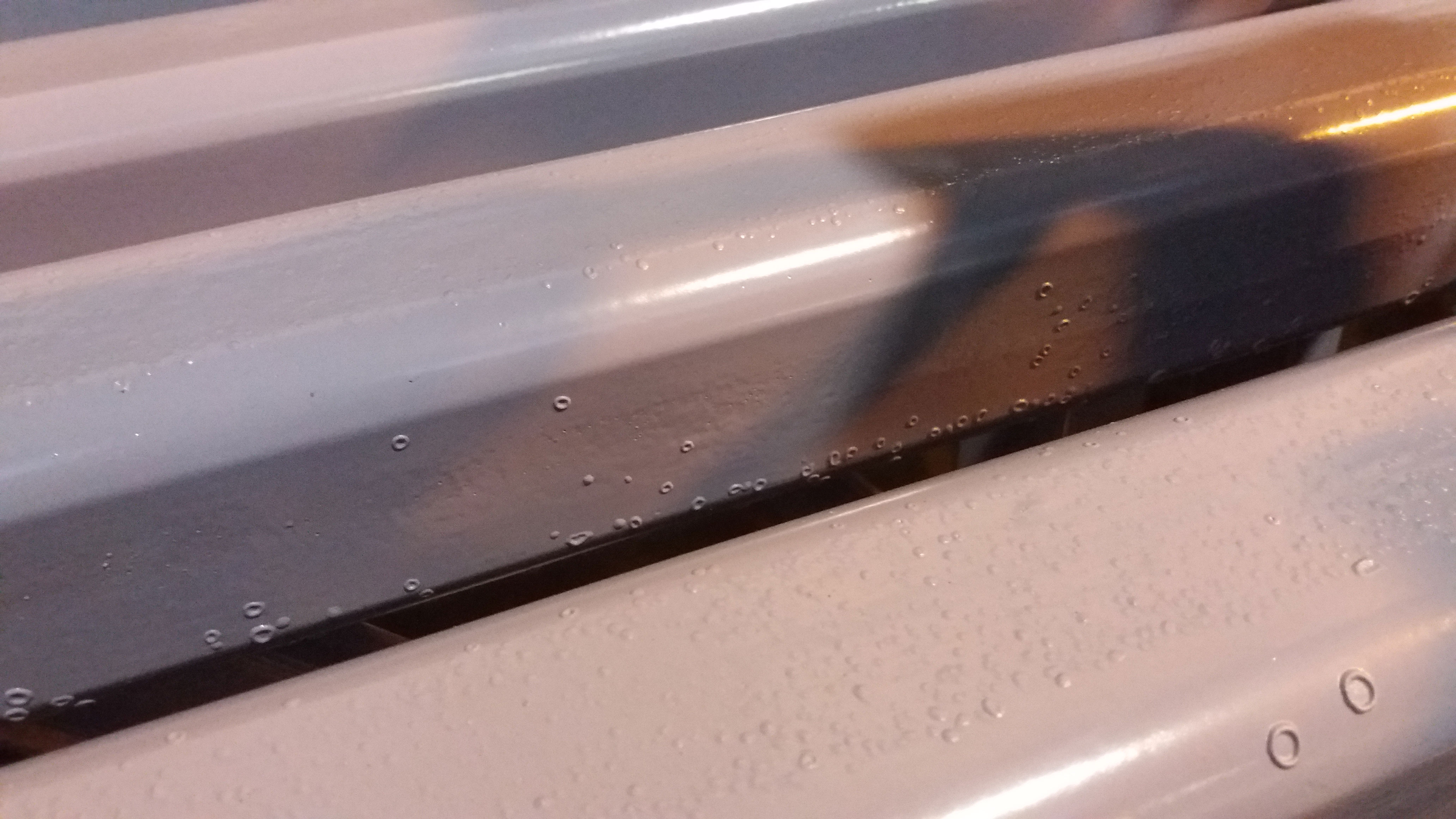
Hot-dip galvanized components often tend to outgas due to the relatively high baking temperatures during powder coating. This is visually unattractive and also significantly weakens the corrosion protection. An appropriately matched powder coating system promises a remedy here.
If a substrate tends to outgas excessively, especially at higher temperatures, there is a risk of surface defects during coating. Typical manifestations are craters, pores and blisters, which not only look unattractive (Fig. 1), but can also significantly reduce the corrosion protection in the affected areas. In industrial applications, these problems occur particularly frequently with hot-dip galvanized steel. Although heating the components before powder coating, i.e. so-called annealing, can drive the defect-causing substances out of the base material, this is both energy- and time-intensive, especially in the case of more massive components, which leads to corresponding additional costs. What's more, such a procedure is difficult to justify from the point of view of sustainability. The 200-year-old thermozinc process still practiced today has been refined over time by the addition of other metals. But legislation also influences the composition of the zinc bath in the boiler, creating new challenges. This is because the composition of the starting material has a significant effect on the subsequent properties of the zinc coating as well as its quality and corrosion protection.
Unfavorable influences from silicon and phosphorus
Unfavorable influences from silicon and phosphorus
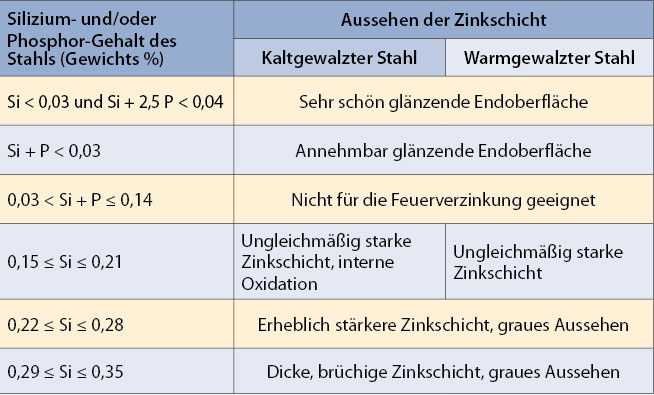
According to current findings, unfavorable silicon and probably also phosphorus contents have a dominating influence on the zinc coating structure. As a result, a brittle and porous structure of the zinc coating can occur. The chemical relationships in the case of uneven zinc structure are shown in Table 2. Hot-dip galvanizers try to influence and prevent this so-called sandelin effect - the result of a reaction that can occur during hot-dip galvanizing - by adding other metals to the molten zinc. However, the elements used do not only have positive effects in terms of their chemical action and sometimes react with each other in undesirable ways. Another challenge is the composition of the steel to be plated, which has a great influence on the control of the zinc buildup. Predicting the final result is not easy given the wide variation in steel composition of many semi-finished products. Even though experienced galvanizers are of course still able to get a solid zinc coating on the components that protects against corrosion, the properties of the zinc coating in terms of outgassing behavior often only become apparent after the plastic coating has been baked on.
But it is not only outgassing per se that can become a crux with a powder coating on zinc. A porous, brittle zinc coating can significantly reduce the adhesive strength of the powder coating. The corrosion protection, the main function of a duplex system, loses its effectiveness drastically as a result. Thus, in unfavorable cases, two difficulties arise at the same time: on the one hand, a brittle zinc structure which, as a result of insufficient paint adhesion, cannot provide the desired corrosion protection, and on the other hand, outgassing defects in the coating, where oxidation and corrosion can occur more quickly. Most surface defects can be successfully avoided by heating the hot-dip galvanized parts to about 200 degrees Celsius before plastic coating, as previously mentioned. Although this is not desirable, especially for solid materials, it is often the only solution, particularly in stubborn problem cases. Remedies using commercially available powder coatings with outgassing additives mixed in, which are supposed to ensure that the gas bubbles escape before the surface crosslinks, are not always reliable in their effect. Sometimes there is no alternative but to accept and install components even with outgassing defects in the surface.
Minimize outgassing
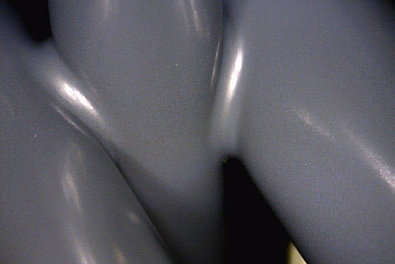
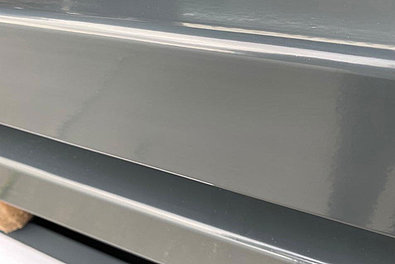
Ten years ago, a new type of powder coating system was launched on the market for the first time, with which outgassing effects can be avoided or at least reduced to a minimum, and which also offers the user a whole series of very advantageous properties. In particular, under appropriate plant-side conditions, the time-consuming annealing process can be avoided. According to coating manufacturer Protech Oxyplast, which developed the powder coating system, 98 percent of users who switched to this coating system were subsequently able to do away with annealing. This is because even with substrates that are prone to outgassing, the result is a closed coating with very good corrosion protection and mechanical properties (Fig. 3). To date, many thousands of tons of this product have been used and installed in Europe.
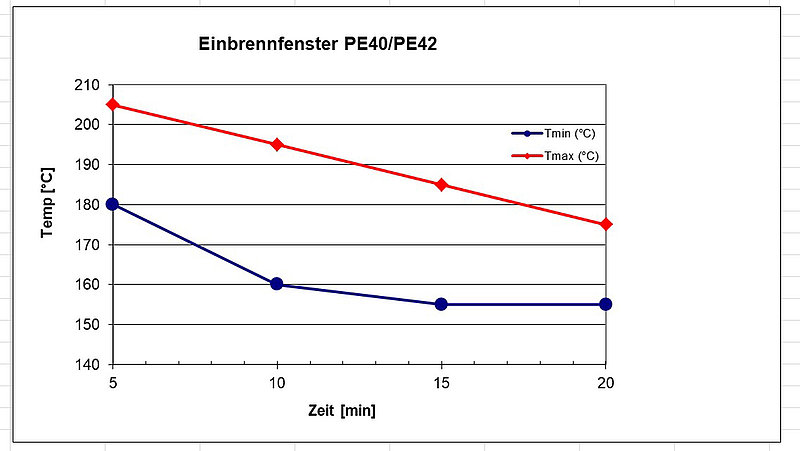
The original type, PE40, smooth with about 75 GU at a 60-degree measuring angle, has been supplemented over time by a matte fine-textured powder coating (PE42). In addition to outgassing stability, which according to the manufacturer is unprecedented, this coating system also allows baking temperatures on the object of between 155 and 200 degrees Celsius with the formation of all desired and certified properties (Fig. 4). This means that otherwise very critical components, where varying object temperatures are achieved due to widely varying material thicknesses, do not pose a challenge.
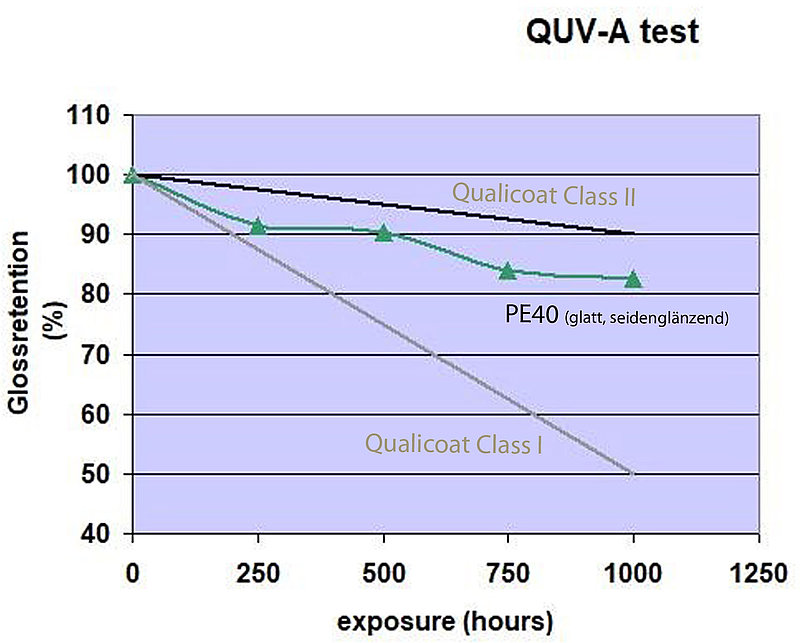
The specially adapted rheology of the powder coating ensures optimum flow of the powder and an attractive appearance of the finished coating (Fig. 2 and Fig. 3). The UV resistance of the surfaces produced is above the specifications of Qualicoat Class 1, as Fig. 5 shows. The lower baking temperatures help, on the one hand, to increase throughput because the necessary dwell times in the oven are reduced and, on the other hand, to save energy to a significant extent due to the reduced oven temperature. Measurements in practice show that a reduction of the baking temperatures by 20 degrees Celsius results in a 20 to 25 percent reduction in gas consumption, depending on the component and the furnace efficiency.
Sintering-free application
Further advantages for the user include sintering-free application in the corona or tribo process, uncomplicated storage and transport, and a reduction in powder coating consumption of up to 15 percent compared with other exterior polyesters. According to Protech Oxyplast, 130 RAL color shades in PE40 (smooth, 75 GU) and 30 RAL color shades as PE42 (fine structure, matte) plus special products for special applications, such as fencing or architecture, are available from stock within 24 to 72 hours.
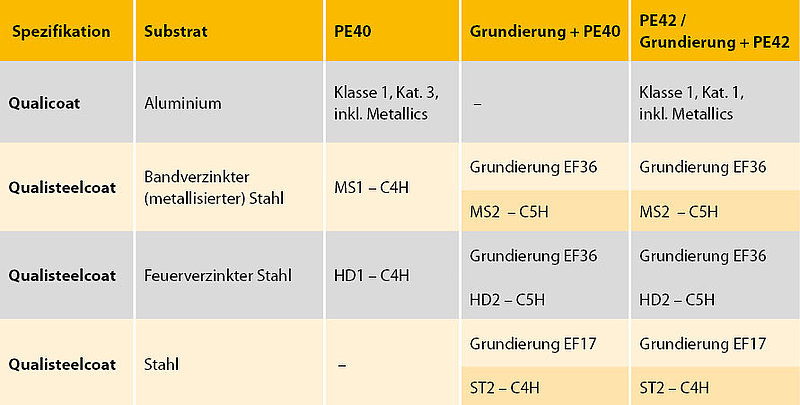
Coating up to corrosion protection class C4 without primer is now standard among users. With an appropriate pretreatment including primer, it is possible to meet the requirements of class C5H - as Table 1 shows. The PE40 or PE42 overall system thus promises the coater and end customer significant advantages in terms of application, consumption, quality, corrosion protection, resistance and cost.
Protech Oxyplast
www.theprotechgroup.com/de