
Automate or coat manually
Automation is high on the list of priorities for many companies. This is quite understandable in the case of constant and predictable series production, as is the case with many in-house coaters, but for contract coaters the consideration is much more complex. It is also often uncertain whether orders are repeated, so that it is worthwhile to run in processes at great expense. In addition, the throughput of an automatic system is often overestimated compared to one or even two skilled manual coaters.
"A good coater can coat up to 60 m² per hour for simple workpieces - i.e. 1 m² per minute. If two correspondingly good coaters are used, the achievable throughput already approaches a normal continuous coater running at a belt speed of 1.5 to 2.5 m/min." However, it is not the theoretical throughput that counts. Even with a component that is quite large in itself, such as a tabletop with an area of around 0.8 m², a distance of half a meter must be maintained in front of and behind it so that the booth control system can cope. This means that for every two meters of belt length, only 0.8 m² is coated.
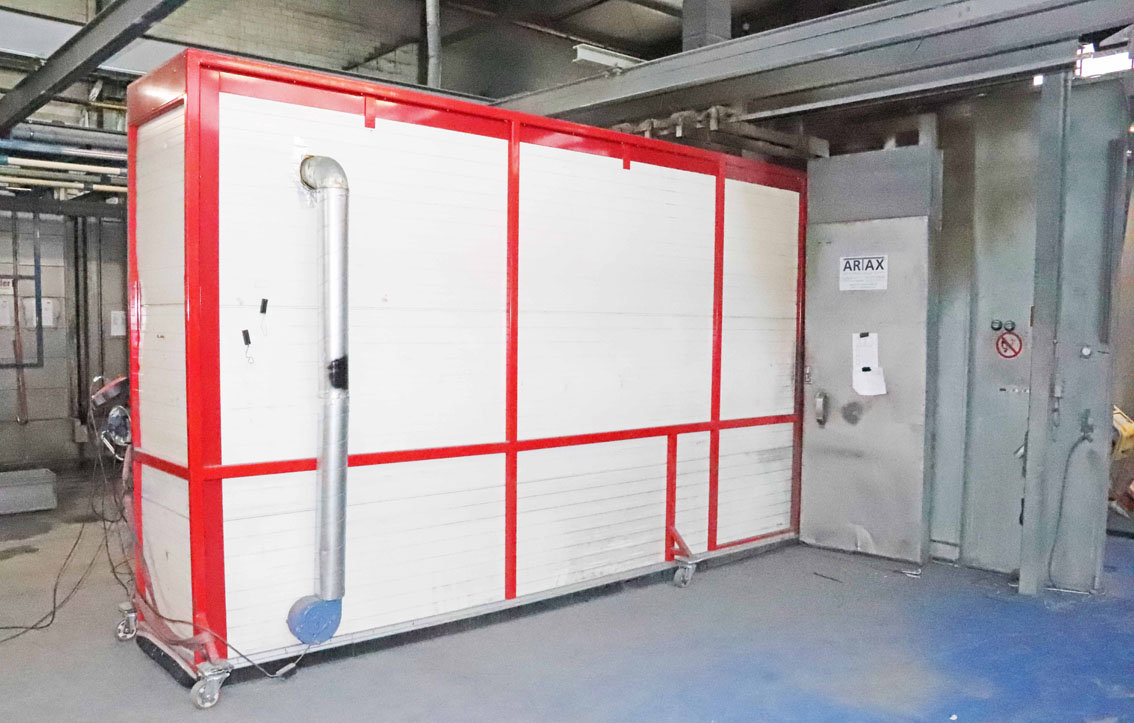
"Bader sums up: "The main effects of this type of automation are therefore to a large extent in the area of process reliability and reduced workload. "These advantages should not be underestimated, but the investment of 300,000 to 400,000 euros for such a system is much higher than for manual coating. In addition, the operating costs increase massively due to maintenance, wear and tear, and also compressed air consumption. The topic of color change and powder recovery is also worth a closer look. Even if the times for a color change have been dramatically reduced, these downtimes lower productivity.
Bader therefore relies on manual coating and runs at a loss, because measurements have shown that the application efficiency at Bader is between 65 and 75 percent, depending on the component. So out of 10 kilograms of powder, a maximum of three kilograms are lost. In this context, it must be considered that the real application efficiency of an automatic booth is usually worse, and here, too, powder becomes unusable due to the circulation, and is thus lost.
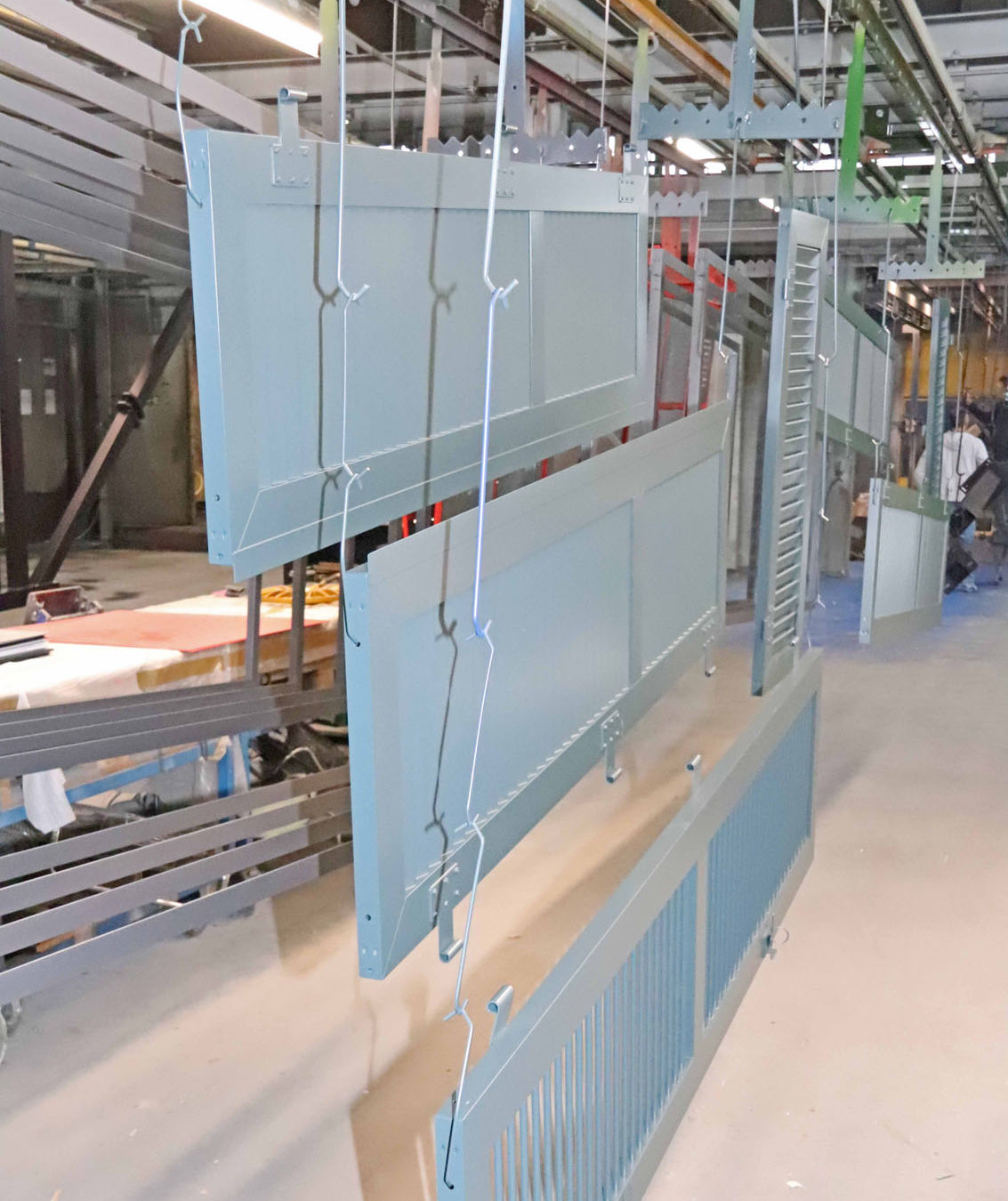
A significant advantage of manual coating is also that the components can be compacted on a hanger to a much greater extent than is possible with an automatic booth. This is another way in which a skilled manual coater can get square meters out compared to an automatic system.
"We calculated examples up and down in this regard and developed our strategy based on the results," Bader explains. "The disadvantage of manual coating, however, is always the human factor. A good powder coater definitely needs talent - many underestimate that. Of course, good training is a prerequisite, but without the right feel for a powder gun, difficult jobs cannot be completed satisfactorily."
The more varied and irregular the jobs, the more frequently the employees, and here especially the coaters, have to make decisions. This starts with choosing the right spot on a component for the suspension hole and doesn't stop with a reliable system for coating complex geometries. "For example, with a long aluminum sliding door like the one we regularly coat, disaster strikes if a coater gets out of sync. Let's say he leaves two bars out. Although there is enough paint mist on the two bars to make it look coated. After the oven cycle, however, the paint no longer covers in the areas that are coated too thinly," Bader describes. "A lot of skill is also required when coating in a glaze look. This is because a reflective substrate must first be coated, and the transparent powder must be applied transparently to this substrate in the same layer thickness," explains Bader. "If the coater does not have sufficient talent here, there will be no homogeneous colored surface. Therefore, one can actually only advise all those who work with hand coaters to train their people well at the guns and to promote them with advanced training courses. In the end, every mistake a coater doesn't make saves the company both money and trouble with customers." For those who want to make better use of their employees' potential, Bader recommends appropriate training. This includes the coater training course that Bader developed together with the IFO. Coaters spend three days learning the basics of pretreatment, application, baking and quality assurance. Bader is convinced that a coater who completes this course will do a lot better afterwards.
Calculation and qualification as a recipe for success
If one draws the conclusion from these empirical values, it becomes clear that good coating craftsmanship and qualified employees are a decisive component for long-term success as a contract coater. However, a perfectly executed job only pays the bills if the costs have been calculated correctly. In this respect, a recalculation must be recommended above all as an instrument for reliably achieving positive cost recovery contributions - or at least uncovering the need for optimization. Especially in difficult times, no one should unknowingly sell themselves short!
► Bader Pulverbeschichtung GmbH ► www.bader-pulver.de