


(Kopie 2)
Risky: Simply estimate costs
Contract coating is a challenging line of business. On the one hand, strong competition leads to considerable cost pressure, which limits the achievable margin; on the other hand, the damage caused by quality deficiencies can quickly threaten operations. In addition to mastering the actual craft of pretreatment and coating, however, another aspect is crucial to the future security of a contract coater: calculation, pricing and, if necessary, optimization of coating costs for individual orders.
Particularly in difficult times, the temptation is greater than usual to accept orders whose profitability is already doubtful in advance. In particular, the fact that the direct costs of material consumption are often virtually negligible tempts companies to underestimate the amount of work involved and thus the costs of plant technology, but also of their own employees.
The more the job costing is based on experience, the more likely this is to happen. Freely according to the motto, if you get 500 Euros for an order and only have to buy powder for about 100 Euros, you will get something out of it. This works well as long as there are always enough better paid orders to absorb the miscalculations.
Certainly, in case of doubt, it can be better to fill the empty workpiece carriers and to employ the employees at low pay rather than to accept standstill. However, it becomes highly problematic if, when the order is accepted, the person responsible for the price wrongly assumes that an order will cover costs because of his costing method. This is particularly the case if no post-calculation takes place. Then it is often only the year-end settlement that shows whether a positive operating result has been achieved in the totality of all orders. Then it is much too late to change anything about the result.
"I have now been working as a contract coater for 35 years," says Matthias Bader, Managing Director of Bader Pulverbeschichtung GmbH. "And during this time I have not only been able to experience the truly remarkable technical progress and upswing in the industry, but also many ups and downs in the economic development. And in the process, I had to learn that in difficult times, a contract coater is predominantly left with the lower-paying orders. Bader reports that in the industry, prices for orders are often estimated relatively freely on the basis of gut instinct and that there is often not even a rudimentary controlling system that records the actual work performed before invoicing and compares it with the preliminary cost estimate.
"With a post-calculation, there would still be the possibility of rescuing a loss-making order into the black," Bader emphasizes. "And even if that doesn't work, at least the company would have a chance to learn from the loss for future jobs." Bader has been an active member of the technical committee at QIB for 10 years and has been active at the Sindelfingen Vocational School for 20 years as an instructor and examiner appointed by the Stuttgart Chamber of Industry and Commerce. "I have been in many training companies and my work in the QIB also gives me a good overview of what is going on in the companies on site. Nevertheless, we as job coaters have also paid a lot of apprenticeship money," admits Bader. "That's why I want to make a contribution so that others don't have to go through the same learning curve." With this goal in mind, he founded the Powder Academy three years ago together with the IFO Institute. There, there are not only seminars for the actual coating trade, but also seminars on economic efficiency topics.
Worthwhile: Precise costing tools
Based on his experience, Bader has established a complex but nevertheless easy-to-use graduated price system in his own company. This is basically based on the square meters to be coated - the less coated in a color, the more the square meter costs. In order to remain cost-covering even for small quantities, a minimum order value is taken as a basis. Only when the price of the square meters to be coated exceeds this value does the actual scale price begin. Surcharges are applied for particularly heavy or large components and certain component groups, such as housings. This means that new articles that have not yet been coated can also be precisely created from the costing point of view. In addition, there is always a post-calculation after the job has been completed, in which the number of people working on the job, their working hours and the consumption of materials and resources are determined.
At first glance, this sounds complicated and time-consuming, but thanks to a calculation tool specially integrated into the ERP, employees only have to record the surface of a component in a series and its number as an example. The dynamic calculation takes materials, processing times and other factors into account.
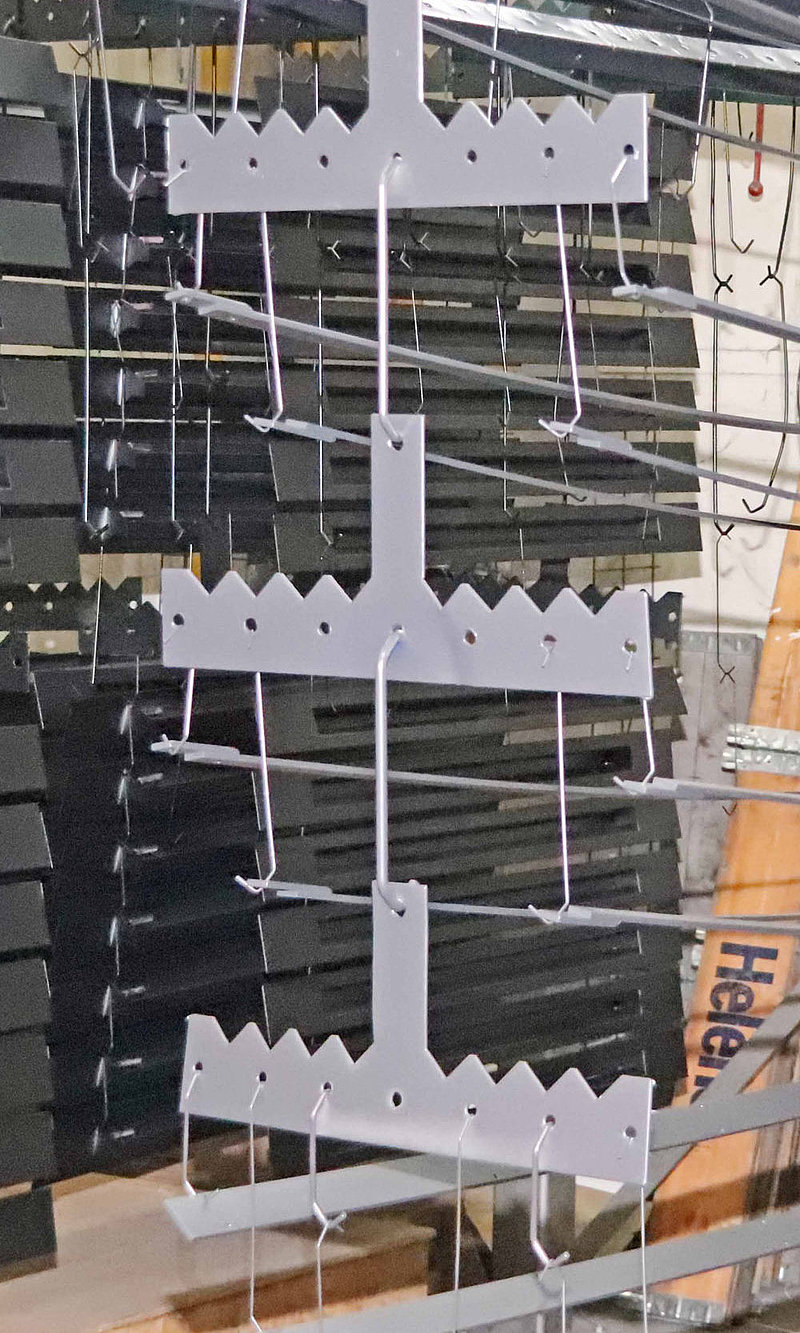
"It is decidedly not advisable to bill only according to the duration of an order processing, as many companies do for the sake of simplicity," explains Bader. "After all, if an intelligent process solution, for example in the area of parts logistics, succeeds in saving time, or the employees have worked particularly effectively, the job coater is punishing himself for greater efficiency and good engineering!" Even more, precise preliminary costing allows timely action to be taken to improve cost recovery before the first part is hung. This can be achieved, for example, by optimizing the workpiece carriers or the occupancy density. Bader reports that they can only accept some orders because special hanger solutions have reduced the coating costs per part accordingly. Without precise costing, the potential for problems would only have become apparent much too late.