

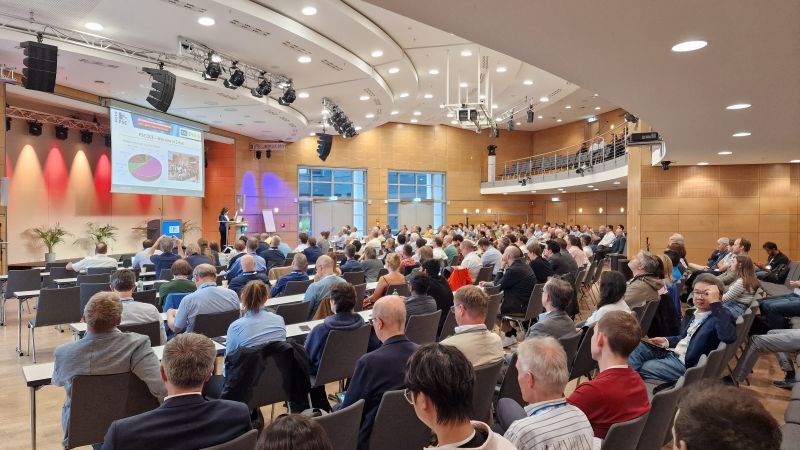
PSE2026 saw record attendance, with 638 participants. 345 experts traveled from abroad, including from European countries, Asia, Australia, and North and South America. 46 percent came from industry and 54 percent from research and development. The European Research Society for Thin Films (EFDS) organizes the conference every two years in collaboration with the European Joint Committee on Plasma and Ion Surface Engineering.
Under the conference theme “Surface Engineering for Clean Energy Solutions,” presentations, scientific sessions, and an industry workshop focused on the application of plasma and surface engineering for batteries, hydrogen technologies, photovoltaics, and other energy systems. In addition to new coating processes and materials, the focus was on the scalability, energy efficiency, and cost-effectiveness of new technologies.
Technology Transfer Between Research and Industry
Another key focus was the transfer of research results to industrial scales. Discussions centered on suitable process conditions as well as opportunities for testing and scaling new technologies. An industry workshop, a panel discussion, and the new Silent Forum within the exhibition complemented the scientific program.
Spain and Portugal, as the partner region Iberia, together formed the second-largest group of countries after Germany. A dedicated session, as well as presentations and posters, showcased research work and opportunities for collaboration in Iberian plasma and surface research.
Awards for Plasma and Thin-Film Research
Prof. Ulf Helmersson from Linköping University received the PSE Leading Scientist Award for his work in plasma surface engineering, thin-film physics, and physical vapor deposition (PVD). The 2026 Rudolf Jaeckel Prize from the German Vacuum Society was awarded to Dr. Jörg Vetter for his scientific and technological work on vacuum arc evaporation and its industrial applications. His areas of research include, among others, AlTiN and AlCrN hard coatings, DLC and ta-C coatings, as well as hybrid coating processes combining arc evaporation and HiPIMS.
The next EFDS event is V2027, taking place October 11–14, 2027, in Dresden.