


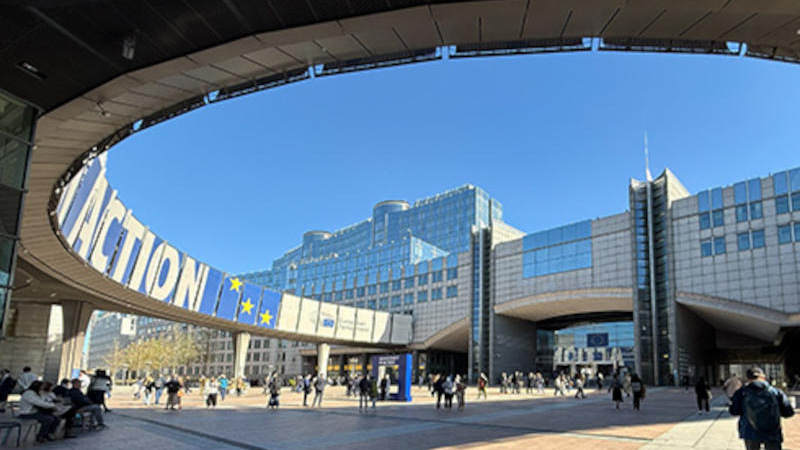
On October 12, 2026, the Central Association for Surface Technology (ZVO) held talks in Brussels on future European chemicals policy. Lukas Hanstein, Head of Policy at the ZVO, held discussions with the offices of Members of the European Parliament Dimitris Tsiodras and Peter Liese. The focus was on the implications of regulatory decisions for the electroplating and surface treatment industries, as well as for downstream industries.
The association emphasizes that chemical regulations extend far beyond its own industry. Among others, the mechanical engineering, automotive, medical technology, and aerospace sectors are affected. Accordingly, the ZVO calls for a regulatory framework that balances environmental and health protection with technically feasible requirements, economic viability, and the preservation of European production capacity.
REACH and Planning Certainty
A key focus of the discussions was the further development of European chemicals policy following the suspension—for the time being—of the comprehensive REACH revision. In April, the European Commission announced that it would not reopen the regulation for the time being. For the ZVO, however, this does not mark the end of the fundamental debate. It remains crucial that the design of the existing legal framework leads to greater planning certainty and practical procedures.
Small and medium-sized enterprises, in particular, depend on transparent requirements and a regulatory framework that enables long-term investments. The association therefore brought the perspective of its predominantly small and medium-sized member companies into the political discussions. At the same time, it made it clear that the challenges regarding chromium(VI) and PFAS remain regardless of a comprehensive REACH revision.
Focus on Hard Chrome Plating and PFAS
Another key issue was the continued use of hard chrome plating with chromium(VI). The ZVO continues to consider the process necessary in cases where no technically suitable and economically viable alternatives are available. Hard chrome coatings perform important functions, particularly in wear protection and in ensuring the service life of industrial components. According to the association’s assessment, restrictions on production capabilities in Europe would foster additional dependence on non-European suppliers and jeopardize value creation as well as technical know-how.
The association therefore advocates for requirements that ensure a high level of protection for workers and the environment while remaining feasible under real-world industrial conditions. It states explicitly that “the consequences for European supply chains must be taken into account from the outset in regulatory decisions.”
With regard to PFAS as well, the ZVO calls for a differentiated assessment of the respective applications, their emissions, and the actual availability of suitable alternatives. For industrial applications such as hard chrome plating and plastic etching, viable regulations, sufficient transition periods, and exemptions are necessary as long as suitable alternatives are lacking. Blanket restrictions should not lead to the disappearance of important processes from Europe without achieving a corresponding benefit for the environment and public health.
Through the discussions in Brussels, the association aims to incorporate practical experience from the industrial sector into political decisions at an early stage. The goal is a European chemicals policy that ensures protection standards while also creating reliable prospects for industrial value creation in Europe.