

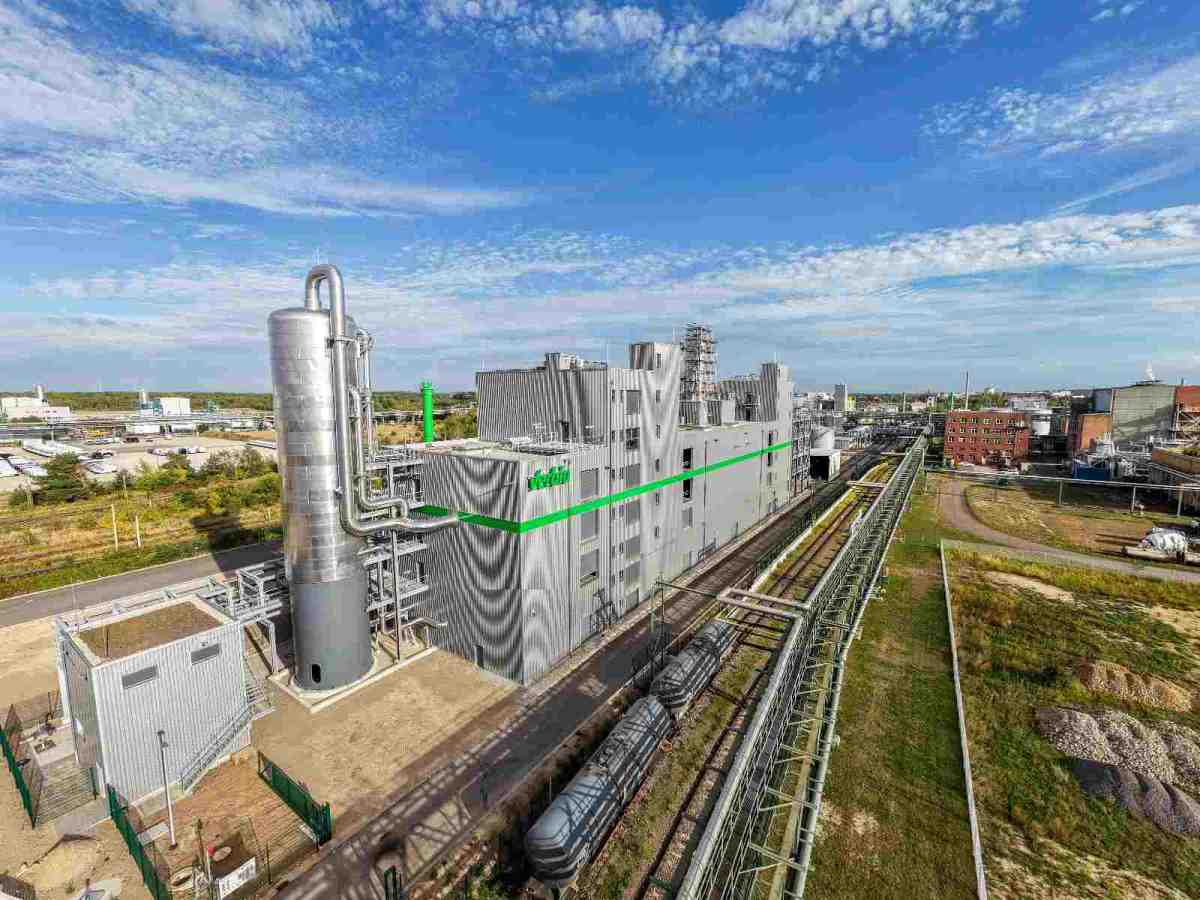
Verbio has launched industrial production of bio-based chemicals in Bitterfeld-Wolfen. At the heart of the expansion is a large-scale ethenolysis plant based on rapeseed methyl ester, capable of producing up to 60,000 metric tons of bio-based chemicals annually. The products are intended to replace fossil-based raw materials in lubricants, detergents and cleaning agents, as well as plastics.
With an investment of just under 100 million euros, Verbio is expanding its business model beyond the biofuel market. The rapeseed methyl ester produced at the site will thus not only be used as biodiesel for energy but also as a feedstock for higher-value chemical products. “With the new plant, we are adding another stage of value creation to our biorefinery based on an established feedstock,” says Verbio CEO Claus Sauter.
New Value Creation from Renewable Carbon
The focus is on the bio-based specialty chemicals 1-decene and 9-DAME. They are based on renewable carbon and are intended as chemical building blocks for industrial applications. Such raw material sources are gaining importance for the chemical industry because they offer alternatives to fossil-based feedstocks and must also be available at scale.
Michael Carus, Senior Advisor and Partner at the nova-Institut, views the plant’s commissioning as a signal for industrial policy: “In the long run, Europe will not be able to compete with other regions of the world on the basis of cheap fossil raw materials. Our opportunity lies in building new value here based on renewable carbon.” It is crucial, he says, that such solutions do not remain at the pilot scale but are scaled up industrially.
The market ramp-up is now proceeding step by step in line with specific customer applications. The chemical building blocks produced in Bitterfeld must first be qualified for their respective fields of application. Accordingly, production volume is expected to grow in tandem with the development of these applications. Verbio is already receiving inquiries from Europe, North and South America, and Asia.
Olefin Metathesis on an Industrial Scale
The technological basis of the new production process is ethenolysis, a special form of olefin metathesis. Catalysts from Verbio’s Hungarian subsidiary XiMo play a central role. They enable the carbon compounds in rapeseed methyl ester to be selectively converted into new molecules for chemical applications.
The scientific basis of the process dates back to the work of Yves Chauvin, Robert H. Grubbs, and Richard H. Schrock, who were awarded the Nobel Prize in Chemistry in 2005. Commenting on the plant’s commissioning, Schrock said, “It is truly special to see today how our research is being translated into industrial applications.”
Expansion of the Bitterfeld-Wolfen Site
With the new facility, Verbio is further expanding its site in the Bitterfeld-Wolfen Chemical Park, which has been in operation for 25 years. About 50 new jobs will be created, bringing the total number of employees there to approximately 130. The project was funded through the Joint Task “Improvement of the Regional Economic Structure” for particularly environmentally friendly and innovative technologies.
For Verbio, the expansion also represents a commitment to Saxony-Anhalt as an industrial location. “Our sites in Zörbig and Bitterfeld are long-term investments. Here, we want to further advance the bioeconomy and regional value creation,” emphasizes Sauter. The proximity to regional agriculture and the existing industrial infrastructure are important locational advantages for this purpose.