
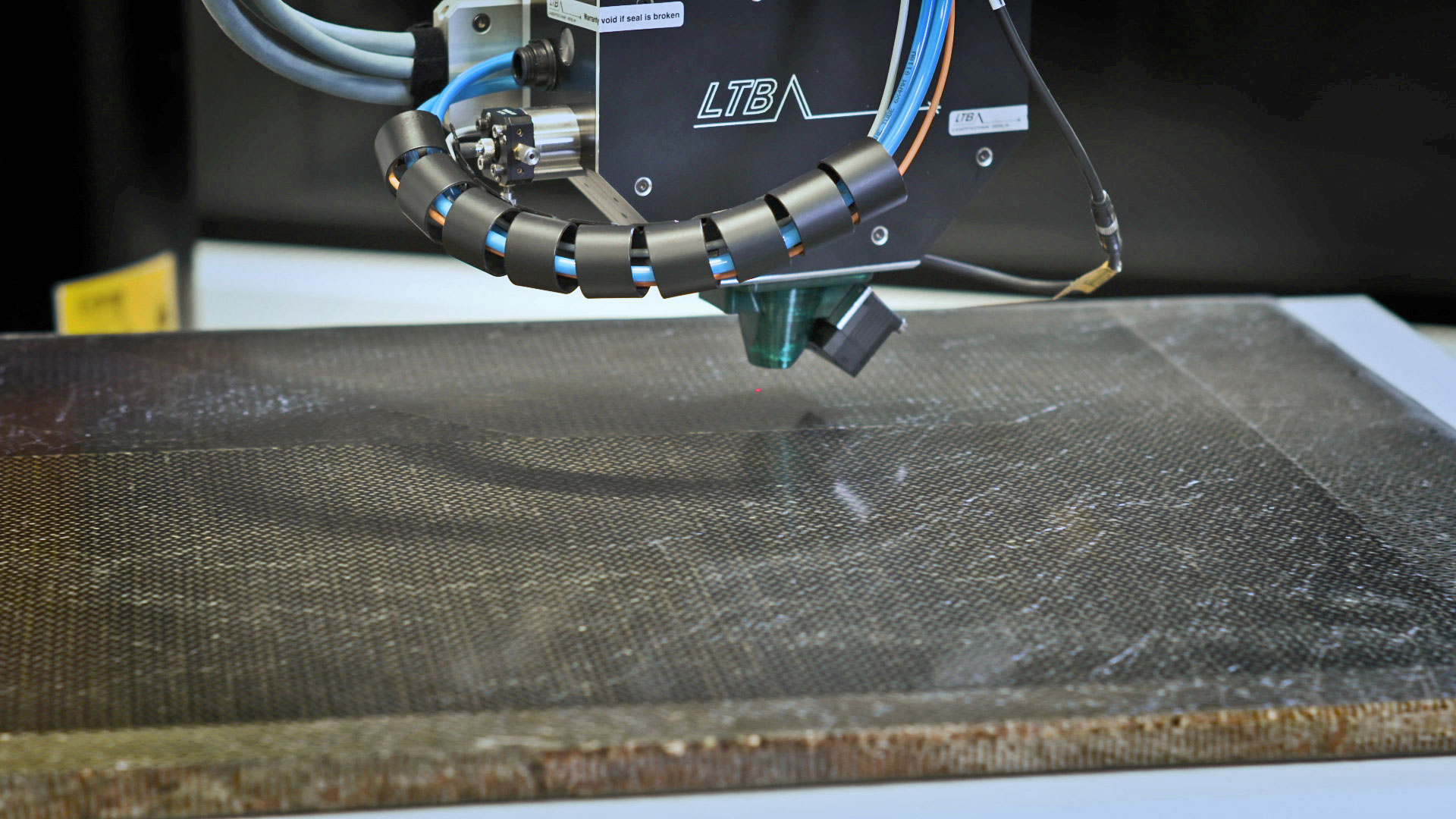
If there are particulate or filmic contaminants on material surfaces, they have a considerable influence on subsequent production steps such as bonding or painting. Particularly in adhesive bonding manufacturing processes, the detection of surface contamination is extremely important, since only clean surfaces can be reliably bonded. In this case, process-securing, accompanying quality assurance is of great importance. For this purpose, Fraunhofer IFAM uses laser-induced plasma spectroscopy - LIPS or LIBS for short.
LIBS is a laser spectroscopic technique that can be used to determine the element-specific composition of a sample. The high energy density of the laser - with a wavelength of 1064 nm as standard - generates a plasma with excited atomic and molecular states at the surface, which emits light radiation on cooling - when the particles change back to their ground state. This is specific and unique to each element.
Read the detailed article in the December 2021 issue or online right here!