
Tracking down the smallest residues
A newly developed LIBS measuring head enables integration into automated process chains
Laser-induced plasma spectroscopy can be used to analyze the components of a surface and detect contaminations. Within the ALASKA project funded by the BMWi, this technology was successfully transferred into a fully automated unit for complex process chains.
If there are particulate or filmic contaminants on material surfaces, they have a considerable influence on subsequent production steps such as bonding or painting. Particularly in adhesive manufacturing processes, the detection of surface contamination is extremely important, as only clean surfaces can be reliably bonded. In this case, process-securing, accompanying quality assurance is of great importance. For this purpose, Fraunhofer IFAM uses laser-induced plasma spectroscopy - LIPS or LIBS for short. LIBS is a laser spectroscopic technique that can be used to determine the element-specific composition of a sample.
The high energy density of the laser - with a wavelength of 1064 nm as standard - generates a plasma with excited atomic and molecular states at the surface, which emits light radiation on cooling - when the particles change back to their ground state. This is specific and unique to each element.
Bringing all particles to light
The radiation is then picked up by a special light guide and fed into a spectrometer, which evaluates the surface composition in real time. With the aid of the LIBS system, a large proportion of the elements in and on surfaces can thus be analyzed qualitatively and quantitatively without the samples requiring any special preparation. LIBS is thus an important technology in quality assurance, with low measurement effort and little preparative preparation.
Material- and application-specific further development
With the use of a 1064-nanometer laser, many applications where surface and material properties are of great relevance - for example, in the aerospace and automotive industries - can already be covered. For the successful use of the LIBS measurement technique in quality assurance, it is necessary that all relevant LIBS parameters are adapted to the specific problem as well as the given boundary conditions. For minimally invasive surface analysis, for example, the energy density and wavelength of the laser are adapted to the material-specific excitation energy and optimum excitation wavelength. For example, the measurement of fiber composite plastics requires a different excitation wavelength and energy density of the laser than metals, glass or plastics, each with their own excitation energies. In order to keep the impairment of the material by the measurement as low as possible, the use of a laser with a wavelength of 532 nm or 266 nm, each with adapted energy, may be necessary in certain applications.
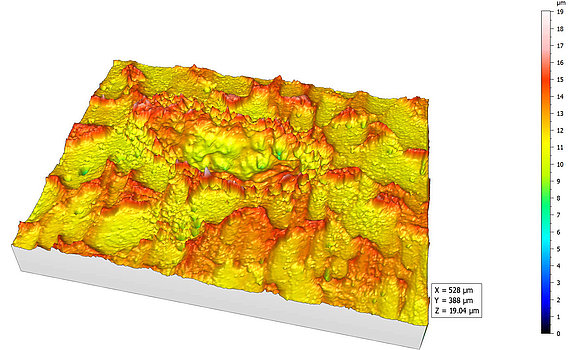
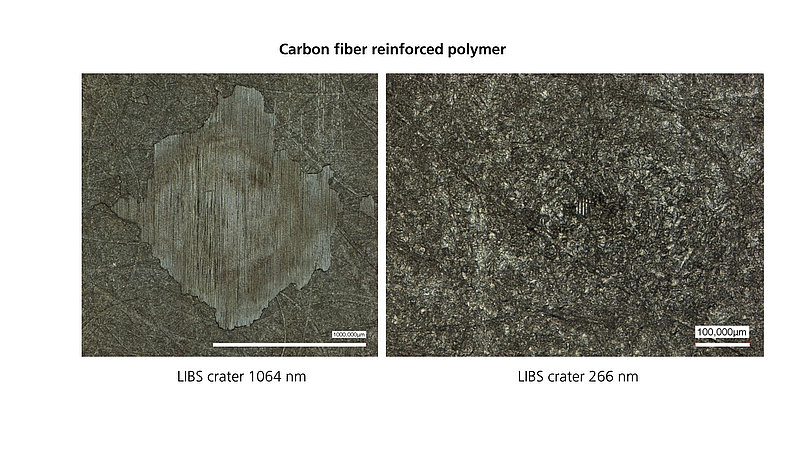
Laboratory tests at Fraunhofer IFAM have shown that the LIBS technique with 266 nm compared to 1064 nm reduces the material degradation for CFRP in diameter by 95 percent to less than 100 µm - while maintaining the quality of the measurement data (see Fig. 5). Thus, in any manufacturing area where surface and material properties play an important role, the LIBS system can be individually adapted and used. The minimum material removal by the laser pulse can be reduced in such a way that downstream manufacturing steps are not affected and the surface remains largely intact (see Fig. 3).
Integration into automated production environments
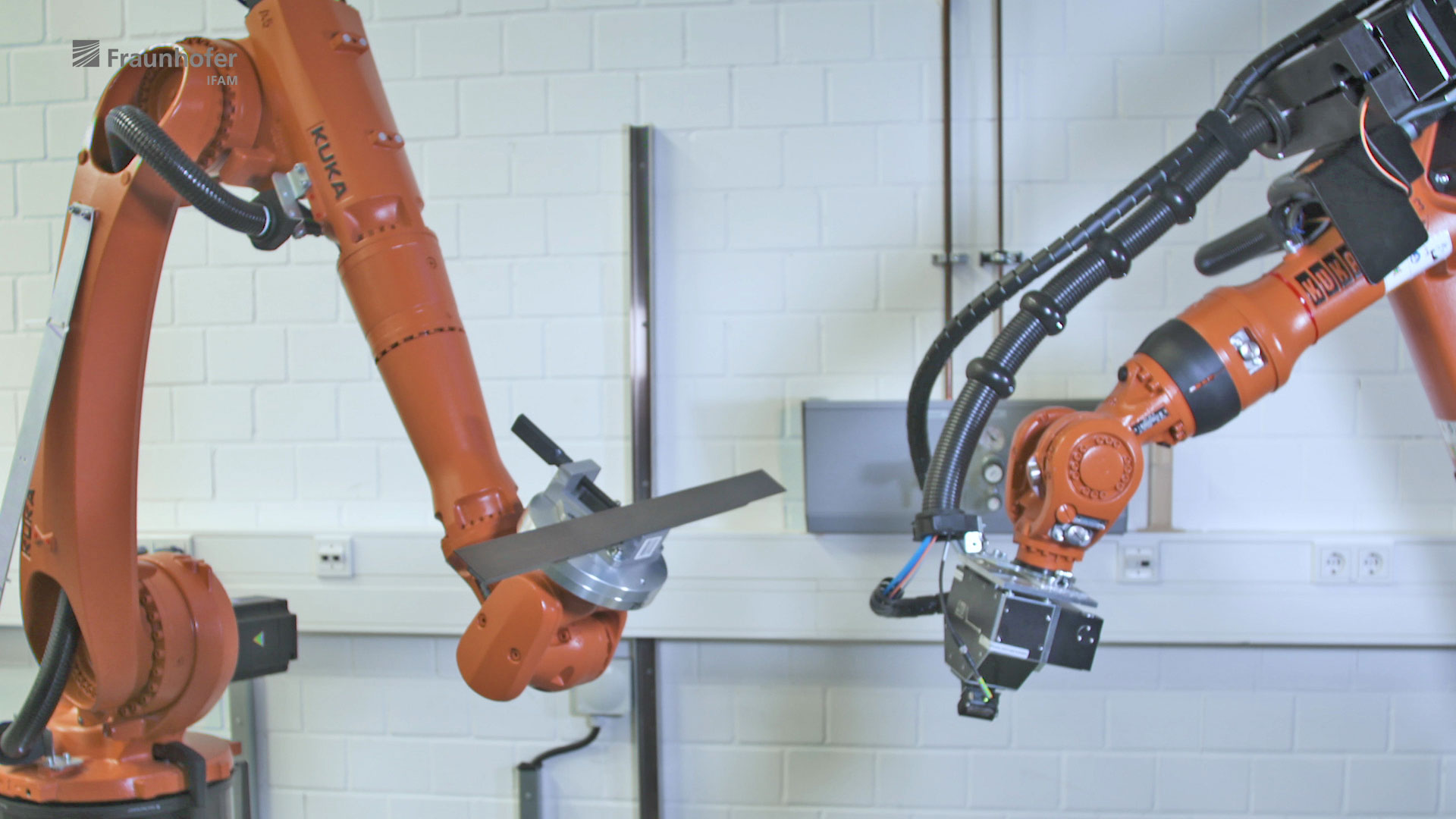
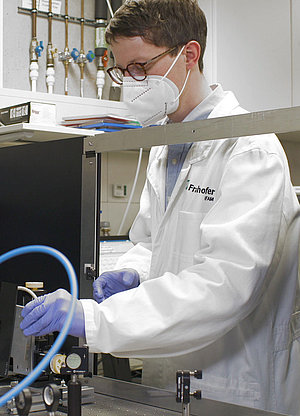
Fraunhofer IFAM in Bremen has various LIBS systems with different laser wavelengths in its own optical laboratories, so that methods can be developed which are specifically adapted to the problem at hand (see Fig. 4). By means of precise automated linear gantries, even larger surfaces can be measured quickly.
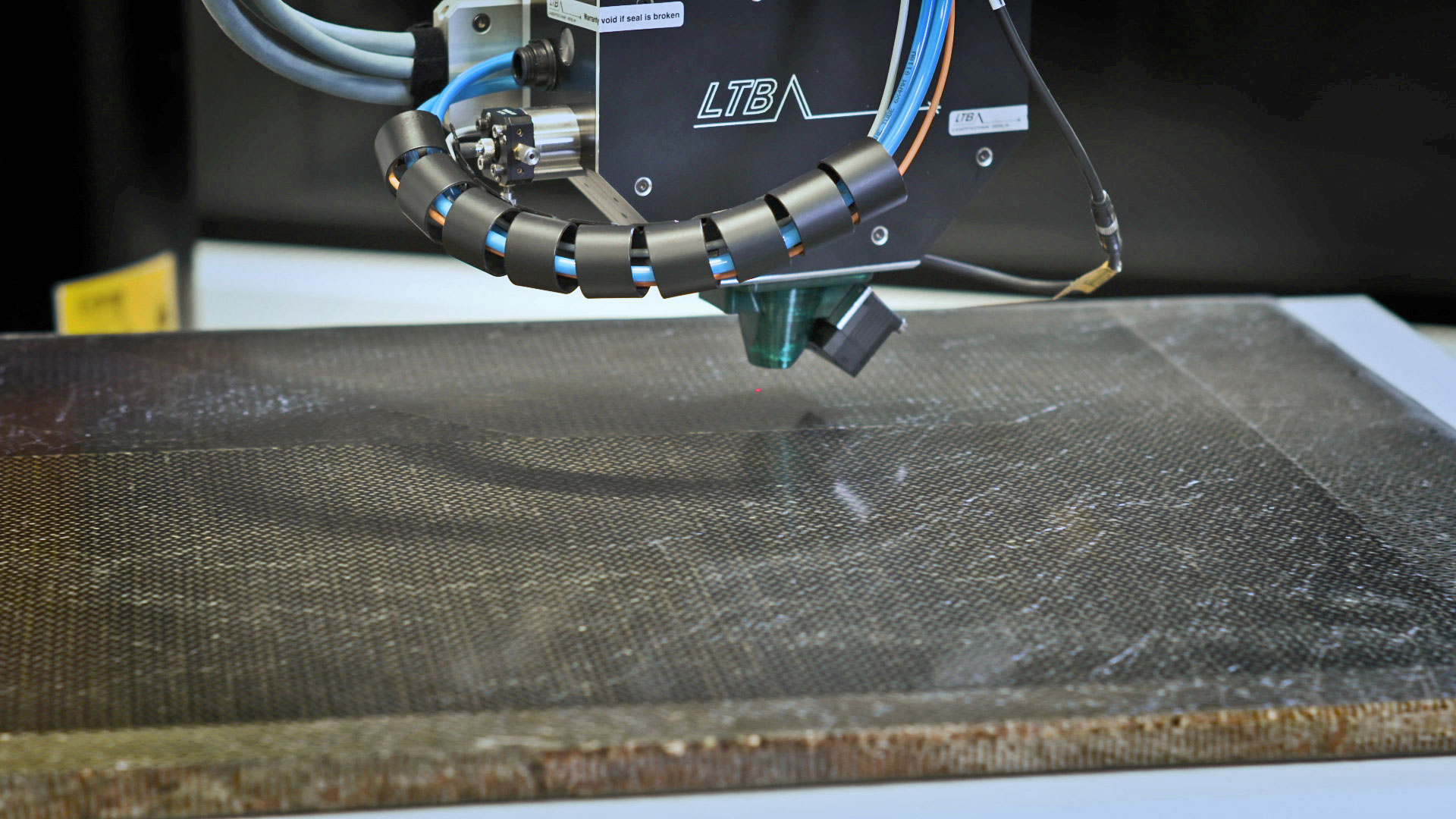
Special competence is the development of a LIBS measuring head for integration into an automated production environment. In cooperation with the company LTB Lasertechnik Berlin, a compact LIBS measuring head for mounting on robot systems was developed in the publicly funded project ALASKA (see Fig. 2).
The primary goal within the project was to design a small, lightweight system that is also equipped with robust components to withstand the movement on the robot and the production environment and thus not cause any changes in the measurement quality. A laser with a wavelength of 1064 nm was used for this purpose. As a result, LIBS measurements can now be integrated fully automatically into complex process chains. Concrete application scenarios are conceivable, for example, in the production of fiber-reinforced plastics or in the prevention of paint wetting disturbances. If the measured values are outside the previously defined tolerance range, the process can be readjusted directly and easily.
Application field Inline process monitoring
Fraunhofer IFAM's further research and application expertise is in the use of LIBS technology for rapid inline process monitoring of contaminants and active components in wet chemical pretreatment or cleaning baths. Together with its partners Secopta analytics GmbH and Göhler Anlagentechnik GmbH & Co. KG, Fraunhofer IFAM is working in the publicly funded LABSKAUS project on the development and adaptation of a LIBS system for the detection of paint wetting impairment substances (LABS) in purified process water to be recycled for painting operations.
Determining element concentrations in liquids
By selectively evaporating minute quantities of liquid on a defined surface, sensitive analyses of the residue can be performed using LIBS. The analysis results in turn allow direct conclusions to be drawn about element concentrations in the liquid. The use of LIBS technology here enables fast analysis times and very low detection limits with minimal and fully automated sample preparation. This is an innovative advance in the field of water analysis, as it is no longer necessary to use discontinuous, laboratory-based methods such as gas chromatography, mass spectroscopy or atomic emission spectroscopy.
Since all measuring systems are available at Fraunhofer IFAM, the experts can use their know-how to develop and implement solutions for all relevant processes for surface analysis and inline integration. Detailed documentation of the method and the fields of application can be found at s.fhg.de/libs.
Fraunhofer Institute for Manufacturing Technology and Applied Materials Research IFAM
www.ifam.fraunhofer.de