


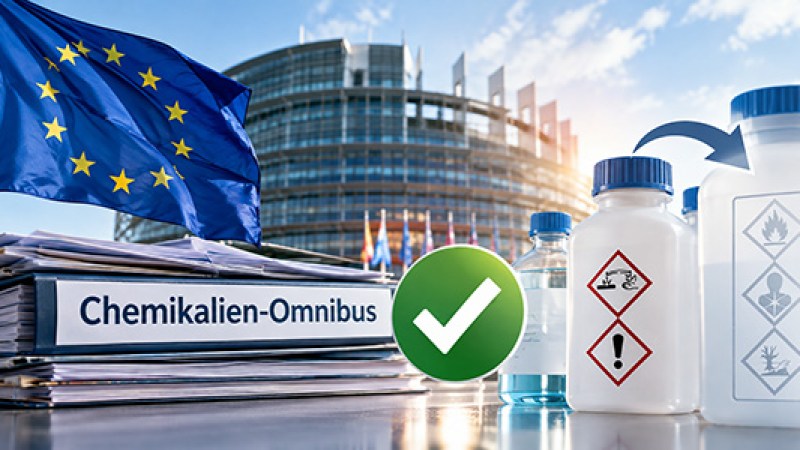
On October 22, 2026, the European Parliament approved the Chemicals Omnibus VI. For the electroplating and surface treatment industries, the planned amendment to the CLP Regulation—which governs the classification, labeling, and packaging of chemicals—is particularly relevant. The goal is to simplify certain provisions of the 2024 CLP revision even before they take effect and to reduce the administrative burden on companies.
Of particular importance for industrial supply chains is the proposed change to labeling for business customers. In the future, general requirements for legibility will apply in this context, while mandatory minimum font sizes will be eliminated. The obligation to convey hazard information clearly and comprehensibly remains in place. Stricter formatting requirements will continue to apply to products sold to the general public.
In addition, the negotiated compromise extends the deadline for certain label updates in cases of more severe hazard information from the current six months to 15 months. While adjustments must still be made without undue delay, the longer deadline is intended to give companies more leeway in practical implementation. In addition, there are new options for digital labeling as well as simplified requirements for certain small packages. However, this does not entail a general replacement of physical hazardous substance labels with digital information.
Relevance for Surface Treatment
Suppliers of process chemicals, in particular, as well as companies that place substances or mixtures subject to labeling requirements on the market themselves, can benefit from these changes. For surface treatment companies that use these products, the potential benefit lies primarily in reduced transition costs along the supply chain.
Especially with numerous products, varying container sizes, and multiple language versions, changes to labels entail considerable organizational effort. Greater flexibility in this area can free up personnel and resources without compromising the clear communication of hazards. However, the extent of the relief in each individual case depends on the product portfolio and the role of the respective company in the supply chain.
Next Steps in the Legislative Process
The parliamentary resolution does not yet constitute a new regulation that takes immediate effect. The conclusion of the legislative process, publication in the Official Journal of the EU, and the respective implementation and transitional provisions remain decisive. This does not entail a blanket suspension of existing CLP requirements.
The ZVO considers the direction taken to be correct but sees a need for further action. “The benchmark for further reforms must be: How much effort is actually saved in operations—and how much planning certainty is created for investments and industrial processes?” Simplifications must extend across the entire value chain, including small and medium-sized chemical users. Among other things, the association calls for fewer duplicate data requirements, better-coordinated reporting obligations, and reliable transition periods.
At the same time, from the association’s perspective, the Chemicals Omnibus Act does not resolve key regulatory issues. This applies in particular to PFAS, chromium VI, and the interplay between chemical, occupational safety, and environmental laws. For the electroplating and surface treatment industry, the call for proportionate and technically feasible regulations therefore remains.