

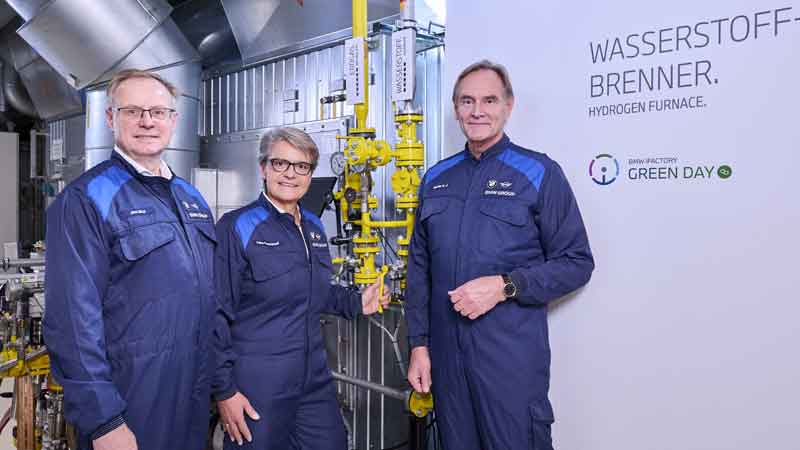
The first fuel-flexible burner for a paint dryer was commissioned at the Leipzig plant in October. What makes it special is that the burner can burn hydrogen (H2) and the natural gas methane (CH4) both on their own and in a mixture. The changeover of fuels can take place during operation. The dual burner will initially be used in pilot operation. The burner system was developed in cooperation with the Bremen-based company Saacke, and the Fraunhofer Institute IFF in Magdeburg is providing support in integrating the safety concept. Chief Production Officer Milan Nedeljković: "This technological breakthrough underscores our innovative strength and our will to continuously improve the sustainability of our production." In the area of solutions forCO2 reduction, geothermal energy, photovoltaic systems or hydrogen are being considered, depending on the location. A prerequisite for the continuous use of hydrogen is the sufficient availability of green hydrogen from pipelines. The Leipzig plant has the opportunity to use a hydrogen network being developed in the region for this purpose.
Hydrogen has already been used as an energy carrier in plant logistics for years. In 2013, Germany's first indoor hydrogen filling station was built on the Leipzig plant site. Forklifts and tugger trains for intralogistics can be refueled there. Almost ten years later, the Leipzig plant has the largest fleet in Germany with over 130 fuel cell-powered industrial trucks. Five intralogistics hydrogen refueling stations are located on the plant site, and the most recent has just gone into operation, enabling fully automated refueling operations for the first time. In logistics beyond the plant gates, the BMW Group is also working with partners to test the use of hydrogen to decarbonize transport logistics and is involved in the H2HAUL and HyCET research projects, two projects to develop and pilot fuel cell trucks.
Hydrogen is a promising energy carrier in transport logistics due to short refueling times, high payload and operational flexibility as well as attractive ranges. The use of green hydrogen, which is produced on the basis of renewable energies, thus creates the prerequisites forCO2-reduced long-distance logistics in the future. "Sustainability is in the genes of the Leipzig plant, so to speak. Right from the planning stage of the plant, we attached great importance to efficient and sustainable processes. One result visible to all is the four wind turbines that supply the plant with electrical energy," says plant manager Petra Peterhänsel.