

On the pulse of surface technology
Pulsed diode lasers with beam converter optimise manufacturing processes in the electronics industry
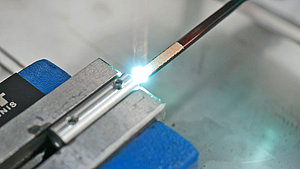
In industrial electronics manufacturing, the cleaning and structuring of surfaces is often realized with lasers that do not meet all requirements in terms of beam quality or output power. A new ns-pulsed laser represents an alternative in both fields of application.
Cleaning and structuring of surfaces are two of the most common processes in industrial electronics manufacturing. Laser technology plays an important role here. Copper components, for example, often have to be freed from coatings for further processing. This applies in particular to lacquer layers that have been applied for insulation or corrosion protection and must be removed again in later joining areas. For other components, the specific application of defined structures or patterns is required. Up to now, these applications have often been carried out with classic marking lasers. This increasing prevalence of laser-based solutions has to do with fundamental technological advantages such as contactless and high-precision processing, short cycle times and low total cost of ownership. At the latest, since the investment costs for laser systems are continuously decreasing, the laser as a tool has become interesting for more and more fields of application. Typical cleaning lasers today offer high output powers of up to 2 kW, but their beam quality is rather mediocre. This stands in the way of maximum processing accuracy. Conventional marking lasers, on the other hand, have - in accordance with their actual purpose as engraving tools - high beam qualities that support the creation of selective and very filigree structuring. At the same time, however, they provide only moderate output powers of around 100 to 200 watts, which does not enable optimum results with all materials and also causes long process times.
Against this background, a pulse laser developed by Laserline could become interesting for a large number of users. The LDFpulse with currently up to 1 kW average power and a beam quality of 4 mm-mrad combines the power of cleaning lasers with the precision of marking lasers and thus represents an alternative to commercially available laser types in both application areas. The new pulse laser system is based 80 to 90 percent on the Laserline LDF diode lasers with beam converter. The pulse effect is generated with the aid of a pulse module, which guarantees high flexibility in terms of pulse frequency. The laser system provides a maximum pulse energy of 10 mJ, with pulse lengths of 50 ns, a repetition rate of 30 to 200 kHz and an average power of up to 1 kW. In addition, it can also be operated in CW mode (i.e. as a continuous wave laser), which further expands the range of applications.
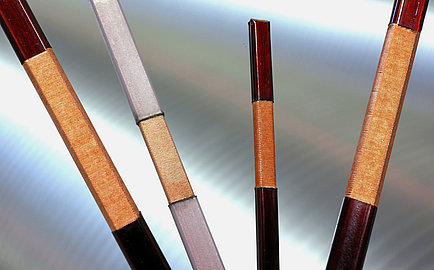
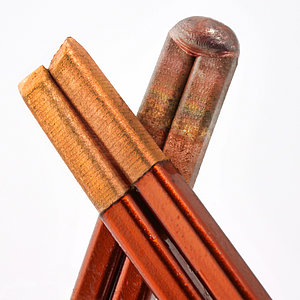
A vivid example of the successful use of the new type of laser is provided by the decoating of enameled copper wire. These so-called hairpins are bent into the structure of a hairpin and are now increasingly used to build powerful electric motors. In favor of higher packing densities, they replace the classic copper wire windings there. For the electrical contacting of the individual hairpins, two wire pairs are usually joined together by laser welding. Before this joining can be realized, however, the insulating lacquer layers of the pins must be removed in the joining area. This is necessary because the varnish layer does not evaporate without residue during welding, but rather varnish components and fume are carried into the melt. The burning plastic also represents a noticeable disturbance to the welding process. The ablation process can be carried out very uniformly, gently and efficiently with these lasers: When ablating PEEK coatings, for example, an LDFpulse achieved ablation rates of up to 455 mm2/s at about 1 kW output power and 10 mJ pulse energy. Removal of PA coatings was achieved at identical output power with ablation rates of up to 385 mm2/s, with a pulse length of 50 ns. In contrast to a CO2 laser, which emits at a wavelength of 10.6 µm, the LDF pulse operates at a wavelength of 1080 nm.
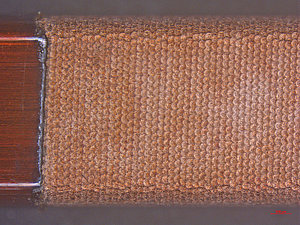
However, the absorption behavior of the coatings differs significantly at these wavelengths. Where the CO laser is already absorbed in the paint structure, the LDFpulse penetrates the paint layer completely and cleans the copper surface without leaving any residue. The CO2 laser, on the other hand, leaves behind residues that can interfere with the weld. Scanner-generated oscillations of the laser beam allow high-precision decoating to be achieved and provide optimum surface preparation for subsequent processing steps. Since the LDFpulse can operate in both pulsed and CW mode, even the subsequent welding of enameled copper wires can be realized. The system is thus an all-rounder for stripping and welding enameled copper wires or power rails.
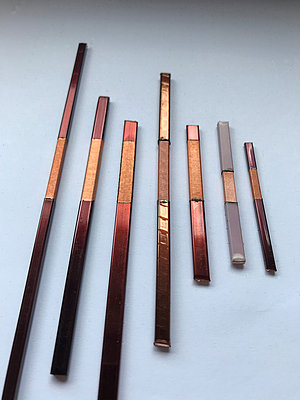
In addition to cleaning surfaces, there are also other possible applications for the LDFpulse. With pulse lengths of approx. 50 ns and repetition rates of up to 200 kHz, for example, the application in selective structuring of metallic surfaces or in laser drilling of components is also conceivable. Fiber-reinforced plastics in particular could be processed in this way in a resource-efficient manner. But laser polishing, where minimal heat input is desired to smooth surface roughness, would also be a suitable field of application. Pulsed diode lasers such as the LDFpulse provide users with a real alternative for implementing cleaning, decoating and structuring processes. The combination of high output power and high brilliance supports the processing of critical surfaces while enabling a highly precise and selective approach. Typical processes such as the stripping of hairpins or the structuring of metallic surfaces can be implemented with process speeds that are suitable for series production and in some cases even far above average.