

On the pulse of surface technology
Pulsed diode lasers with beam converter optimise manufacturing processes in the electronics industry
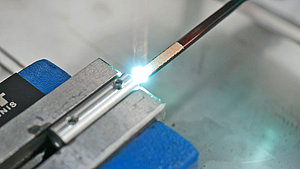
In industrial electronics manufacturing, the cleaning and structuring of surfaces is often realized with lasers that do not meet all requirements in terms of beam quality or output power. A new ns-pulsed laser represents an alternative in both fields of application.
Cleaning and structuring of surfaces are two of the most common processes in industrial electronics manufacturing. Laser technology plays an important role here. Copper components, for example, often have to be freed from coatings for further processing. This applies in particular to lacquer layers that have been applied for insulation or corrosion protection and must be removed again in later joining areas. For other components, the specific application of defined structures or patterns is required. Until now, these applications have often been carried out with classic marking lasers.
Typical cleaning lasers today offer high output powers of up to 2 kW, but their beam quality is rather moderate. This stands in the way of maximum processing accuracy. Conventional marking lasers, on the other hand, have - in accordance with their actual purpose as engraving tools - high beam qualities that support the creation of selective and very filigree structuring. At the same time, however, they provide only moderate output powers of around 100 to 200 watts, which does not enable optimum results with all materials and also causes long process times.
Against this background, a pulse laser developed by Laserline could become interesting for a large number of users.
Read more about this in the April issue of the magazine for surface technology - or right now with premium access to oberflaeche.de!