
Vehicle painting - as flexible as printing
Neue Applikationstechnik verspricht wirtschaftliche Erfüllung auch individuellster Kundenwünsche
Without the need to mask or unmask the body, new painting technology allows individual paint jobs to be completed in a single pass. This can reduce throughput times by 50 percent.
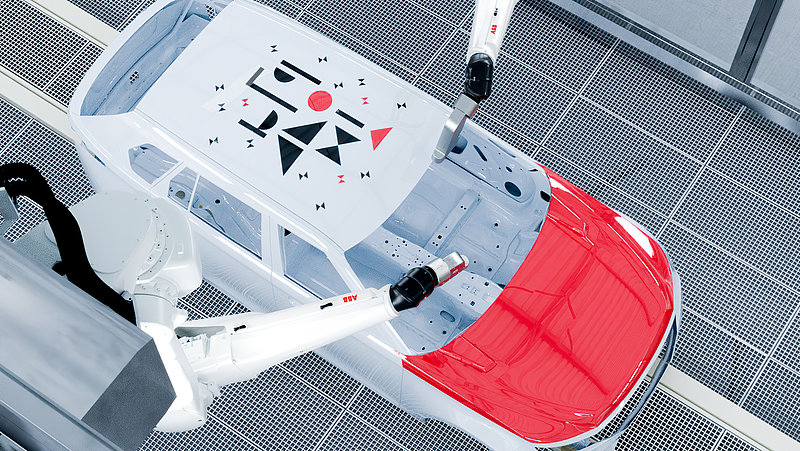
The trend toward greater individualization is on the rise and is being fueled by millennials in particular. This is also making itself felt in vehicle painting. Demand for customized and individualized paint finishes is on the rise - be it the desire for a second color, a different paint finish, such as matte, or a special design. However, it is not only in response to personal customer requests that the popularity of multicolor paint finishes for motor vehicles is increasing.
Contrast paints are also used to emphasize or soften aspects of the vehicle design. Until now, a two-color paint finish has usually required a double pass through the painting process. This costs considerable capacity in the paint shop. An alternative would be to build another paint line for this - a very cost-intensive decision. Taking into account that a paint shop accounts for the largest share of an automotive plant's total energy consumption, multicolor painting is not exactly conducive to reducing the environmental footprint.
Classic process: High resource consumption
Another cost factor is the additional personnel required, because extensive masking of the bodywork is necessary between coats of paint to ensure a perfect result. This usually requires between ten and twenty employees per shift. At the end of the process, at least two operators are also required to unmask the vehicles again after painting, with the masking materials having to be disposed of. Since even efficient high-rotation atomizers only actually apply about 70 to 80 percent of the applied paint to the body, multi-color painting also adds considerable costs in this area.
For this reason, vehicle manufacturers are looking for solutions that will help them improve flexibility, efficiency and cost, while reducing their environmental footprint by cutting waste and energy consumption. The solution must also deliver a high-quality paint finish to meet high customer demands, especially for individualized vehicles. The answer to this problem may be ABB's PixelPaint solution, which uses a novel painting process to achieve the desired effects quickly, accurately and economically. The solution includes a high-precision paint applicator, a metering unit and software for logo and two-color painting.
Fully automatic alternative
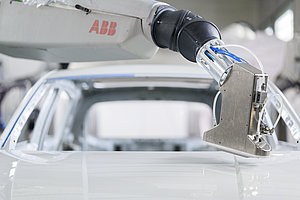
The technology used by PixelPaint works similarly to inkjet printers but uses paint, opening up new possibilities for applying custom patterns and designs to vehicles of all sizes and shapes. ABB's offline RobotStudio programming tool makes it easy to set up and test different paint designs before applying them.
Because the paint is printed directly onto the body via the nozzle head instead of being conventionally atomized, there is no overspray and all of the paint lands on the vehicle. With over 1,000 nozzles that can be controlled individually, PixelPaint enables droplets to be applied in sizes ranging from 20 to 50 μm at a rate of over 1,000 droplets per second. This allows extremely precise control of layer thickness and overlap, and is said to ensure that images can be printed at the highest quality. The process also requires significantly less ink than traditional atomization and therefore releases fewer volatile organic compounds (VOCs). The application distance can be between three and ten millimeters. Before application, the robots use sensors to precisely determine the actual position of each component. The system can also test itself and carry out a cleaning process as required or cyclically.