Self-developed special electroplating systems
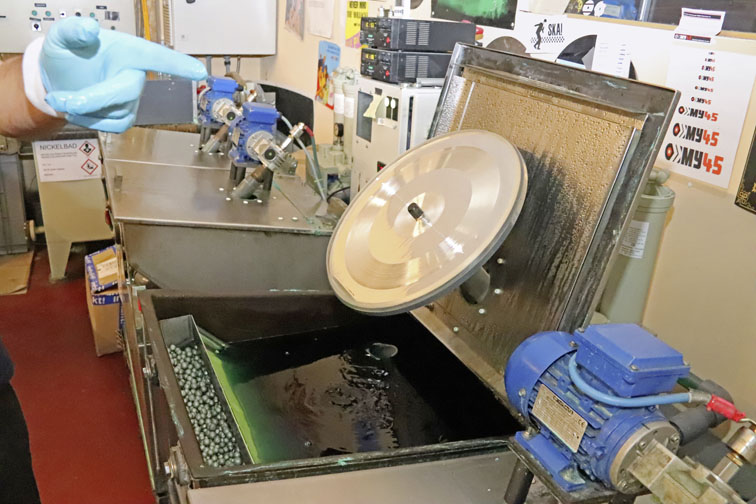
Before Dieter screws the silver-plated enamel films to the rotary devices mounted in the bath covers with a central screw, he puts on a silicone ring at the edge as a masking. This prevents excessive nickel deposition in this area, which would later make demolding more difficult. The lid is closed, the current flow is started, and about 30 minutes later the beautifully shiny mastercut has turned into a dull, matte nickel surface. This now moves to the next nickel bath for three hours at a much higher current flow. The first step served to fill the tone tracks as precisely as possible; the material now deposited serves as structural reinforcement.
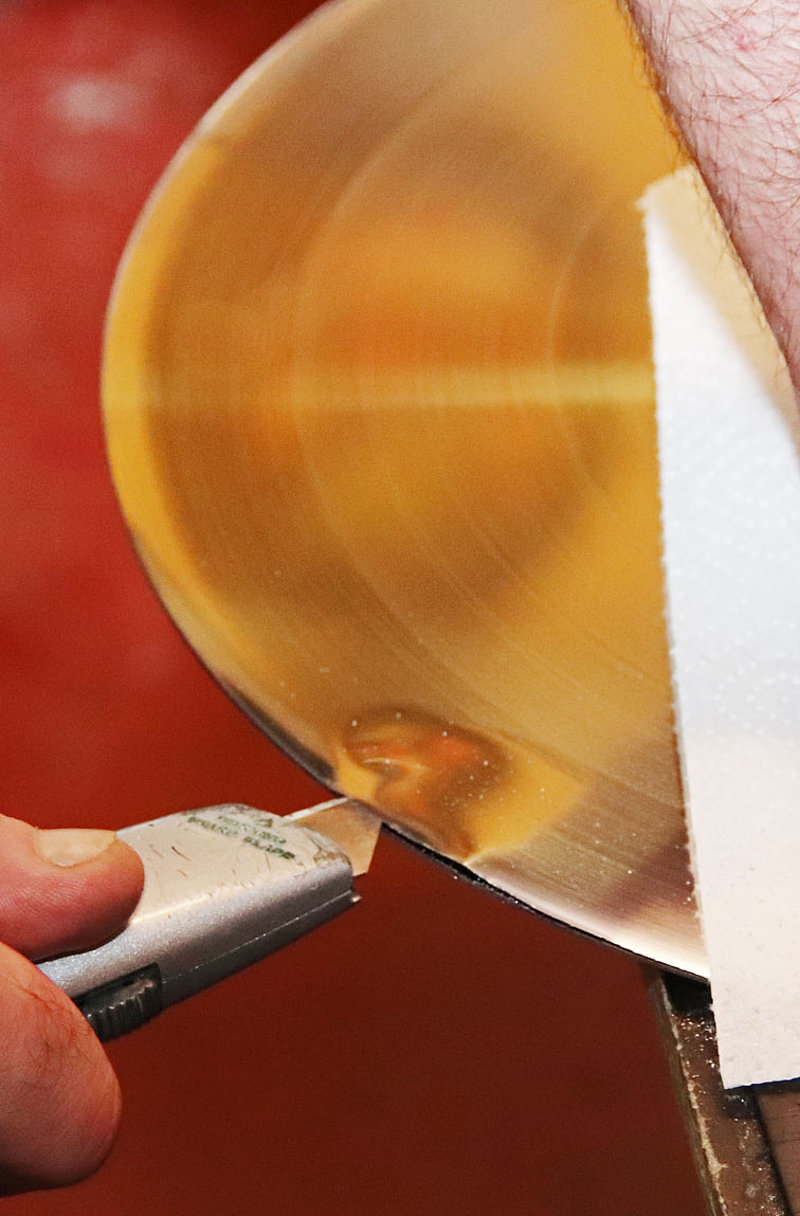
What follows after the plating is complete seems a bit rough. Dieter takes a file, planes up and down a few times on the edge of the nickel-plated disc, grabs a cutter and begins to remove the nickel layer relatively briskly with it. At that moment at the latest, it becomes clear why the master film has several centimeters of reserve in diameter up to the actual plate size. Although this does not look very gentle, the nickel film is not damaged in any way. But no plates can be pressed with it yet. An acetone bath dissolves the last plastic residues from the nickel disk, and a potassium dichromate bath removes the last silver residues. "Without the potassium dichromate bath, we would have to throw away about the first ten pressed records," Dieter explains. " That's because silver residues cause a lot of crackling when they are played."
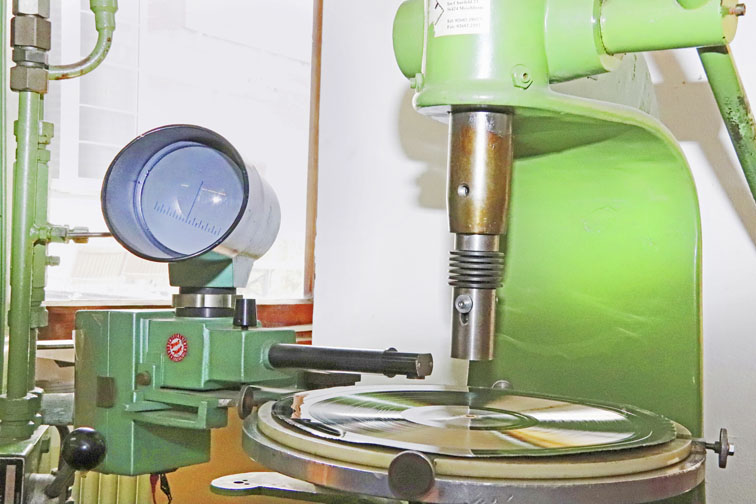
A special punching device is used to center the future stamper, on which an employee uses a microscope to center the outlet groove of the stamper to within fractions of a millimeter. Another punching device gives the nickel disk its final shape based on the center hole. In this step, protruding material in the edge area is removed and the center hole and edge area are reshaped so that everything later fits perfectly on the printing plates of the record press. This also improves the stamper's dimensional stability and robustness.
From film to pressing tool
Before a record can be pressed, a pressing mold, the so-called stamper, must be produced from the sound recording in several steps. This is subjected to very high stresses, as it must withstand 110 tons of pressure and 140 degrees Celsius in the press.
After the mastercut is finished, the electroplating part begins. The sound recording is pretreated in three panning baths. Dieter carefully slides the black sound carriers into the trays in a concentrated manner. The first one contains an alkaline cleaner, RBS 35, for non-corrosive materials, which can be rinsed off without leaving any traces. This is followed by saponin as a rinse aid. The sensitizing solution, a nickel fluoride-hydrochloric acid mixture, is the final step. It is critical for the subsequent silvering process and is therefore prepared daily. The swiveling device for the baths was developed in-house. Between each bath, the mastercuts go on a pickup device into a large tub and Dieter thoroughly rinses them with a Gardena shower - using desalinated water. There's no timer running, but the rinse times seem almost constant. "I've got the feel of it by now," he grins. Things get spectacular when it comes to silver plating. Dieter hangs the black disc on a rotating plate in the silvering booth. Then he takes the somewhat bizarre-looking two-nozzled gun and sprays slowly from the edge inward. The spray is colorless, then suddenly after a few seconds the color of the mastercut turns from black to shiny silver from the outside to the inside. After rinsing with desalinated water, a shiny silver gem hangs in the spray chamber that could easily be hung on the wall as a silver record.