


Our interlocutor
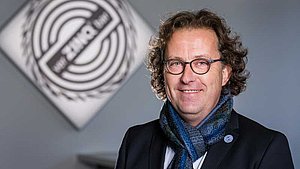
The ZINQ Group coats over 650,000 tons of steel on behalf of its customers every year, has 2,000 employees and now 50 locations. ZINQ is the first surface technology company to implement a circular business model (Planet ZINQ).
The group operates in five European countries and has customers from a wide range of sectors, from craftsmen and construction companies to the commercial vehicle industry, manufacturers of agricultural machinery and the chemical industry.
Lars Baumgürtel has been managing director at ZINQ since 1992, and since 2008 he has been the sole shareholder of the fourth-generation family business. He is a graduate of the double diploma program of the Otto Beisheim School of Management (WHU Koblenz) and the Lyon School of Economics (EM Lyon).
Energy challenge for coaters
High energy prices, gas shortages - how do you act as an entrepreneur in these turbulent waters ?
Lars Baumgürtel, the managing director of the Zinq Group, advises a dialog between energy-intensive companies and utilities to prevent arbitrary shutdowns and sees an alternative in green hydrogen.
mo: Mr. Baumgürtel, what are your biggest energy consumers?Baumgürtel: These are the furnaces for zinc smelting, which have to hold up to 800 metric tons of zinc at 450°C. So far, there are no alternatives to natural gas for such hot-dip processes. Across all our sites in Europe, we consume a total of almost 250,000 MWh of gas and electricity per year. Therefore, the current energy prices affect us very strongly.
mo: How do you purchase energy?Baumgürtel: At present, it is necessary to combine all forward and spot market options in order to achieve price advantages. But it is just as crucial to have a supplier as a basis that can guarantee delivery. We started early on to contractually secure the energy volumes we needed - that seems to have been a good strategy. I am hearing more and more from industry colleagues that they are not being offered contracts for the quantities they need - a serious problem, especially for the smaller companies in the surface technology industry.
mo: Is it to be expected that companies without a utility contract will actually find themselves without energy next year?Baumgürtel: In principle, this is possible, because there is no right to basic supply for companies, as there is for private consumers. That's why it's important for companies to do everything they can now to secure the energy they need.
mo: Are you pursuing strategies to move away from natural gas as an energy source? Baumgürtel: For us, in-house generation of alternative energies in the quantities we need for galvanizing is out of the question. That's why we are striving to substitute natural gas with hydrogen. Admittedly, this is complex and not a short-term solution, but it is one of the ways to make ourselves less dependent on the energy markets in the future, which will remain very volatile for some time to come.
mo: Hydrogen as a green energy carrier of the future is being discussed very controversially, why are you convinced of this?Baumgürtel: It makes sense to keep as many options as possible open for energy procurement. If we want to substitute natural gas and at the same time effectively reduce our CO2 emissions, there are not very many alternatives. In the future, we will need at least 1,000 terawatt hours of additional energy in Germany on top of the electricity from renewable sources. To be able to provide these amounts of carbon-free energy, it will not be possible without a production ramp-up of hydrogen. Internationally, the train toward green hydrogen has long since begun to pick up speed, and we must be careful not to be left behind on the platform.
mo: How can hydrogen become interesting as an alternative for companies, and are there already concrete projects?Baumgürtel: In Gelsenkirchen, we are part of the Klimahafen project, which consists of a cluster of around 20 local companies and institutions that have pooled their requirements, resulting in an annual demand of 15,000 tons of hydrogen. This makes the project attractive for suppliers of hydrogen. We want to test the use of an energy gas containing hydrogen for process heat as a substitute for natural gas at Zinq as early as next year. For the medium-term supply of green hydrogen, either an appropriate electrolysis capacity will be built on site or the climate port will be connected to a hydrogen pipeline. In the GetH2 project, for example, hydrogen will be transported from the north to the Ruhr region in five to ten years, for example through decommissioned natural gas pipelines. The LNG terminals currently under construction will be pre-equipped to land hydrogen.
mo: How will hydrogen compare to natural gas in terms of price?Baumgürtel: Producer capacities are currently still low and not every company will be able to use hydrogen as an energy carrier. At current gas prices, however, its production would already be economically interesting. In any case, expanding the necessary infrastructure for importing globally produced green hydrogen would be much cheaper than trying to raise the required additional 1,000 terawatt hours from the expansion of renewable energies in Germany alone. OGE, a major network operator in the field of gas distribution, estimates that the conversion of natural gas pipelines and the addition of new pipelines will cost only about six billion euros per year. This is considerably less than the 15 billion that an expansion of renewable energies will cost us every year until 2045.