


Our interlocutor
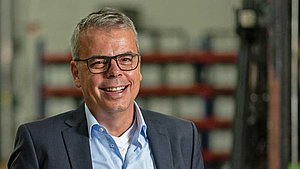
The Rheinmut Galvanik Group operates two sites in Lower Franconia, one in Bürgstadt am Main and one in Würzburg. A total of 80 employees work at both sites, supplying mainly special machinery manufacturers and the capital goods industry with zinc and zinc alloy coatings and phosphatings.
The sites are certified according to relevant quality criteria. Jörg Reinmuth studied industrial engineering at the University of Applied Sciences in Gießen Friedberg and started as production manager in the family business in 1994. In 1997 he took over the management and has been the sole shareholder since 2000.
Ensure the ability to deliver
High energy prices, gas shortages - how do you act as an entrepreneur in these turbulent waters ?
Jörg Reinmuth is the managing director of the Reinmuth Galvanik Group and is counting on a conversion to oil and LPG in the short term in order to remain able to deliver. He calls for an Agenda 2030 for energy.
mo: In what order of magnitude do you consume electricity, gas and heat?Reinmuth: Our consumption is in the range of a million kilowatt hours, depending on which location and energy source you look at. Our energy source for heat has been mainly gas, because we use it directly to fire our drying processes - a special feature in the industry. Otherwise, electrically heated rack dryers are the norm. As an electroplating company, we consume a lot of electricity for coating as well as for the entire process technology, from pumps to transport systems.
mo: How do you safeguard your production in the event of a gas shortage?Reinmuth: We are currently converting to oil and liquid gas in order to remain capable of production. However, this entails investment costs of around 100,000 euros per site, for additional tanks, structural modifications to buildings and so on. However, this will also lead to rising operating costs due to oil as an energy source. We reckon on orders of magnitude of 500,000 euros per year and site.
mo: Is the conversion to oil reversible?Reinmuth: Of course, we will not tear up the old pipelines and will try to keep all alternatives open at both sites. In Bürgstadt, we will be able to use natural gas, liquid gas or oil, and a changeover will be possible within a few working days.
mo: Some time ago, you had Bürgstadt converted from oil to gas - do you regret that today?Reinmuth: No, the site ran very profitably with gas for several years, so it was well worth it.
mo: How high are the energy costs in your production?Reinmuth: Since we are not an electroplating shop that produces mass-produced parts, our energy cost share in the total value added is not quite as high. In special machine construction, the parts are heavier and the cost of rack construction, coating coverage and special fixtures is much higher. But in the meantime, the escalation on the energy market has also become a significant factor for us.
mo: How do you manage to pass on the price increase to your customers?Reinmuth: In the case of owner-managed medium-sized suppliers, who can often relate to our situation, a constructive negotiating situation usually arises at eye level. Unfortunately, we have also experienced very little understanding and a massive blocking of negotiations with larger companies. Depending on the size of the order, the latter can threaten the existence of a medium-sized company.
mo: How do you supply yourself with electricity on the energy market?Reinmuth: We used to be a classic special contract customer and put our electricity out to tender for two years - without an external service provider, but with the support of the VEA, the Association of Energy Consumers. This fixed price helped us a lot during the very volatile phase, when others who bought their tranches on the spot market were hit very hard. But in the meantime, the development is also having a full impact on us. That's why I have now joined a pool that will buy in tranches on the spot market every quarter from the year after next, in order to reduce the purchasing risk.
mo: Is cogeneration an issue for you?Reinmuth: We have had concepts for cogeneration presented to us several times. Although our electroplating shop needs heat and electricity at the same time and could actually be an ideal application, it is not lucrative, at least for us. If the cogeneration unit needs an overhaul after 80,000 hours of operation, that can largely consume the savings achieved. Apart from that, with gas prices of 1.5 cents per kilowatt, direct heating used to be unbeatable. Now we need to think about alterants to gas. One idea is to run the dryers on green electricity instead of CO2-emitting fuels.
mo: Does that make economic sense in the current price situation?Reinmuth: In the medium term, electricity prices can be expected to fall, especially if alternatively generated electricity becomes available on a larger scale. Once the energy markets have calmed down, the price of electricity alone could be between eight and eleven cents per kilowatt hour. That's why we are already upgrading our infrastructure and enlarging our transformer station, which could take up to a year and a half due to current delivery times. This is also an important step towards being able to temporarily charge electric trucks on our site in the future, for example.
mo: Do you have an exact overview of how much energy you consume and where?Reinmuth: We have a pretty good overview of our energy consumption because, as an energy-intensive company, we get some of the energy taxes and levies back. To do this, we have to show exactly which energies flow where. It makes a considerable difference whether the electricity is used for hall lighting or for electroplating. However, we are below the gigawatt limit, so we are not yet subject to energy management. The higher administrative and technical outlay for this would not have been worthwhile in the past. The high energy prices have now changed the situation. We are expanding the IT infrastructure in production and installing more and more accurate measuring technology by the end of the year to find potential savings.
mo: What role does peak load base load smoothing play for you?Reinmuth: We have been working intensively on this topic. In particular, because we do not generate the heat required in the process electrically, there is little scope for peak load. And we can't switch off the lights or the transport carts. Turning off filters or agitators would not be an option either. Just delaying the start of an annealing oven doesn't help much. Apart from that, our customers demand short delivery times. Longer lead times to optimize our load distribution would not meet with any understanding.
mo: What are the prospects for your company and also for the industry in view of current developments?Reinmuth: We are an agile company and I see the current difficult situation as quite manageable. As an owner-managed company, I don't have any shareholders putting me under pressure, and I can think and act for the long term. However, I do see the danger that the customer market could implode. It is true that more production facilities will return to Europe in the future due to the supply chain problems. However, according to a supplier study by Merril Lynch, Germany is not expected to benefit significantly from this, but rather Spain and Eastern Europe. Even if the automotive business only accounts for a small double-digit share of sales for us - if the large companies that have served this market up to now can no longer utilize their coating plants to capacity and engage in price dumping in our market, it will be difficult.
mo: How do you assess the public discussion on the current economic developments?Reinmuth: Employees are unsettled and nervous because the biggest scare scenarios are being discussed up and down and politicians are delaying decisions immensely. Employees have frequently revealed to me that they are afraid for their jobs because they read in a newspaper that energy-intensive companies will not survive the year. Our political leadership does not seem to be thinking about the counterproductive psychological effect of the current reporting and the publicly aired debate about the right strategy. Even though, as a managing director, I am aware of my balance sheets and reserves, this is causing unrest among the workforce.
mo: What measures would you expect from the political side?Reinmuth: We need calculable energy. Regardless of whether my customer builds excavators or cranes, everyone needs reliable prices and procurement costs. Everyone has to pass on their prices and the calculation must not be volatile. That's why the energy markets need to be stabilized and regulated. Just like an entrepreneur acts in a crisis situation: Hide everything unimportant and make decisions and develop strategies based on the information at hand. But our current politicians are obviously not good at making difficult and far-reaching decisions. But we need a strategy, not public discourse on Sunday evening talk shows.
mo: What do you think should happen in concrete terms instead?Reinmuth: Politicians must consistently make a plan, just as Gerhard Schröder set up Agenda 2010 back then and reset the premises in the labor market. That was the basis for the economic success of the following decades. For example, a plan must be drawn up for what the energy market must look like in the future so that there can still be a manufacturing industry in Germany and Europe in the future. We need an Agenda 2030 that defines what needs to happen in the next eight years - and then everything must be done to implement it. If you have a goal, you know what to do - even if there are rare butterflies fluttering around somewhere or an abstract concern about shadows. After all, the economic future of all of us is at stake!
mo: What are your expectations for next year's planning?Reinmuth: I am of the opinion that if we get the price development stabilized, we and many other companies will get by in the next few years. In terms of investments, we are concentrating on digitization and optimization. We assume that it will continue and that we suppliers will also be needed in the future - especially in our segment for special machines and special vehicles. Farmers need tractors and no one can build highways without cranes and excavators. There is no reason why such products should no longer be needed in economic terms.