


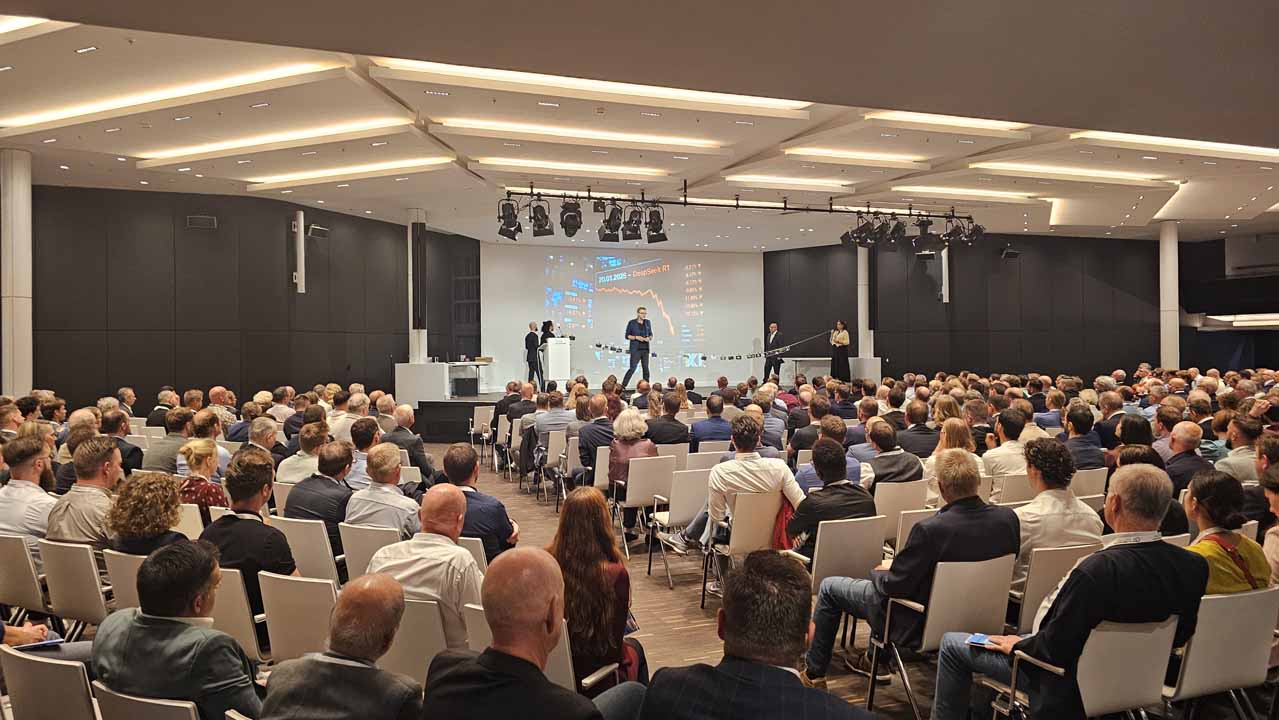
From September 16 to 18, the electroplating and surface treatment industry gathered for the first time at the newly modernized Stadthalle Karlsruhe. The 569 attendees demonstrated that the ZVO Surface Technology Days remain of great importance to the industry, even in challenging times. Seventy exhibitors presented their portfolios—some with exhibits specially designed for a conference—and were available for technical discussions. The lecture program took place in five parallel sessions, with AI and automation, raw materials and energy efficiency, new surface technologies, and the strategic sustainability of companies serving as central themes.
For ZVO Chairman Jörg Püttbach, the focus is not solely on technical information. “The Surface Technology Days are and will remain the industry’s premier event,” he concluded in an interview with mo. In particular, the exchange of ideas across the entire supply chain—between coaters, chemical and equipment suppliers, researchers, customers, and competitors—is a key value of the congress. The electroplating and surface technology sectors come together here once a year in an exceptionally concentrated setting.
AI Is Evolving from a Future Topic to a Tool
Just how clearly priorities are shifting was already evident on the opening night. Torsten J. Koerting titled his keynote address “AI in SMEs: Not a Pipe Dream, but a Competitive Advantage.” Instead of abstract future scenarios, the focus was on real-world industrial applications—such as accelerated quote calculation, intelligent data analysis, and the preservation of experiential knowledge.
The following morning, this translated directly into practical work. The “AI Compass for SMEs” workshop, limited to 80 participants, was well attended. The concept deliberately avoided focusing on extensive AI strategy papers, instead addressing the question of what bottlenecks exist within the company, defining them, and only then introducing potential AI applications.
Püttbach sees very clearly that AI is increasingly coming into closer contact with businesses and becoming significantly more practical. Especially for smaller companies, however, it remains challenging to identify meaningful areas of application and allocate resources for their implementation. At the same time, Püttbach sees considerable potential—for example, in the automation of production and administrative processes, as well as in cost reduction. His advice to companies that have so far paid little attention to AI is correspondingly clear: the topic should be addressed systematically now.
The technical program also confirmed this trend. AI-based analysis of process data in Cr(III) processes, automated quality assurance even before plating, the preservation of empirical knowledge, and intelligent electroplating processes with automated parameter control demonstrated that AI is increasingly being linked to specific electroplating tasks. Digitalization was thus less of an end in itself and more of a tool for quality, efficiency, and process reliability.
Efficiency, Circularity, and Supply Are Becoming Competitive Factors
A second clear focus ran through numerous presentation series: the more efficient use of energy and raw materials. The spectrum ranged from the recovery of rare earth elements, as well as nickel and cobalt, from battery materials, to closed-loop systems in plastic metallization, and to energy-efficient cleaning, drying, and coating processes. Automated plant concepts and improved process monitoring were also frequently aimed at simultaneously reducing scrap, energy consumption, and resource use.
On Friday, this theme continued with topics including energy (systems) of the future, automation, circularity, and hydrogen. Presentations on heat pump drying, power quality, closed-loop zinc-nickel systems, and electroplating components for electrolysers highlighted just how closely surface engineering is now linked to the overarching issues of energy efficiency, securing raw materials, and future energy systems.
In addition, topics such as fire protection, insurability, cyberattacks, damage analysis, and regulatory developments received an unusually large amount of attention. This, too, is a sign: in surface technology, future viability has long since ceased to be defined solely by the performance of a coating. Production reliability, data, energy, personnel, regulatory requirements, and the resilience of entire companies are increasingly part of the same bigger picture.
Püttbach: Germany as an industrial hub is under considerable pressure
As positive as the response to the Surface Technology Days was, Püttbach described the economic conditions just as clearly in his interview with mo. In his view, industrial manufacturing in Germany is under significant pressure. High energy, labor, and social costs, as well as bureaucracy and regulatory requirements, are placing a particular burden on small and medium-sized enterprises. For the electroplating and surface treatment sectors, these challenges are compounded by chemical regulations and environmental policy issues—such as those surrounding REACH, chromium(VI), PFAS, and European industrial and emissions regulations.
The association is paying particularly close attention to developments in key customer industries. For many surface treatment companies, the automotive industry plays a central role. According to Püttbach, if production capacities were to be relocated, this could mean that suppliers would have to follow their customers abroad or risk losing business. The ZVO is therefore calling for, among other things, competitive energy costs, a reduction in bureaucratic burdens, and regulations that take the consequences for small and medium-sized enterprises more into account.
“Made in Germany” Aims to Give the Industry a Distinctive Identity
This is precisely where a new initiative launched by the ZVO during the Surface Technology Days comes in. Under the motto “Made in Germany,” the association’s political work will be more strongly supported by public relations efforts in the future. The central question is under what conditions industrial production can actually continue to take place in Germany in the future.
The approach is noteworthy: Communication should explicitly not come solely from the association. Entrepreneurs, managing directors, employees, and trainees should share their own experiences and perspectives via social media. The ZVO intends to offer assistance with wording and background information, but at the same time does not want to impose pre-formulated opinions. According to Püttbach’s vision, this approach will make the people behind industrial value creation more visible and give the public discussion about Germany as an industrial location a more concrete face.
Significant Challenges—But Also Significant Progress
The ZVO Surface Technology Days 2026 thus conveyed a multifaceted picture: The economic and regulatory challenges are recognized in all their complexity and are by no means glossed over. At the same time, the industry is actively seeking concrete solutions to overcome these challenges.
It was precisely this blend of technical detail, business-related issues, and intensive networking that once again made the Surface Days a standout event this year.
A detailed follow-up report on the 2026 ZVO Surface Technology Days, including details on the presentation topics, themes, and insights from Karlsruhe, will be available shortly online at oberflaeche.de as well as in the June 2026 issue of mo.