
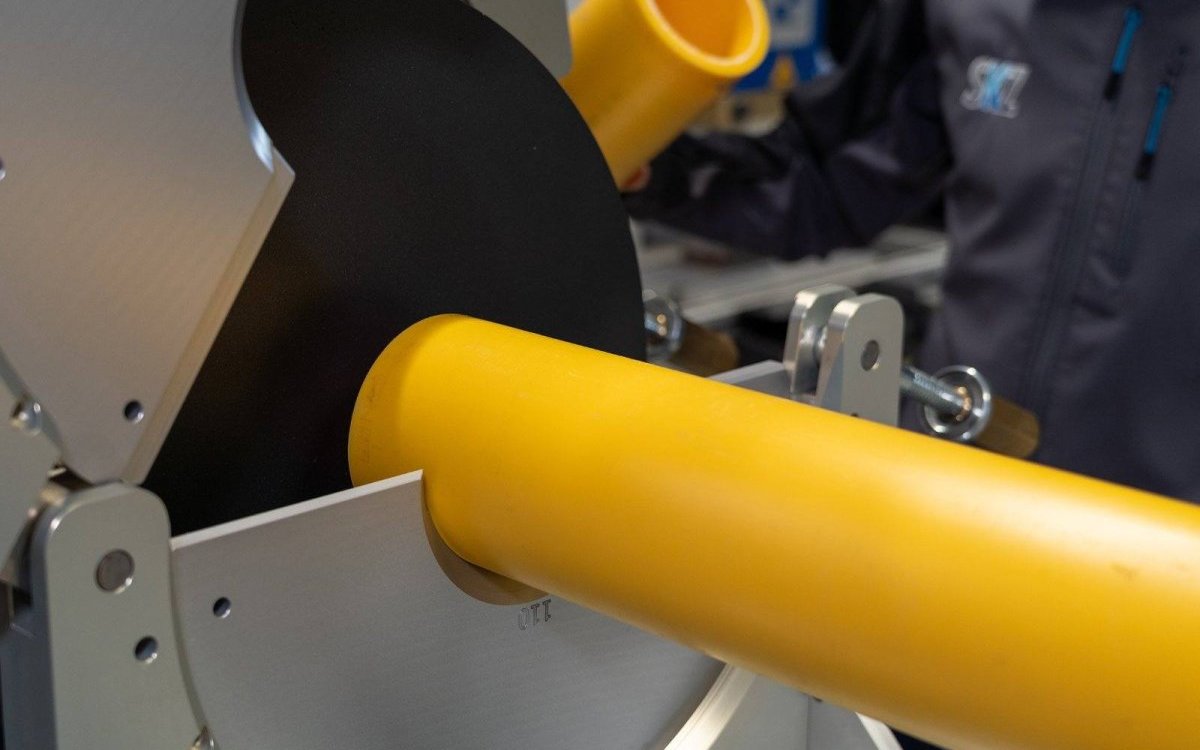
The SKZ and the Thuringian Institute for Textile and Plastics Research (Innovent) are jointly developing PFAS-free nonstick coatings for applications in plastic welding. The focus is on tools and functionally critical components where, until now, plastic adhesion has often only been effectively limited using fluorinated coating systems.
This development responds to growing regulatory pressure surrounding per- and polyfluorinated alkyl substances. For many industrial applications, alternatives are being sought that do not contain PFAS yet still offer high non-stick performance, thermal resistance, and sufficient mechanical strength. These properties are particularly crucial in plastic welding, as tools are repeatedly subjected to thermal and tribological stress.
Alternatives to Fluorine-Containing Systems
The project is investigating new coating solutions that do not contain PFAS and are suitable for use in welding processes. The focus is not only on the nonstick effect itself, but also on the interaction with the respective plastic surfaces, cleaning requirements, process stability, and the service life of the coated components.
To this end, the partners are pooling their respective expertise: SKZ is contributing its know-how in plastics processing and plastic welding, while Innovent is bringing its experience with functional surfaces and coating processes. On this basis, coatings will be developed and evaluated for use in industrial processes.
Requirements in the Welding Process
Non-stick coatings play an important role in plastic welding because polymer melts adhering to tools, heating elements, or process-related components can impair the quality of the joint and cause downtime. PFAS-free systems must therefore meet several requirements simultaneously: They should minimize adhesion, not adversely affect heat transfer during the process, and remain stable even under cyclic loading.
The research aims to identify suitable materials and coating systems and to test their suitability under real-world conditions. In doing so, the project addresses both environmental and regulatory aspects as well as requirements from industrial manufacturing. “The goal is to develop PFAS-free non-stick coatings for plastic welding,” states the project description.
For surface engineering, the topic is relevant across industries: The search is on for functional surfaces that replace the established properties of fluorinated systems as much as possible without creating new limitations in the process. If successful, this could open up new options for tools and components in plastics processing.