

Infineon Technologies began operating its site in Dresden in 2004. In this context, the question of reliable units for rough vacuum arose early on, especially for pick-and-place applications, which are common in semiconductor production outside the ultra-vacuum.
Durability and energy efficiency are the deciding factors
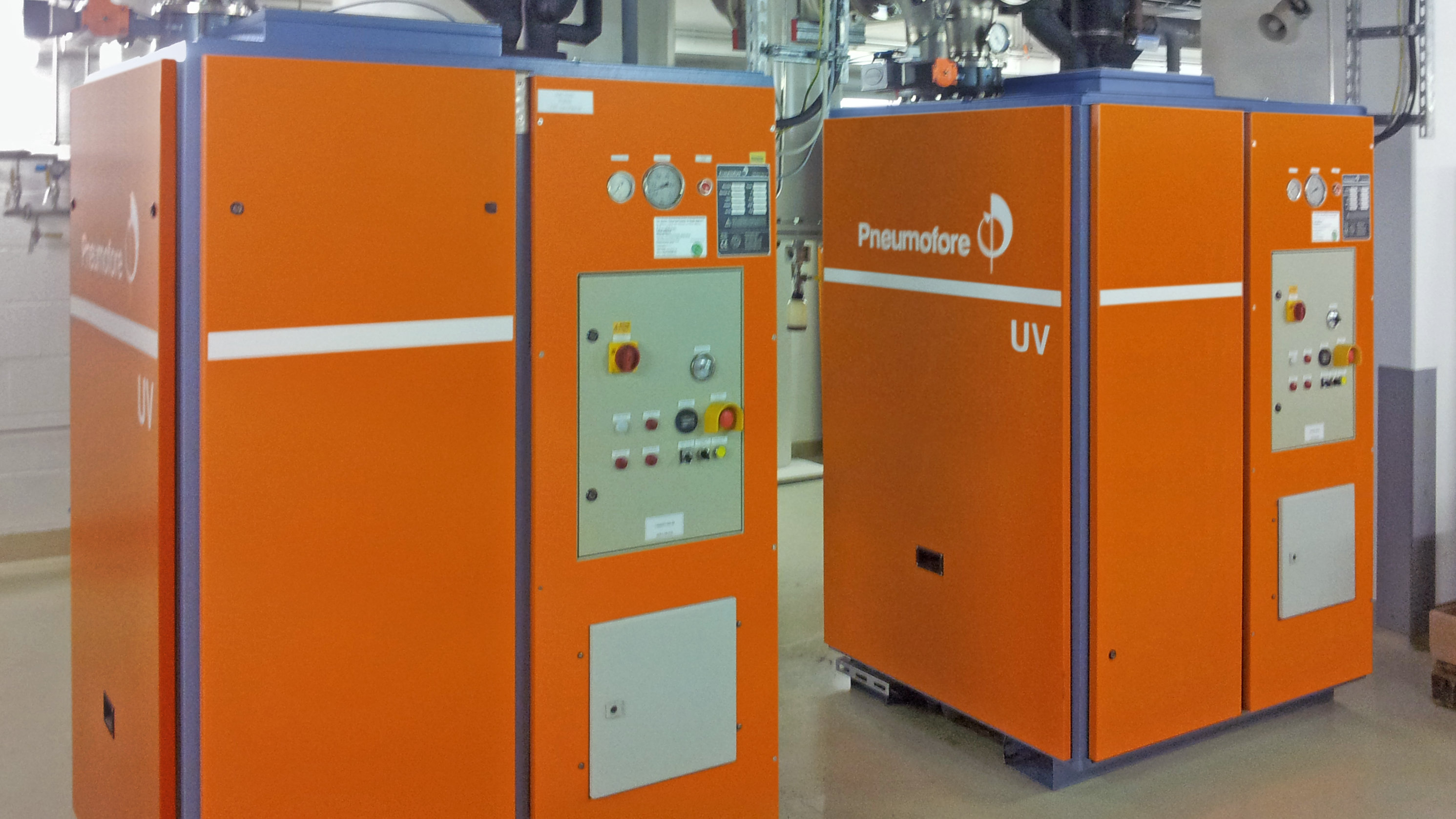
At that time, the choice fell on Pneumofore's rotary vane pumps, despite a higher initial investment. The decisive factor was the company's focus on energy efficiency, underlined by extended warranty conditions and measurable savings in power consumption. These criteria could not be met by competitors, according to the Italian manufacturer. The long-term perspective of this approach has been confirmed: The UV16 vacuum pumps installed in 2004 will run trouble-free until 2025, with no discernible loss of performance.
The UV vacuum pumps are designed vertically and are therefore space-saving and easily accessible for visual inspections and maintenance work. As the intake air is clean, particle-free and free of aggressive gases, one maintenance per year is sufficient. The closed coolant circuit keeps the unit at a low operating temperature, while the direct drive of the electric motor on the rotary vane unit enables a slow rotation speed of 1,450 rpm at 50 Hz, which extends the service life of the ball bearings to more than two decades of continuous operation.
With the expansion of production at Infineon, the need for rough vacuum technology also grew. Two more UV16 vacuum pumps were installed in 2013. Scheduled maintenance and the exclusive use of original spare parts have ensured the long-term performance of the vacuum pumps. Continuous availability is a decisive factor in semiconductor production, not only from an operational perspective, but also in terms of energy efficiency and CO₂ reduction.
Rough vacuum pumps technically enhanced
Additional UV16 units were needed again in 2022 and 2023. Pneumofore was again the first choice based on experience. However, the new units were technically enhanced and adapted to the increased requirements. This included a speed-controlled drive with frequency converter, water cooling and a harmonic filter in the control cabinet to reduce electromagnetic interference. This meant that the vacuum pumps were no longer regarded as peripheral support equipment, but as an integral part of a precisely coordinated production environment.
A further step was the integration of monitoring systems. The operating data of each vacuum pump is transmitted in real time via a PLC to the central control station. This allows efficiency parameters to be monitored, settings to be adjusted remotely and the vacuum setpoint to be precisely adjusted. This networking creates the basis for a process with precision, flexibility and operational reliability.
Today, Infineon operates a total of twelve UV16 vacuum pumps with a combined flow rate of around 12,000 m³/h at its Dresden site. Some of the units have been in continuous operation for over two decades, demonstrating the durability, robustness and efficiency of these units.