


Just under 60 percent. That’s how full Germany’s natural gas storage facilities were on October 10, 2026. A year earlier, the fill level at the same time was still around 76 percent; in 2024, it was even just under 97 percent. Germany is thus beginning the heating season with minimal reserves—of all times, during a phase in which geopolitical risks to the international energy supply are once again intensifying.
At the start of the storage season in April 2026, gas storage facilities across the EU were only about 28 percent full. At the same time, high gas prices and the at times unattractive spread between summer and winter prices have weakened the economic incentives for refilling the storage facilities. For its part, the government has reduced the statutory storage requirements compared to the crisis years and apparently places its trust in market-oriented decision-makers.
A normal winter could become a problem
The winter outlook published on October 8 by the European gas network association ENTSOG makes it clear that even with average winter temperatures and favorable LNG availability, European storage levels will drop to about 29 percent by the end of March 2027. In the event of a mere 20 percent fluctuation in consumption or supply, this figure would drop to just 13 percent under the corresponding scenario. If several unfavorable factors converge—for example, a surprisingly cold winter—ENTSOG estimates, depending on LNG availability, a potential unmet demand or required consumption reductions of about seven to twelve percent.
A cold winter alone, therefore, does not necessarily mean a gas crisis. Conversely, with limited import volumes, even normal winter conditions can reduce reserves to such an extent that supply comes under pressure again the following year. In addition, as storage levels at many facilities decline, the technically feasible daily withdrawal rate also decreases. A prolonged cold spell in February or March, in particular, could therefore become critical.
Geopolitical risks are growing—reserves are not
The recent escalation between Saudi Arabia and the Iran-backed Houthi rebels—which once again jeopardizes key international trade and energy transport routes—demonstrates how risky it is to have to rely on sufficient LNG supplies.
The German chemical industry demonstrates that the consequences of an unreliable and expensive energy supply do not begin only when actual supply disruptions occur. Production of key chemical raw materials in Germany has now fallen back to 1990s levels.
To be fair, this slump cannot be attributed solely to energy policy. Nevertheless, in addition to regulations governing energy-intensive raw materials, gas and electricity costs are a key location factor.
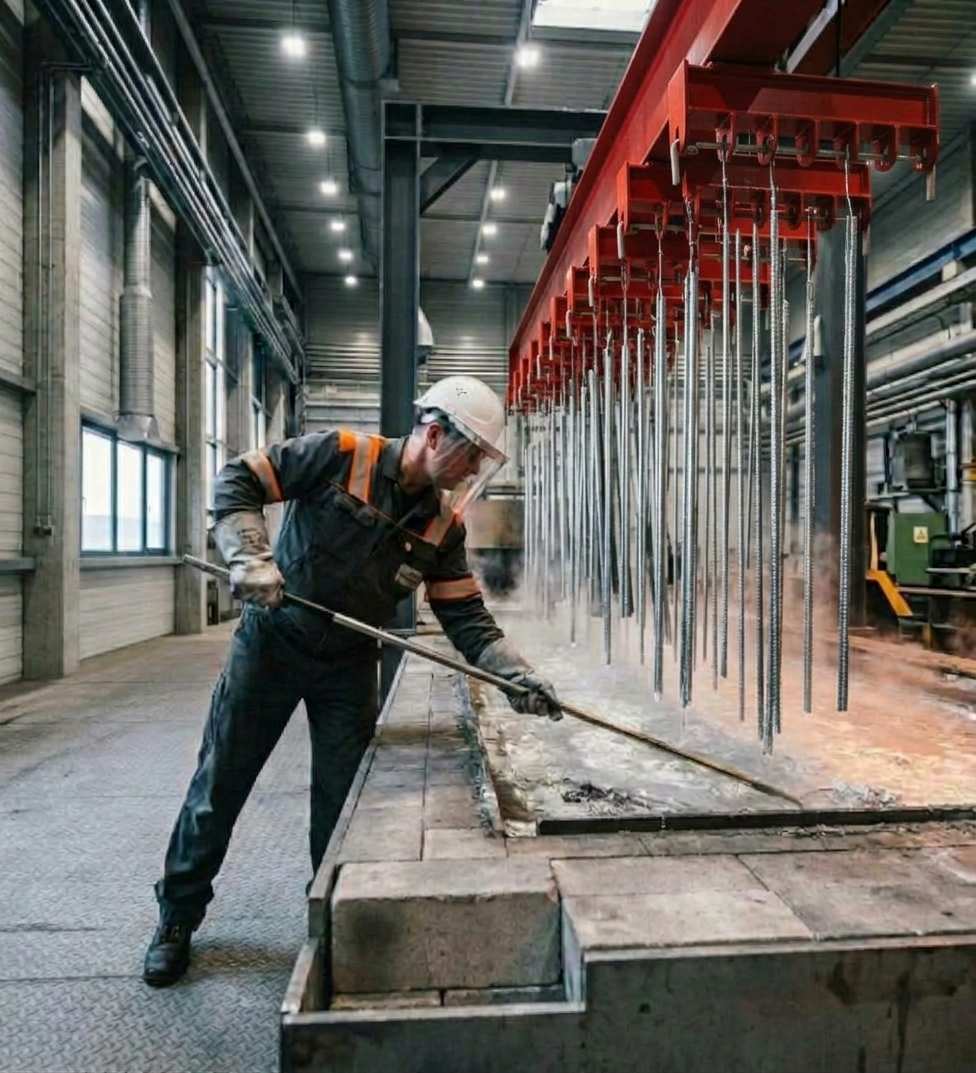
For the surface treatment industry, this is not an abstract problem. In hot-dip galvanizing plants, molten zinc must be continuously maintained at around 450 degrees Celsius. Electroplating facilities require substantial amounts of electrical energy, while paint and powder coating plants rely on a reliable heat source for drying and curing processes. Numerous companies are also dependent on chemical precursors, the production of which is energy-intensive.
A further increase in energy costs—and possibly even a shortage of energy—would be yet another escalation that would plunge not only companies in the surface treatment industry into serious distress.
Energy Policy Without a Sufficient Safety Margin
The Federal Network Agency nevertheless assesses the current gas supply as stable and currently considers the risk of a supply crunch to be low. This assessment must be taken seriously. However, it answers only some of the crucial questions.
After all, an adequate supply of gas is not synonymous with an economically competitive energy supply. And a supply system that functions under normal conditions is still far from having sufficient reserves to cope with extraordinary strains.
This is precisely where a fundamental shortcoming of German energy policy becomes apparent. The expansion of renewable energy, the electrification of industrial processes, new gas-fired power plants, hydrogen infrastructure, and the phase-out of fossil fuels are proceeding largely in an uncoordinated manner, supported by political measures—some more helpful than others—designed to bolster the regulatory mechanisms of the free market. At present, political discourse is dominated by wishful thinking rather than concrete, fully developed action plans. The security of the energy supply and the resulting energy prices therefore depend, to a not insignificant extent, on chance. At the same time, companies are expected to remain internationally competitive and to finance substantial investments in the energy transition.
This may work. It is simply not a particularly robust strategy for a highly industrialized economy. What is particularly concerning is that Germany is not taking on these risks from a position of economic strength. Energy-intensive industries have already suffered significant production losses, while numerous small and medium-sized enterprises have been struggling with high costs and weak demand for years.
The real danger, therefore, lies not solely in a potential gas shortage this coming winter. It lies in the fact that with every passing year of inadequately coordinated energy policy, industrial capacity is lost—a loss that will be nearly impossible to recover later.
Germany still has a strong industrial base. However, policymakers should not take it for granted that it will continue to function despite these conditions.