
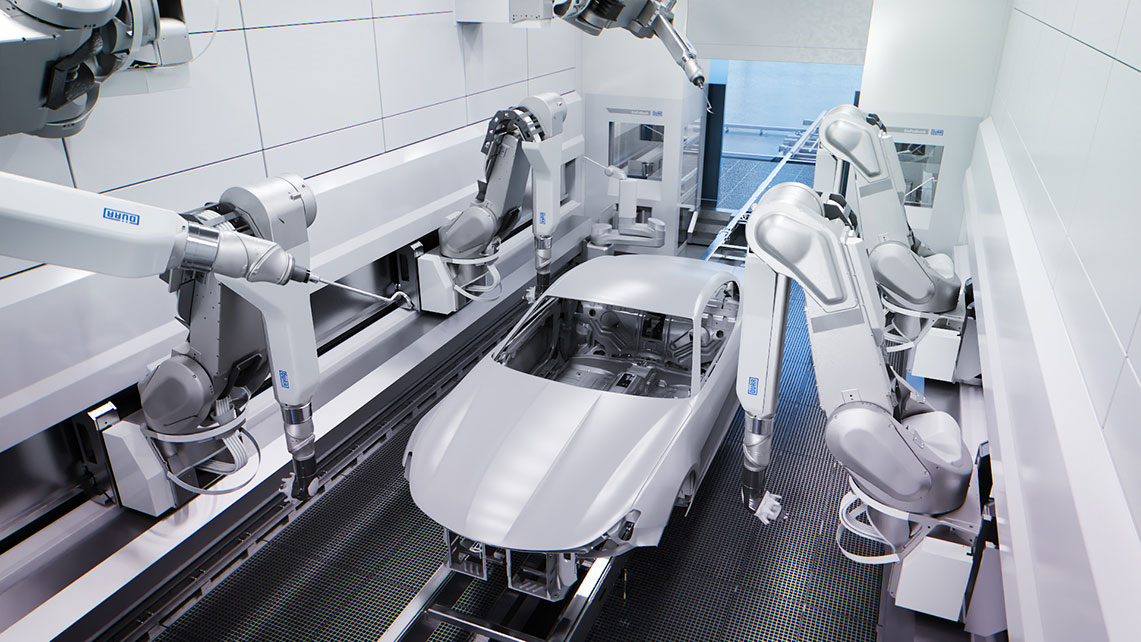
Until now, there was no alternative in large-scale automotive production to having body shells enter the paint shop strung on a skid like a string of pearls and then leave the paint shop after numerous stations in the same order. Any deviation from the standard sequence of processes costs a considerable amount of time, productivity - and usually also investment in additional conveyor technology. When it comes to coating a large number of products that are very similar, such a rigid production line is unbeatably efficient.A few decades ago, for example, almost ideal series production was achieved in the automotive industry because car manufacturers offered one or at most two body variants of a model. They even took advantage of the opportunity to reduce the number of color changes by pre-sorting the bodies by color. Those days are long gone, however, and not only has the number of body variants multiplied since then, but customer demand for individualization in both the interior and exterior is growing unabated. In addition, the structural shift toward e-mobility is driving the variety of models even higher. As a result, the conventional concept of a paint line is increasingly becoming a balancing act between the suitability of variants and cost efficiency. It can therefore be assumed that flexible, intelligently networkable and scalable process modules will play an increasing role in future paint shop layouts. Dürr demonstrated what such a concept might look like at its virtual openhouse event at the end of 2021 using a virtual model in which visitors were able to move around inside a paint shop in a similar way to a computer game.
Parallel and flexible instead of serial and rigid
"Flexibility, cost efficiency and sustainability are the most important requirements that manufacturers place on the painting process today. We meet these with our concept of the paint shop of the future by overcoming the limitations of the rigid production line. The approximately 120 work steps run in scalable modules or small sections - in parallel and precisely timed to meet the needs of the individual car body," explained Jochen Weyrauch, CEO of Dürr Systems AG. This means that capacities can be expanded without major rebuilding measures and even a wide variety of vehicle variants can be fed through the painting process - even individual pieces within ongoing production.
Read more about the new concepts for the modern paint store in the March issue of Surface Technology magazine or online right here