
Structural change in the paint shop
More flexibility, alternatives to the rigid line concept and more individuality in th paintshop
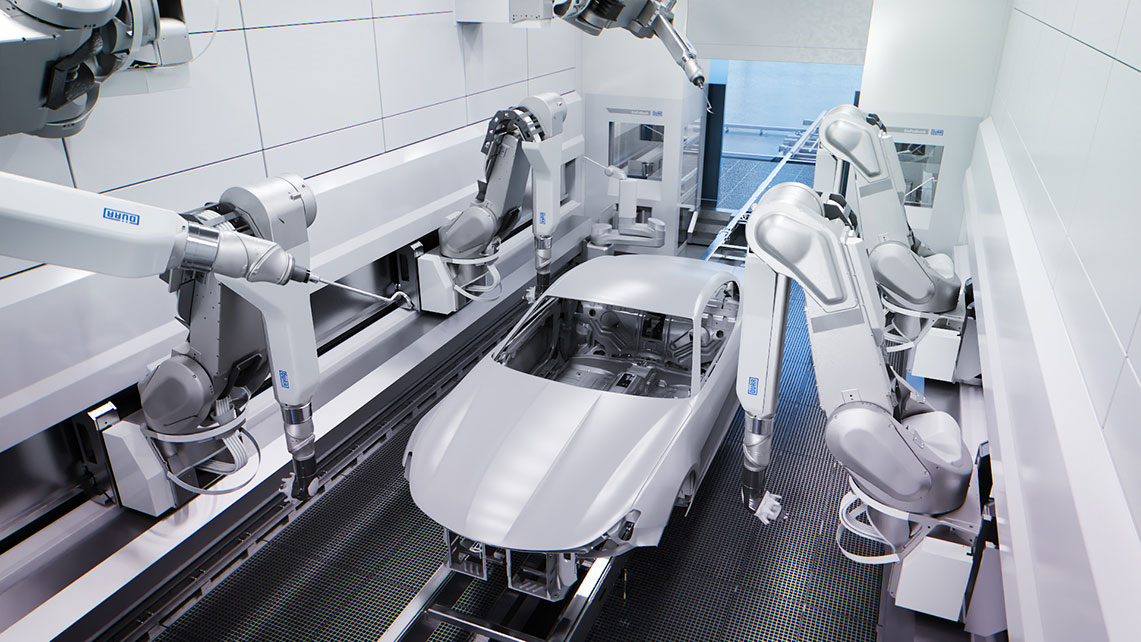
Until now, there was no alternative in large-scale automotive production to having body shells enter the paint shop strung on a skid like a string of pearls and, after completion of the painting process and after numerous stations, leave the paint shop in the same order. Any deviation from the standard sequence of processes costs a considerable amount of time, productivity - and usually also investment in additional conveyor technology. When it comes to coating a large number of products that are very similar, such a rigid production line is unbeatably efficient.A few decades ago, for example, almost ideal series production was achieved in the automotive industry because car manufacturers offered one or at most two body variants of a model. They even took advantage of the opportunity to reduce the number of color changes by pre-sorting the bodies by color. Those days are long gone, however, and not only has the number of body variants multiplied since then, but customer demand for individualization in both the interior and exterior is growing unabated. In addition, the structural shift toward e-mobility is driving the variety of models even higher. As a result, the conventional concept of a paint line is increasingly becoming a balancing act between the suitability of variants and cost efficiency. It can therefore be assumed that flexible, intelligently networkable and scalable process modules will play an increasing role in future paint shop layouts. Dürr demonstrated what such a concept might look like at its virtual openhouse event at the end of 2021 using a virtual model in which visitors could move around inside a paint shop in a similar way to a computer game.
RFID technology prevents errors during maintenance
Whether in the bell disk, in the steering air ring, in the turbine or in the atomizer, RFID technology helps the new atomizer generation to improve processes directly in the paint booth and in maintenance. The transponders used by Dürr make it possible to store operating data directly on the components and to clearly track components and their operating cycles. The useful life of components can thus be optimally exploited and maintenance times can be planned in advance. Typical sources of error, such as incorrectly assigned bell disks or steering air rings after a cleaning break, can also be eliminated in this way. This is because the system detects the incompatible component and warns the operator even before the painting process starts. This increases system availability and the first-run rate. Another helpful feature is a vibration sensor integrated in the robot, which detects imbalances on the bell disk and turbine before they lead to damage. Availability is also increased by a new robot protective stocking with a patented mounting concept that reduces contamination so that painting can continue for at least four hours without having to clean the atomizer.
Parallel and flexible instead of serial and rigid
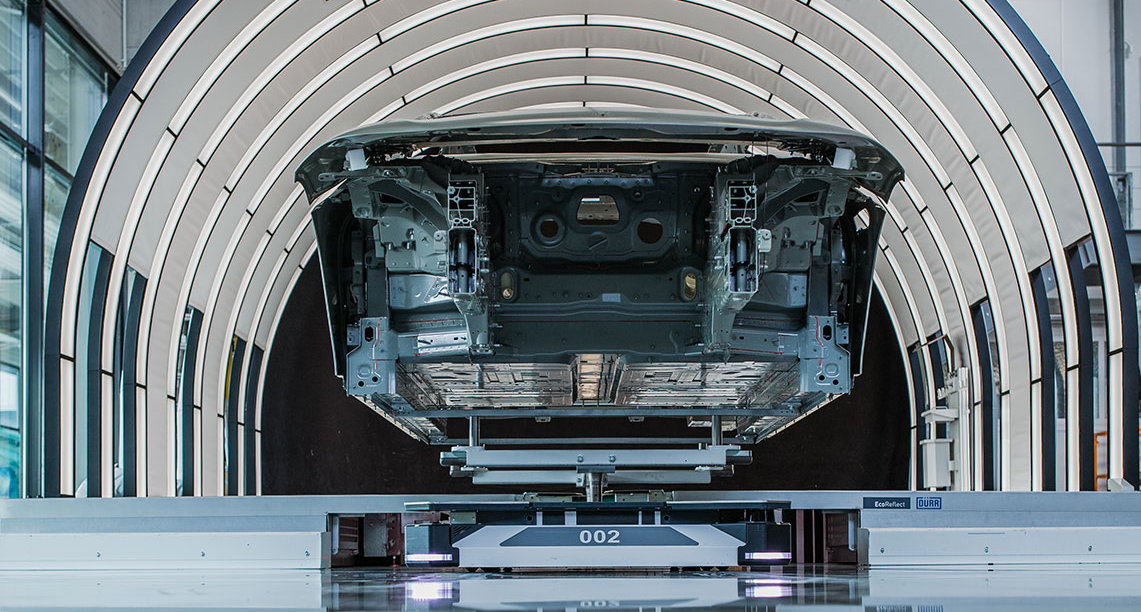
"Flexibility, cost efficiency and sustainability are the most important requirements that manufacturers place on the coating process today. We meet this with our concept of the paint shop of the future by overcoming the limitations of the rigid production line. The approximately 120 work steps run in scalable modules or small sections - in parallel and precisely timed to meet the needs of the individual car body," explained Jochen Weyrauch, CEO of Dürr Systems AG. This means that capacities can be expanded without major rebuilding measures and even a wide variety of vehicle variants can be fed through the painting process - even individual pieces within ongoing production. An important role in linking the individual stations is played here by the EcoProFleet driverless transport system, which has already been tested in practice and is the first AGV (Automated Guided Vehicle) developed specifically for paint shops. In combination with a high-bay warehouse, the AGV enables intelligent material flow control along the entire process - without the need for conventional routes with countless rollers, drive motors and corresponding maintenance effort. What's more, AGVs that fail unexpectedly can be replaced quickly without bringing production to a standstill. By contrast, a defect in the conveyor system in a conventional painting line - if repair is not possible quickly enough - inevitably leads to a plant stop.
Reducing conveying operations
The new box layout of the EcoProBooth paint booth is ideally suited to a line concept in which the car bodies are transported by AGV. This is because the application of the primer and basecoat coats - both the inside and the two outside coats - can be combined in just one booth. This eliminates the need for two of the three conveying operations previously required in standard solutions. In addition, the EcoProBooth can be used as a standard booth with the same robot equipment for both basecoat and clearcoat - for a wide variety of car bodies from compact cars to pickups.
Artificial intelligence in the paint shop
Particularly in modular paint store concepts, the smooth interaction of the individual processes is of decisive importance, and Dürr ensures this with the DXQ software family. An important tool in this context is DXQplant.analytics, which uses AI algorithms and machine learning modules to provide and specifically evaluate sensor data, messages and information. This supports those responsible for quality in identifying correlations at an early stage in order to avoid errors and increase the first-run rate. A feedback function means that the algorithm is constantly learning, so that predictions about maintenance requirements (predictive maintenance) or quality status (quality prediction) become increasingly precise.
Atomizer - rethought
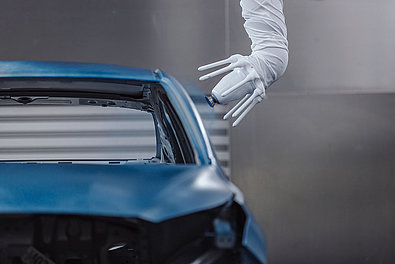
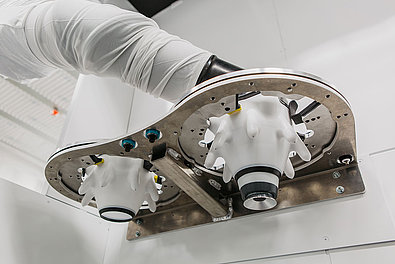
To further optimize the box concept, Dürr has developed a new atomizer, the EcoBell4, which is suitable for both interior and exterior painting. This is the only way to fully exploit the potential of the EcoProBooth paint booth - because it allows all painting tasks to be performed with the EcoBell4 Pro Ux variant in just one box. With one and the same bell cup/steering air ring and exterior charging system, it is possible to apply both interior, exterior and metallic paints (Bell/Bell process) without any qualitative disadvantages. The atomizer can focus the spray jet appropriately for work on the interior of the body and efficiently paint larger areas on the exterior with wide spray jets. A notable innovation is also the patented, laydownable and efficiency-enhanced external charge, which can be combined individually within the Pro series. Instead of losing cycle time during atomizer cleaning, dirty electrode rings can simply be put down and exchanged for a clean one in a maintenance box, a so-called service cubicle - without the system having to stop. Since these small maintenance boxes are flushed with fresh air, it is permissible to enter them during the painting process. In addition, the Ecobell4 uses a new 4-main-needle technology, allowing the patented system to perform color changes on up to four high-runner colors in just four seconds each. Everything from 4x 1K basecoat to 3x 2K clearcoat solutions - and all combinations in between - are possible. In addition, the shortened rinsing paths reduce paint and rinsing agent losses - according to Dürr, they are lower than with any other atomizer available on the market.
RFID technology prevents errors during maintenance
Whether in the bell disk, in the steering air ring, in the turbine or in the atomizer, RFID technology helps the new atomizer generation to improve processes directly in the paint booth and in maintenance. The transponders used by Dürr make it possible to store operating data directly on the components and to clearly track components and their operating cycles. The useful life of components can thus be optimally exploited and maintenance times can be planned in advance. Typical sources of error, such as incorrectly assigned bell disks or steering air rings after a cleaning break, can also be eliminated in this way. This is because the system detects the incompatible component and warns the operator even before the painting process starts. This increases system availability and the first-run rate. Another helpful feature is a vibration sensor integrated in the robot, which detects imbalances on the bell disk and turbine before they lead to damage. Availability is also increased by a new robot protective stocking with a patented mounting concept that reduces contamination so that painting can continue for at least four hours without having to clean the atomizer.


Overspray-free painting - the next generation
Contrasting colors on roof surfaces or A- and C-pillars, stripe designs or intricate elements such as lettering: Customers' demands for design and individuality in automotive production are rising inexorably. Contrast coatings are to be applied flexibly with different colors and types of paint to diverse, even vertical surfaces, without having to change the body design or hinder the production process. On top of this, production costs and resource consumption are to be kept low. To this end, Dürr has further developed its EcoPaintJet into the Pro version. Up to now, contrast roof painting with the EcoPaintJet has already been the first series application of overspray-free paint application in the automotive industry. Now, with the further developed Pro version, it is also possible to paint very complex body surfaces, such as vertical surfaces or A- and C-pillars, and to apply individual design elements - masking-free and fully automatically. The heart of the new application technology is the EcoPaintJet Pro applicator, which uses dozens of barely visible individual nozzles with a diameter of around a tenth of a millimeter to direct parallel jets of paint onto the car body from a distance of up to 25 millimeters. In the process, 100 percent of the paint lands on the surface without loss, and two-tone paint jobs without masking are possible more quickly and conserve resources. The fact that the nozzles can be closed and opened independently of each other in a fraction of a second opens up completely new design possibilities. These include the application of decorative stripes or contrasting colors. The EcoPaintJet Pro also creates a direct transition between two-dimensional coating and patterns.
Fast color changes without waste
The design of the applicator also prevents paint from being deposited in critical areas - crucial for fast, low-loss changes between two color tones. This feature is also important when processing 2K coatings, because the smallest residues would inevitably clog the fine nozzles permanently. To ensure coating quality, the applicator head cleans itself regularly in the EcoPaintJet Cleaner, which carries out all cleaning and rinsing processes in a closed system, thus preventing any emissions into the booth. Both solvent-based and water-based 1K and 2K paints can be processed. The complex geometries of the body parts to be painted, as well as the high precision required by the process, place the highest demands on the 3D measurement and programming of the robot paths. Therefore, DXQ3D.onsite supports the operators in configuring the process parameters and the software automatically calculates the painting paths. Before painting, an initial measurement detects any inaccuracies in the conveyor system or body shell. A second sensor mounted on the robot measures the deviation of the car body to be painted from the reference sample in the range of a few tenths of a millimeter.

Highest precision in measurement and application
The robot control system then adjusts the coating paths in real time. After a fully automatic check of the beam pattern, the speed and tilt angle of the applicator are controlled in the coating process so that the paint is always applied evenly and no overspray occurs. Despite the highly complex control system, the electronics take over all critical processes. Not only in new plants, but also in existing plants, the EcoPaintJet Pro offers automotive manufacturers the option of integrating overspray-free applications. Various options are available for this, suitable for different positions in the paint sequence. For example, the contrast coating can be applied both on top of the intermediately dried basecoat and as a single-layer topcoat on top of the baked clearcoat. Overall, such a masking-free two-tone coating has a much lower space and energy requirement than a comparable conventional two-tone line. Calculations show energy savings of up to 32 percent. This can save up to 33 kg of CO2 per body. In addition, without overspray, paint separation is not necessary, at least in this application step, and the rest of the body does not have to be masked with film, so large quantities of waste are saved. What's more, throughput times are reduced and, compared with other multicolor processes, better utilization of the paint shops can be achieved. "Printing instead of spraying is the future of automotive painting," Dr. Lars Friedrich, President & CEO Application Technology Dürr Systems AG, is certain. "Even with vertical surfaces, we can do without overspray and masking altogether. In terms of cost efficiency and sustainability, Dürr has thus taken another step in the right direction with the EcoPaintJet." The new process is currently being integrated into production at a renowned Bavarian automobile manufacturer and is scheduled to be used in series production in the second half of 2022. The renowned plant manufacturer has thus developed important technologies for future challenges in the automotive industry and made them suitable for series production.
► Dürr Systems AG ► www.durr.com