


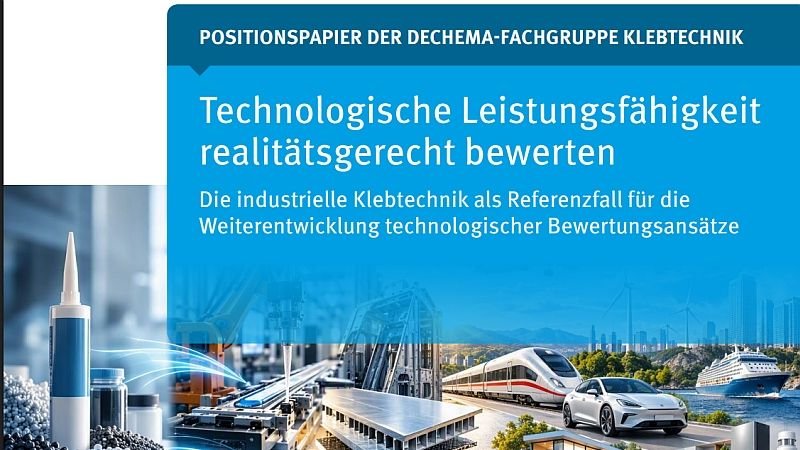
The DECHEMA Adhesive Technology Division calls for technological evaluation criteria to be aligned more closely with the final state and the performance within the application system. This call stems from a recent position paper that, using adhesive technology as an example, highlights what the technical group views as a systematic weakness in existing regulatory and administrative evaluation approaches: Often, the focus is on the properties of the raw materials, while the transformation during the process and the function of the finished system are given insufficient consideration.
Particularly in the case of adhesives, this perspective leads to a narrow assessment. The evaluation primarily focuses on the flowable adhesive before processing and thus on its material composition. Adhesive technology is thus treated primarily as a “chemical issue.” After processing, however, an adhesive bond with different properties and functions is formed, which only achieves its technical performance in interaction with the bonded components.
Consider the Final State Within the System
In the expert group’s view, it is therefore insufficient to evaluate technologies solely on the basis of their initial state. The position paper states that existing evaluation frameworks must be expanded so that they “systematically take into account not only the raw materials but also process control, transformation, the final functional state, and the effect within the application system.” Only then would different joining methods and other transformation-based technologies be more appropriately comparable.
The expert group points out that with other technologies, such as welding or fiber-reinforced composites, the focus is more strongly on the finished workpiece. For adhesive bonding and comparable processes, however, the current logic could lead to technological contributions being underestimated. Lightweight construction, energy efficiency, and the circular economy are specifically mentioned.
Implications for Regulation and Innovation
From the experts’ perspective, such an underestimation could lead to misguided decisions in regulation, funding, and the setting of industrial policy priorities. If the technological performance of the final state is not adequately assessed, this could weaken innovative capacity and result in competitive disadvantages.
The DECHEMA Technical Group therefore does not call for a departure from existing safety standards, but rather for a broader basis for assessment. The testing of hazardous substances, as well as occupational safety, environmental protection, and health protection, remains indispensable. However, the manufacturing process, the final state of the product, and its impact on the overall product should also be factored into the assessment.
The Adhesive Technology Technical Group organizes conferences and symposia, supports collaborative industrial research, and promotes the transfer of information and technology. Together with DVS and IVK, it is also committed to education and continuing education, as well as to promoting training in the natural and engineering sciences in the field of adhesive technology.