
Managing Director Joachim Wolf is now the third generation to run the Austrian family business Wolf Nudeln, based in Güssing (Burgenland). The fourth generation, his two sons, is already waiting in the wings. The company's roots go back to 1890, when the Wolf bakery was founded. In 1956, pasta production began in the bakery with the first variety: the fine, thin golden threads that are still used today as a soup topping. The company processes around 5,500 tons of pasta a year in three-shift operation with 50 employees, five days a week. Production is completely CO₂-neutral: the company's own biogas plant covers its entire energy requirements and is powered by maize, green waste from its own farm and residues from its own poultry farm. The manure comes from an egg production facility that has been supplying the company with eggs since 1968. Sustainability is firmly anchored in the company's philosophy: Wolf Nudeln relies on 100% Austrian raw materials such as durum wheat semolina and spelt as well as completely paper-based packaging. The company sells 90% of its products through Austrian food retailers and also supplies catering businesses directly.
Vacuum for flour conveying and dough production
In production, vacuum pumps are used in two processes: firstly, cereals such as spelt, semolina and durum wheat are sucked in and processed via seven flour suction lines. Secondly, the vacuum pumps ensure controlled oxygen reduction during dough production in seven dough pans. The vacuum also preserves the color of the pasta - a quality factor, especially when processing fresh eggs.
In the past, Wolf Nudeln relied on eight liquid ring vacuum pumps to operate the dough pots, which in this application were associated with comparatively high water consumption, increased humidity and a considerable amount of maintenance. The pumps were housed in a technical room with an open water basin, which made the system susceptible to calcification and occasional malfunctions. Regular cleaning and weekend water changes were necessary. Water cooling was also required, which increased the use of energy and resources. The company relied on compressed air technology for the flour vacuum cleaners. This was often clogged with flour dust, which caused the systems to break down and required extensive cleaning.
Start with two vacuum pumps for the dough pans
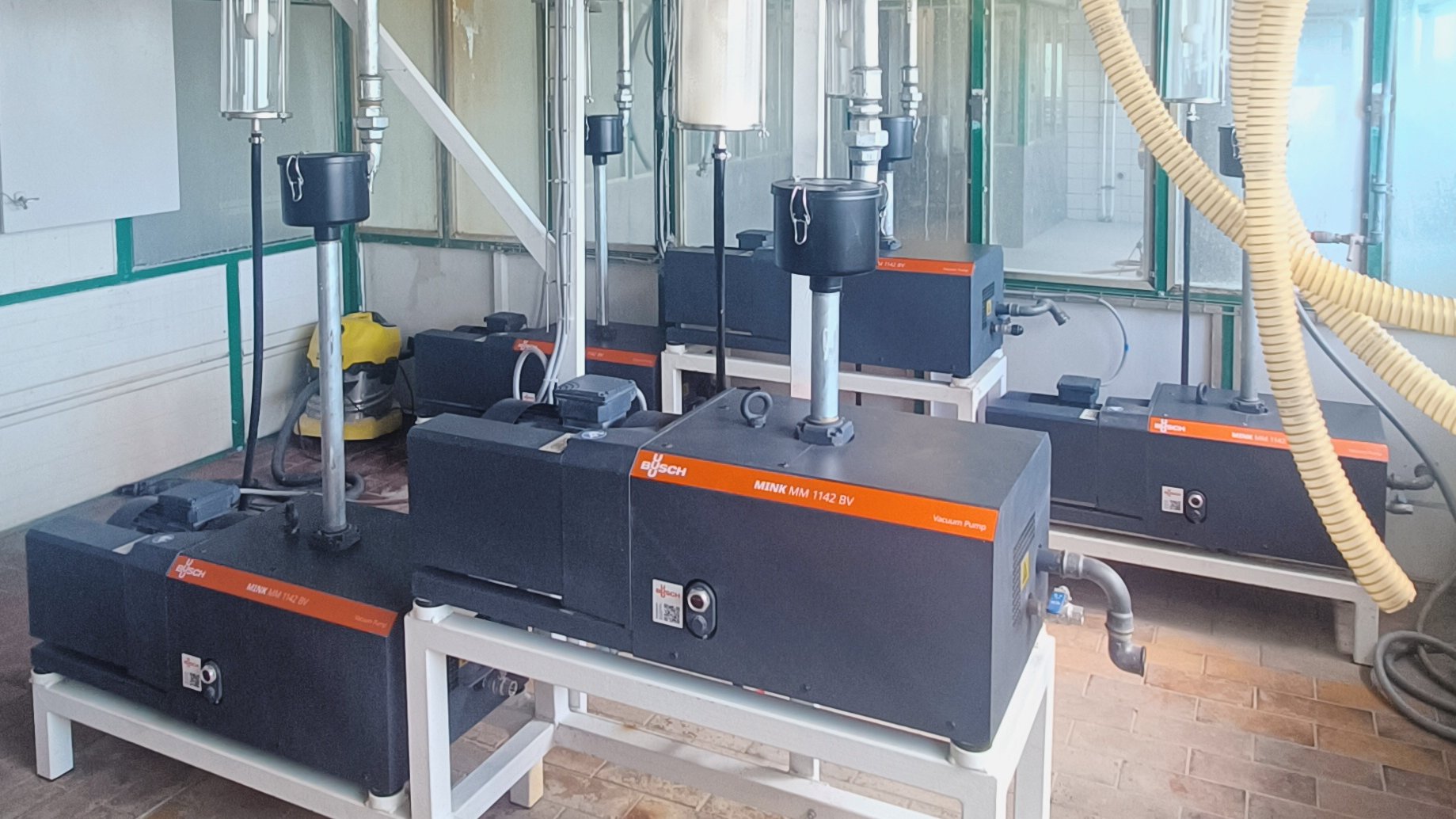
Joachim Wolf became aware of Busch through a specialist article in an industry magazine - and got in touch, as the vacuum pump manufacturer reports. At the beginning of 2020, the company started a test run with two Mink MM 1142 BV claw vacuum pumps in the area of dough pans. Each of these units offers a nominal pumping speed of 140 m³/h and can reach a final pressure of 60 mbar. The sound pressure level, measured at a distance of 1 m, reaches 75 dB(A) at medium load.
During operation, the residual moisture in the application made it necessary to switch to the Aqua version of the pumps, which is better suited to humid environments. In addition, two filter systems were added to the two vacuum pumps: an LSA 0003 filter prevents water from being sucked in, while a FIL 0100 polyester filter retains flour particles and thus ensures that no dust gets into the pump.
Vacuum pump system expanded after a few years
After positive experiences, the system was successively expanded. In 2024, five more Mink MM 1142 BV claw vacuum pumps with identical equipment were added. The new system now comprises seven vacuum pumps, which are located in a separate technical room: Two are used for the flour siphons and five for the oxygen extraction from the dough pans. Thanks to an intermediate vacuum buffer, the lines can now even be operated in standby mode, which increases energy efficiency. The pumps are used at a final pressure of 70 to 100 mbar, with a power consumption of 3.5 kWh (50 Hz) per pump.
A further advantage: by placing the central system in the separate technical room with active ventilation, the temperature in the room does not reach more than 40 °C. The system is quiet in operation, more hygienic and low-maintenance, according to the press release. Both filters are easy to clean.
New vacuum pumps offer greater reliability
"I am very satisfied with the vacuum pumps," says Joachim Wolf happily: "There have been no problems since the company has been using the Busch units. Operating costs have fallen, and water consumption, humidity and maintenance costs have also been reduced. Whereas there used to be several pump failures per year, the system now runs stably. At the same time, the current system makes it possible to switch to a replacement pump at any time without interrupting production.
Wolf Nudeln is also planning to switch to Busch technology for packaging in the future. A dry-running Seco SV rotary vane vacuum pump with vacuum regulation unit and suction filter is to be used in a flow-wrapping machine to keep the packaging stable during the filling process. In order to extend maintenance intervals, reduce operating costs and avoid downtimes, the company relies on oil and filter material from Busch for the seven existing vacuum pumps.