
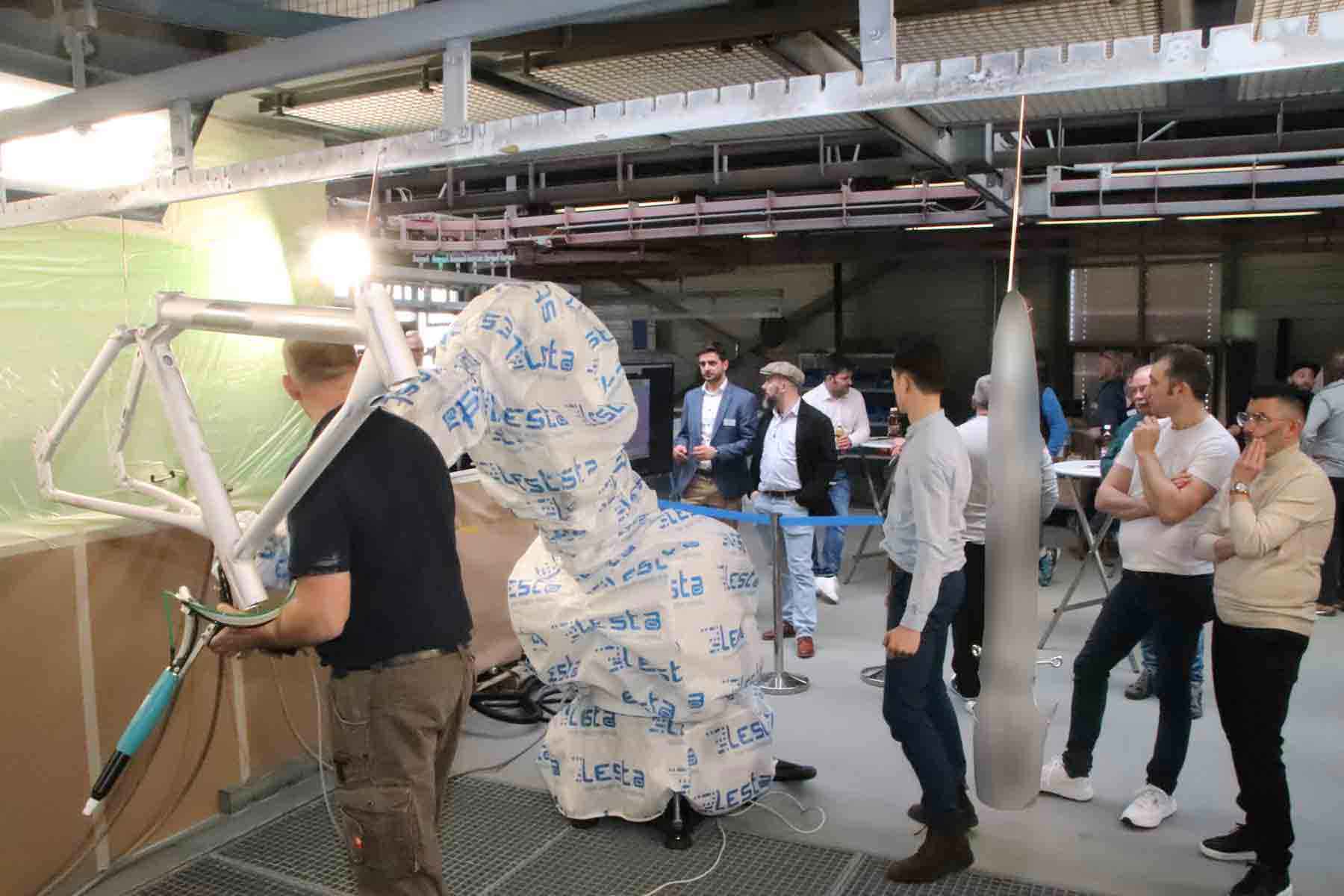
ÂAlso Alexander Pätzold, the CEO of passt Coating AG, a contract coater in Nunningen (Switzerland) was on site. In view of the above problem, he had already been inspired last year to implement an automation solution with two robots for his company and is now convinced, after several months of robot operation, that he made the right decision. This is how the idea of a "Meet the Robot Date" was spontaneously born in Dresden - at passt Coating. Interested users should not only be able to inspect a powder coating application in operation by robot, but also to carry out their own teaching trials. The response that followed the announcement of the meeting came as a pleasant surprise to the organizers, and on March 9 around 30 people interested in robots actually turned up in Nunningen. After a short introduction, in which Alexander Pätzold also referred to the turbulent founding history of passt Coating, including the challenges posed immediately afterwards by the Corona pandemic, the participants went to the powder coating line. There, the participants took a close look at the robot application with great interest. After a few selected presentations on non-contact coating thickness measurement, current developments in the field of powder coating as well as plant engineering and application technology, the participants went to the provisionally equipped technical center, where a coating robot was waiting. In the version of the Lesta robot set up by K.Lips, the robot, which is relieved of pressure by compressed air, is guided along the desired painting path by the operator together with the gun and records the movement so that the robot can then repeat it. It became clear that teaching with a robot that is weight-relieved but not massless and friction-free requires a certain amount of strength and practice. Since the Coatmaster Flex was also available as a measuring device for non-contact coating thicknesses, many participants took advantage of the opportunity to directly check the thickness of the coatings applied during teaching at critical points and then directly start an optimization test. Since the robot control system offers the option of accelerating or decelerating the traversing speed of the robot by up to 50 percent, both excessively thin and excessively thick layer thicknesses can be compensated for within certain limits - as can changes in the conveying speed.
Even very complex parts such as impellers for radial fans were successfully powder-coated during the trials, although here it was less the geometry than the improvised suspension with conventional hooks that proved to be a challenge - something that would naturally be solved differently in regular production.
Overall, the event showed that robotic automation with a simple teaching process can also be advantageous for powder coaters with many different parts, especially because manual pre- and post-coating can either be completely eliminated or at least significantly reduced. Even more, the targeted application results in a high initial application efficiency compared to a classic automatic booth. Together with an interesting financing or leasing concept, there are many good reasons for contract coaters to at least intensively examine such an automation solution. Further below you will also find a video about the event.
Read more about the impressive entrepreneurship from the managing director of passt coating and the implemented robot application in the April 2023 issue of Surface Technology Magazine or soon online at oberflaeche.de.