

From old to new
ReUse projects combine existing plant components with new components to create modern and cost-effective solutions. Holger Schmidt, Managing Director of SEH's Ostrhauderfehn site: "However, it requires careful and precise planning as well as a high degree of flexibility in the preparation and manufacture of components."
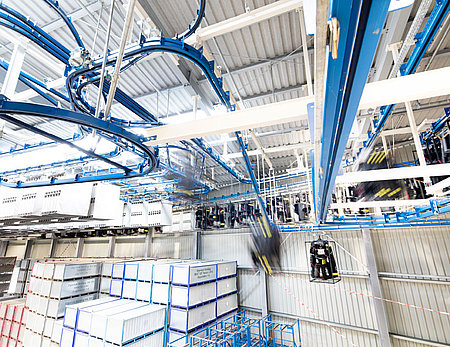
ReUse is possible for many types of conveyor technology, regardless of whether they are electric overhead conveyors, cardan or plug-in chain conveyors, or floor conveyor technology. SEH relies on in-house engineering and manufacturing for successful implementation. "For ReUse projects, we professionally dismantle existing plant components and record the dimensions and condition of all conveyor technology components," clarifies Holger Schmidt. An individual assessment of all dismantled components with regard to their reusability is then carried out at the plant. "We can often refurbish, adapt and reuse a large part of the components. This is what happened, for example, with the renewal of a power-and-free cardan chain conveyor in the automotive sector: we incorporated almost 90 percent of the old system components into the new solution. In this way, we developed an ultra-modern system that complies with the latest safety and control technology specifications with up-to-date CE marking. Our customer benefited from a cost advantage in this project that was more than 25 percent."
In each project, SEH implements very individual solutions according to customer requirements and, for example, manufactures conveyor rails, switches and lifting stations flexibly according to requirements. In order to integrate a ReUse system back into the existing hall environment with a perfect fit, SEH relies on innovative predictive engineering planning processes. Dimensional surveys are carried out with a 3D scanner that digitally records the real hall environment with all interfering factors. Using modern 3D CAD programs, the employees design the new plant and place it in the scanned hall environment on the screen via virtual reality and augmented reality.
In the case of particularly complex reuse projects, SEH first checks the functionality and cost-effectiveness using test plants. "Of course, the complexity of the plant and the customer's requirements also play a role in such special projects. But in the past, we have already been able to develop projects of this type within a very short time and successfully commission them at the customer's site," says Holger Schmidt.
As early as the engineering phase, SEH monitors structural deviations in the hall stock with the digital malfunction detection system, Clash Detection. These are thus detected at an early stage and already taken into account in the layout design. The fine interplay between planning and production results in conveyor systems that are particularly economical, energy-efficient, and low-maintenance.
► SEH Engineering GmbH► www.seh-engineering.de