

Safekeeping for hazardous substances
Mit einem zertifizierten Lagermodul Risiken und Unsicherheiten aus dem Weg räumen
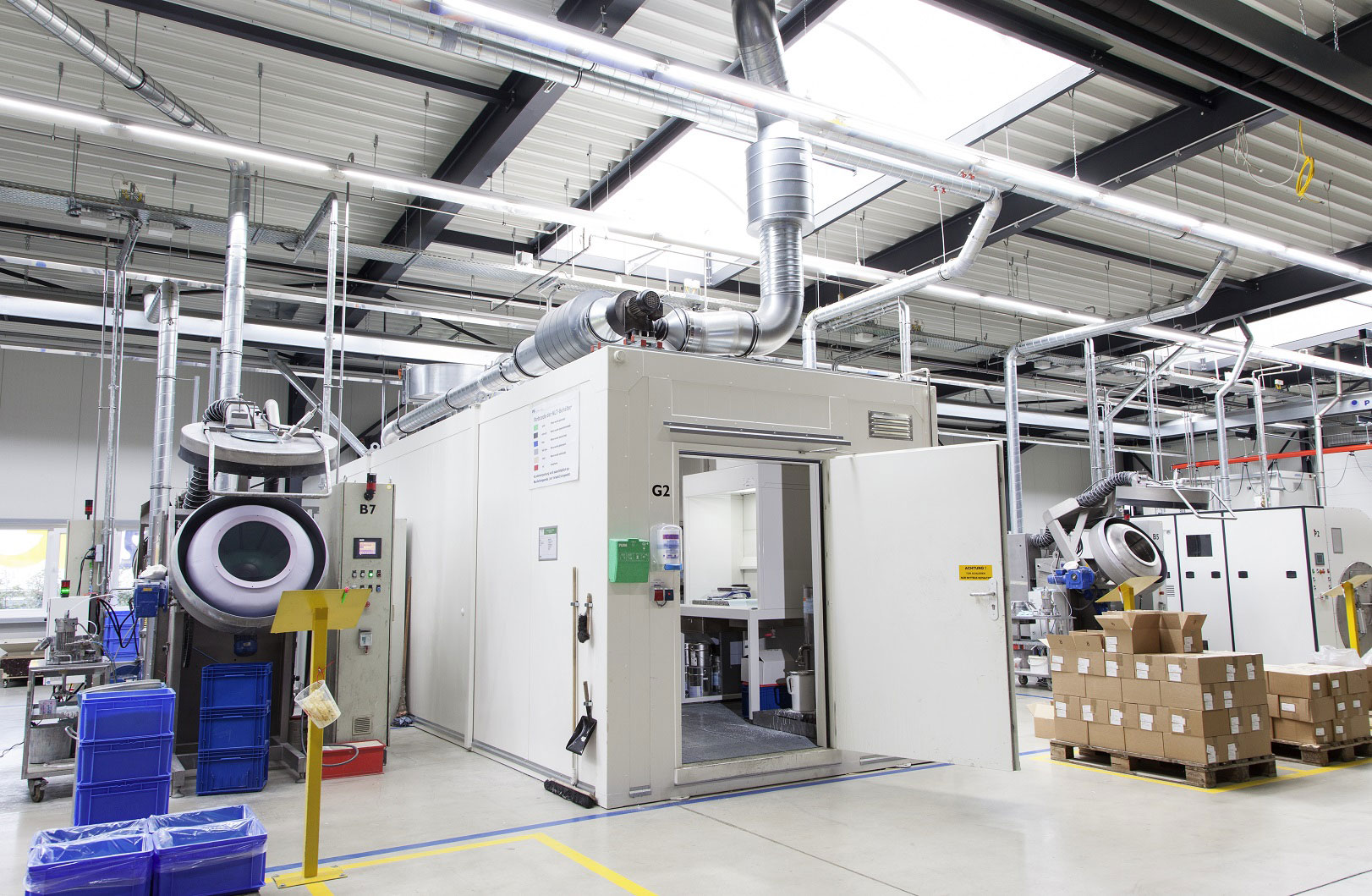
The storage of flammable, explosive or hazardous substances in a legally compliant manner is not a trivial matter. Certified storage modules can save a lot of effort and energy here.
Liquid coating materials and thinners, as well as cleaning agents and auxiliary materials used for painting technology, are generally classified as flammable and water-polluting hazardous substances. Strict protective measures must be taken for storage and processing, particularly with regard to structural and plant engineering aspects. Other hazardous characteristics of the coating materials, for example if they are classified as hazardous to health, can make the requirements even more stringent.
In this respect, it usually requires a great deal of effort and expense, as well as the completion of a lengthy approval process, if additional storage or supply capacities for such substances have to be created in an existing production facility. Under building law, the construction of a paint warehouse in an existing building is basically a change of use that requires explicit approval. If, on the other hand, the warehouse is to be set up outside the building, the whole thing becomes a building project from an official point of view, for which a foundation must be provided and a separate building permit obtained. Both for a change of use and for the building permit, it must be demonstrated that all legally required protection goals are met. In this context, the possible hazards and risks must be determined as part of a customer-side risk assessment, which forms the basis for legally compliant planning. If incorrect assessments are made due to ignorance or a lack of awareness of the hazards, this can have serious consequences for those responsible in the event of damage.
Flammable hazardous substances - the technical rules
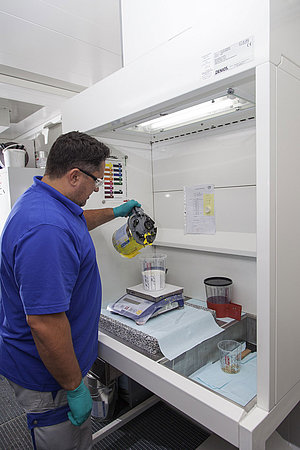
For the storage of flammable hazardous substances in Germany, the protective measures according to the Technical Rules for Hazardous Substances TRGS 510 must be taken into account. Due to the increased risk of fire and in the case of installation close to production, fire protection separation of the paint store from the paint shop and other areas of use is required by law. In the event of a fire, the enclosure of the paint store must be able to withstand a fire for at least 90 minutes so that sufficient time is available for extinguishing the fire. Pipelines for conveying equipment, ventilation ducts and cable penetrations must be secured against fire transmission. Any use other than the intended storage of substances must be ruled out; furthermore, prohibitions on combined storage must be observed. In accordance with TRGS 510, adequate ventilation must also be provided for a paint store, which must also be permanently effective near the floor. As a rule, the prescribed air exchange can only be achieved by means of technical ventilation. With the new version of TRGS 510 in 2021, such ventilation must have exhaust air monitoring, regardless of the air exchange rate. In the paint store and paint supply room, monitoring of the room air temperature is advisable in addition to monitoring of the supply air system. In the event of malfunctions, an automatic message can then be sent to the central control system and the (plant) fire department.
Since the formation of an explosive atmosphere cannot be ruled out despite all the measures taken, Ex zone 2 is assumed for the entire room. For this reason, all metallic objects in the storage and work area must be connected to each other in an electrically conductive manner and grounded for equipotential bonding in order to avoid dangerous electrostatic charges. Electrical equipment must be explosion-proof. If coating materials are processed by persons in the paint supply room, this ventilation equipment must also ensure that the workplace limit values for gases, vapors and mists produced are complied with.
Instead of having to deal with each of these requirements individually, the option of using paint storage and paint supply rooms as ready-to-connect, pre-assembled units with integrated containment and fire protection enclosures offers great simplification in the planning and installation of such hazardous materials storage facilities. This is because experienced manufacturers, such as Denios, supply all the necessary protective measures at the same time - certified and tested by trials. A certificate of approval from the manufacturer then ensures planning and legal certainty in the approval process. New supply capacities can thus be implemented easily, quickly and inexpensively within production. The free positioning option of such a storage unit in the production line is also a major advantage. For example, the paint supply room can easily be positioned as close as possible to the paint booth, and the supply lines can be kept as short as possible, for example to minimize the effects of temperature on the coating material. The same applies to the paint store, which is often placed as close as possible to production or even directly in the building for efficiency reasons.
Safe fire and employee protection
In Denios' technical room systems, fire protection is achieved by a double-walled steel frame construction clad with fire-resistant special panels. The inner frame protects the entire system in the event of a fire from the outside and the outer frame protects the system in the event of a fire from the inside. In case of fire, special swelling materials hermetically seal the self-closing door. At the same time, the ventilation openings melt in parallel. All wall openings are secured by a fire-resistant bulkhead. Compliance with the F 90 fire resistance rating required in Germany for the entire system was established in real fire tests by an independent testing institute. Denios also offers European versions tested for up to 120 minutes. Corresponding proofs can be provided on request.
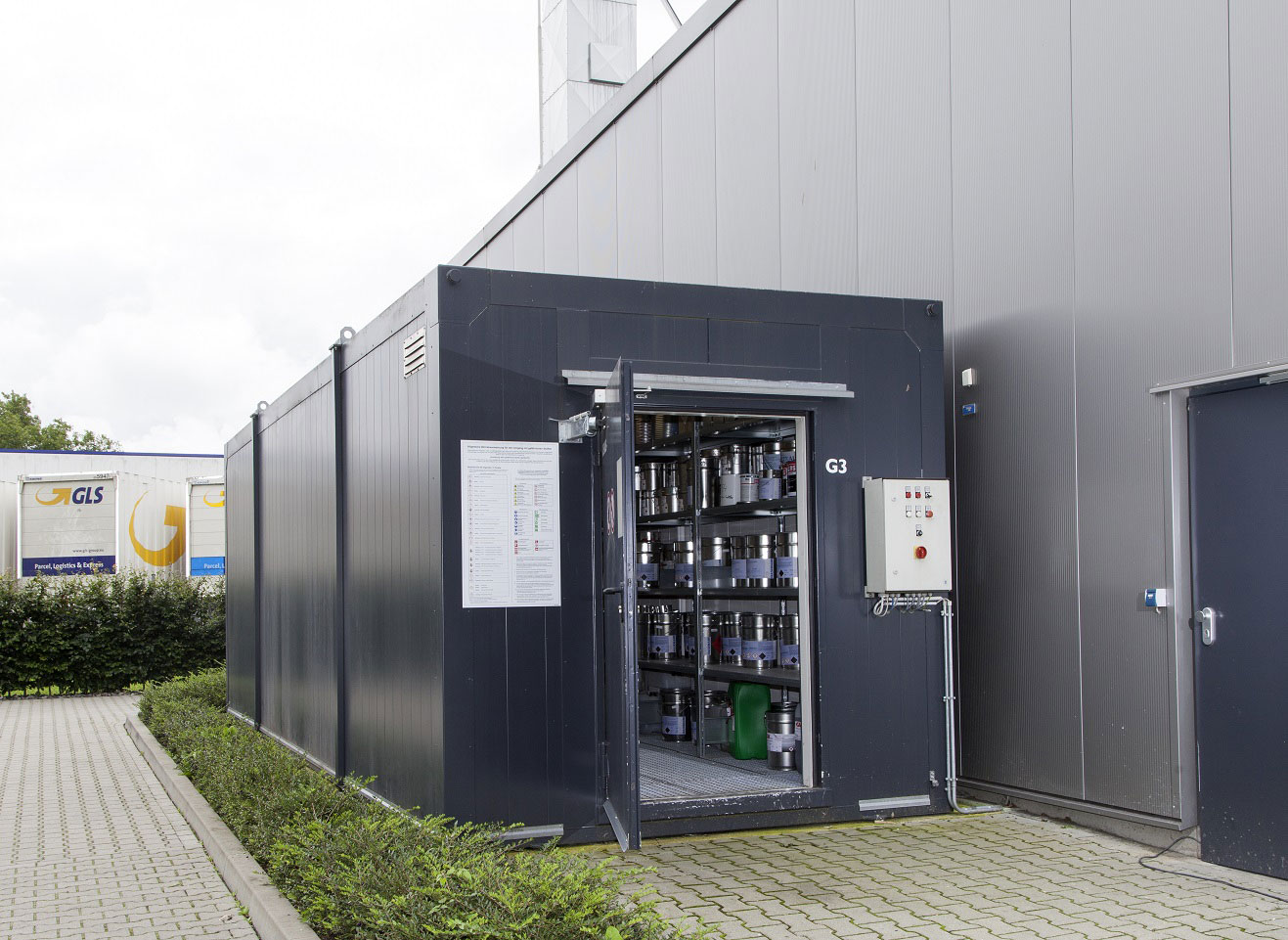
When employees have to handle hazardous substances, workplace limits can usually only be complied with by extracting the solvent vapors at the point of origin. Denios offers special fume hoods for this purpose to protect employees. In contrast to the traditional fume cupboard with sash, the manufacturer of technical room systems offers fume cupboards with ejector technology that enable barrier-free, comfortable working thanks to intelligent air guidance and extraction.
Such ready-to-connect technical room systems meet explosion protection and ventilation specifications, pre-assembled with all necessary equipment so that commissioning can be carried out quickly. With the Denios connect solution, the technical room system also becomes a smart facility that reacts to malfunctions and damage events in real time, thus maintaining operations safely. Effective condition monitoring of the relevant operating parameters ensures optimal early damage detection and fast response times in the event of a malfunction.
Maintenance mandatory
It is also important to note that regular inspection, maintenance and servicing are required by law to ensure that a hazardous materials storage facility remains in a usable condition. Operators who fail to comply with these obligations sometimes risk high fines and, in the event of damage, the loss of insurance coverage. In order to be allowed to perform services - especially on electrical systems as well as fire and explosion protection devices - it is absolutely necessary that the executing specialist is appropriately qualified. This is why Denios offers a certified all-round service throughout the entire product life cycle - recently including the return and recycling of old systems. Anyone responsible for the storage of hazardous materials who wants to worry less about regulations should check whether certified and legally compliant solutions such as a modular hazardous materials storage system and appropriate expert advice can eliminate uncertainties and liability risks.
Denios SE
www.denios.de