


Risks and side effects of disinfectants
The pandemic led to increased use of disinfectants - in part with consequential damage
In the course of the last few years, there have also been new challenges and peculiarities in the damage analysis of coating defects. For example, an increasing number of defect patterns occurred due to the increasing use of disinfectants.
The defect patterns that were observed during the pandemic due to the increased use of disinfectants mostly concerned corrosion-accelerating effects due to chlorine-containing disinfectants - which may contain sodium hypochlorite, for example - or dissolution effects in the case of chemically insufficiently resistant coatings. The realization that disinfectants can cause such damage patterns was met with astonishment by many of DFO's customers at the beginning of the pandemic, but subsequently led in some cases to a hasty general suspicion in the case of comparable defect patterns. Without analytical evidence, however, this is dangerous, since this assumption usually places the customer or end user under suspicion of having treated corresponding surfaces improperly. In the following case of damage, such an erroneous assumption was made, which could, however, be corrected by a quick damage analysis by DFO.
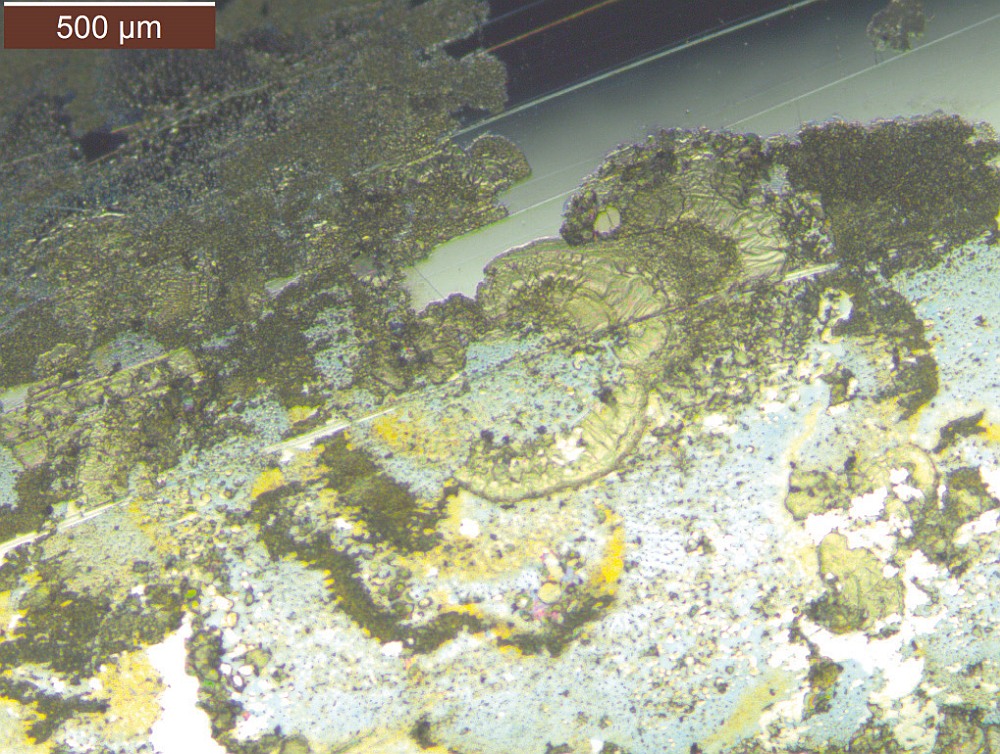
Electroplated chromium-plated steel tubes were affected by staining, which occurred with a time lag and was only noticed during final assembly (see Figure 1). In the search for the cause, a disinfectant was first suspected, which was shown to have been used by the people who came into contact with the steel pipes. It was assumed that this contained sodium hypochlorite, which had caused a corrosive attack on the chromium plating.
Beware of the generalization error
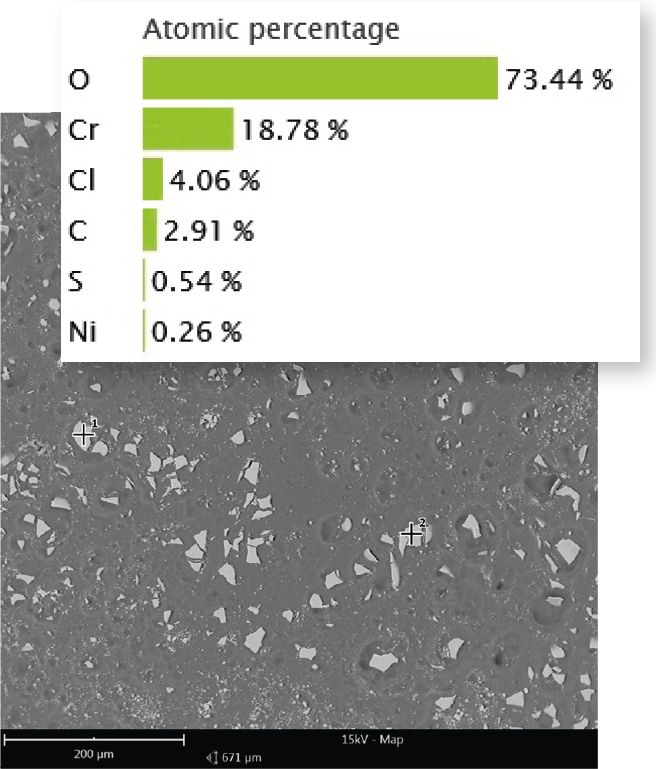
DFO was finally commissioned to verify this assumption analytically. For this purpose, a partial section of an affected chromium-plated steel pipe was provided. By optical microscopy and scanning electron microscopy (SEM), the spots could be clearly classified as corrosive damage. In fact, by means of energy dispersive X-ray spectroscopy (EDX), significant amounts of chlorine (Cl) were detected in the defect area in addition to the expected elements chromium (Cr) and nickel (Ni) of the electroplated chromium plating (nickel layer plus chromium layer) (see Fig. 2). Chlorine or chlorine-containing compounds, in combination with moisture, can cause chromium-plated components to corrode at an accelerated rate.
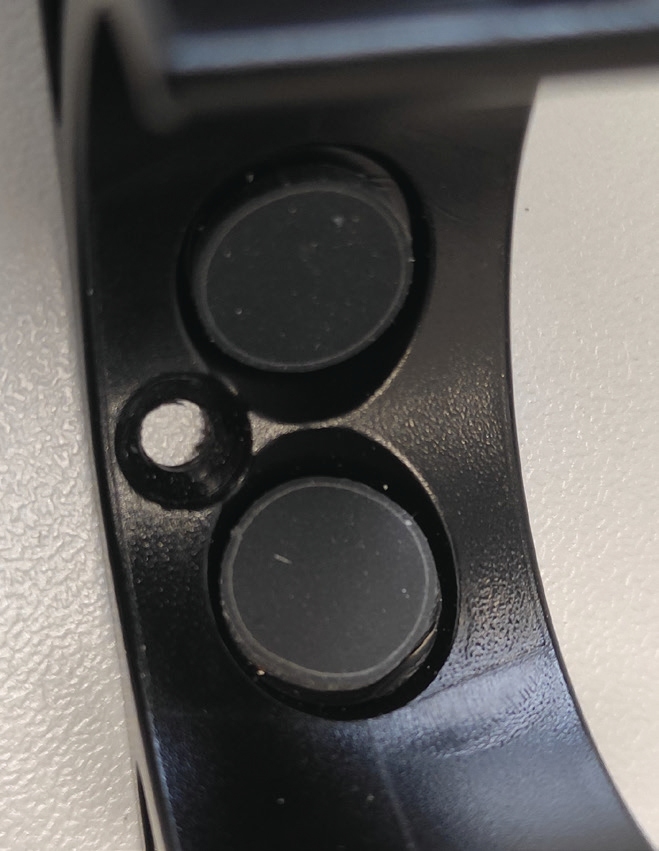
However, what did not fit the theory of sodium hypochlorite-containing disinfectant as the cause of the defect was the complete absence of sodium in the defect area. Therefore, DFO suspected another cause. After an on-site inspection of the entire manufacturing process and also of the affected pipes, a conspicuous feature was immediately apparent: The defect areas were in the exact same places on all defect parts. This made it highly unlikely that the defect pattern had been caused by accidental contamination with disinfectants through manual handling. Instead, attention was directed to the transport locks of the chromium-plated tubes. To prevent scratching, soft inserts made of "rubber" had been inserted in the transport supports. The contact points of these plastic inserts with the tubes coincided exactly with the defect areas (see Figure 3).
Plasticizers can release hydrochloric acid
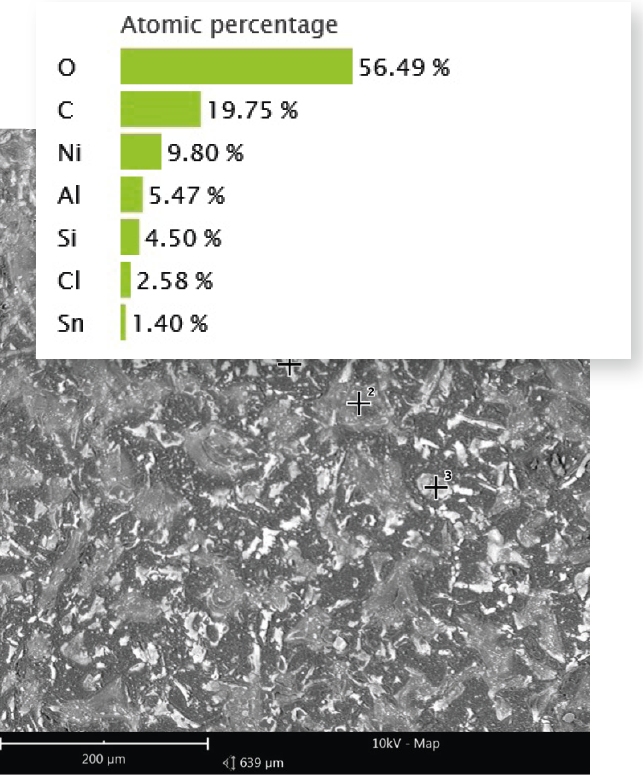
Infrared spectroscopy was used to identify the plastic as polyurethane. Polyurethane is not a chlorine-containing compound, yet by means of EDX, chlorine (Cl) could also be detected within these plastic inserts in addition to the elements carbon (C) and oxygen (O) of the polyurethane, silicon (Si) and aluminum (Al) of the fillers contained in the plastic and tin (Sn) of an organotin catalyst (e.g. dibutyltin dilaurate (DBTL)) (see Fig. 4). This was due to clorparaffins, organic chlorine compounds added as plasticizers, contained in the polyurethane. Organic chlorine compounds can release small amounts of hydrogen chloride - i.e. hydrochloric acid. The hydrochloric acid chemically attacks the chromium, leading to the observed corrosive damage.
Additionally, it was analytically proven that the suspected disinfectant did not contain any chlorine-containing compounds at all. Consequently, the DFO recommendation was to replace the plastic inserts used with plasticizer-free plastic inserts in order to avoid the defect pattern in the future.
Defect picture of the month
In this section, the German Research Association for Surface Treatment (DFO) e.V. reports on current cases of damage from practice that have been clarified by the DFO. The aim is to provide suggestions on how defect images can be interpreted and what the possible causes of unusual coating defects are.
German Research Association for Surface Treatment (DFO) e.V., Neuss www.dfo-service.de