

Reference in animal bone degreasing
Reinigungssystem setzt Maßstäbe bei der Knochenpräparation
Once again, parts cleaning specialist Hemo has succeeded in establishing its plant technology as a virtual reference in a specific industry. Hardening shop and pipe cleaning applications are now followed by animal bone degreasing. With its modified SOLVACS cleaning systems, the company is also setting standards in this area.
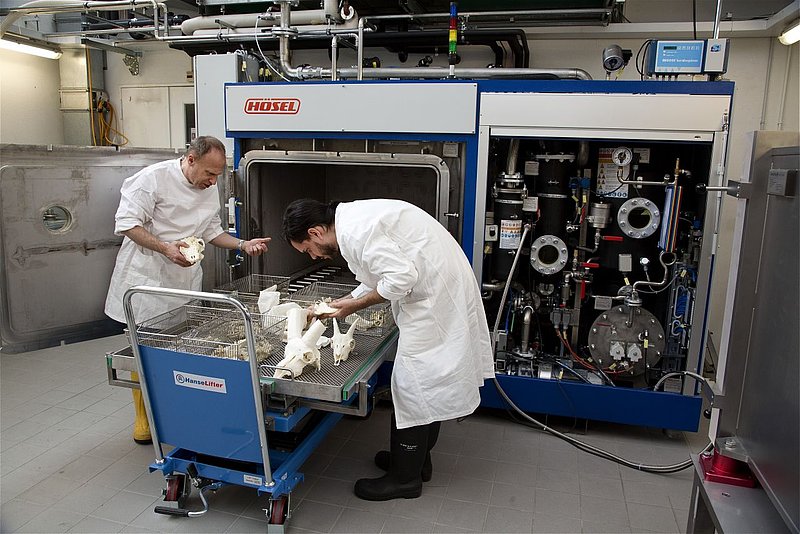
"With a spectacular animal bone degreasing and drying plant for the Natural History Museum in Bern, an unforeseeable development took its course," reveals Hemo Managing Director Andreas Fritz. What had happened? The team of taxidermists there was looking for an efficient process for degreasing animal bones. The background: When preparing animal bones, the fat content plays a decisive role.
If this cannot be reduced to a minimum, the bones quickly turn yellow. In the long term, the fat would decompose the calcium in the bones, making them porous and brittle and causing them to disintegrate over time. Such catastrophes can only be prevented with an almost complete degreasing of the animal bones. And here the taxidermists had an ingenious idea: Why not use industrial cleaning equipment, which is normally used to clean, degrease and dry metal and plastic parts, for degreasing animal bones?
From idea to groundbreaking technology
"At first, as one of the world's leading manufacturers of industrial parts cleaning equipment, we were surprised by the exotic request for animal bone degreasing. But in principle, this idea did not seem at all outlandish: we can degrease all kinds of parts with our solvent systems. So why not animal bones, too?" says Andreas Fritz. However, since Hemo had no experience in this area, the task was to work in partnership with the taxidermists to find a solution that could meet the specific requirements in this particular case. In an intensive exchange, Hemo succeeded in modifying the well-known Solvacs cleaning technology in such a way that, after months of development, it was able to deliver excellent results in animal bone degreasing.
Animal bone degreasing ten times faster with better results
In fact, the degreasing results of the pilot plant for the Bern Museum were overwhelming: the idea of modifying an industrial cleaning and degreasing plant for animal bone degreasing has brought the preparation of animal bones worlds ahead. The plant is around ten times more efficient than the process previously used in Switzerland. Instead of previously taking around 300 hours, comparable batches can now be degreased in thirty hours, with an even better degreasing result. That is a real sensation.
"The rest is quickly told," says Andreas Fritz: "Of course, the spectacular results spread like wildfire in the well-connected taxidermy scene around the globe, and the order intake in the field of animal bone degreasing is going up by leaps and bounds. Soon, another system will go into operation at the Berlin Museum of Natural History. Apparently, we have once again succeeded in setting standards in an industry. The time-intensive investment in the Swiss pilot project has proven to be a bull's eye."
The new standard in animal bone degreasing
HEMO doesn't want to reveal too much about the new technology at this time, but this much can be revealed: The solvent methylene chloride is used as the cleaning medium, which is recirculated with virtually no losses. The key feature of this system technology is that both the solvent-based degreasing steps and the drying process take place in a sophisticated combination of underpressure and overpressure and at a low temperature level. This achieves the best degreasing results as well as relatively fast and, above all, residue-free drying without - and this is extremely important - mechanical, thermal or chemical damage to the bones.
The process also impresses with significantly improved environmental behavior. On the one hand, the methylene chloride used can be recirculated with virtually no losses, and on the other, the preparators no longer come into direct contact with the hazardous substance. The times when experts in protective suits had to handle full solvent canisters are finally a thing of the past with the new degreasing system.