Locate air leaks quickly and easily
Erfolgreicher Einsatz einer akustischen Bildgebungskamera bei einem japanischen Unternehmen
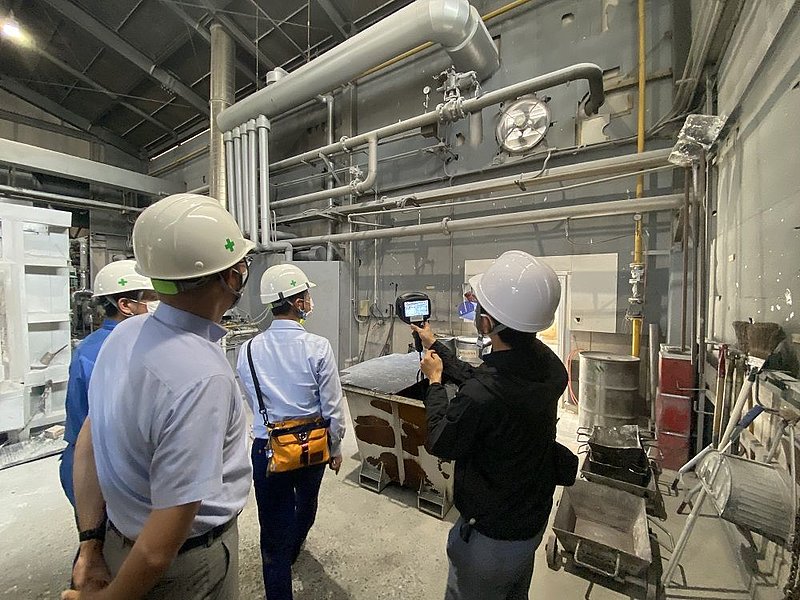
How can compressed air leaks be located and, above all, classified in terms of their size with minimal time expenditure? Acoustic imaging cameras offer promising capabilities for this and can help save compressed air on a grand scale.
Compressed air may come from a quick coupling, but that should not hide the fact that compressed air is one of the most expensive energy sources in a company. Especially in times of horrendous energy prices, it is becoming even more important for companies in all industries to reduce energy consumption - and above all to eliminate waste. The fact that the compressed air networks in many companies are more or less leaky, resulting in sometimes high and completely unnecessary costs for compressed air generation, is often accepted as unavoidable, since leak detection can be quite time-consuming and there is usually little time for this in the constraints of everyday production. So how can leaks be located with a minimum of time and, above all, how can their size be classified? Here, acoustic imaging cameras offer promising capabilities.
Difficult conditions for leak detection
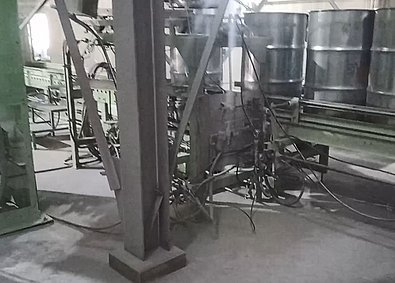
One user of such an acoustic imaging camera is Minalco Co. Ltd - founded more than 104 years ago. The company specializes in the production of atomized aluminum powder - the only company in Japan to do so. Soichi Yagyu, the president of Minalco, had often expressed concern about the hissing noises in the production facilities during regular plant visits: "We couldn't determine where the air leaks were occurring, but we could hear the hissing noises." Minalco's Mie plant (Iga City, Mie Prefecture) requires a large volume of compressed air to produce aluminum powder; accordingly, it runs many compressors, and the share of electricity costs for air production was about 50 percent before optimization. Typically, only 20 to 30 percent of the electricity costs in a production plant are attributable to compressed air production. That's why those responsible at Minalco began to think about countermeasures to reduce operating costs. But such leaks are usually visually impossible to locate. In a quiet environment, leaking air could be safely located by hearing. But in a production hall, many large and small noises make this largely impossible
Acoustic camera in practice
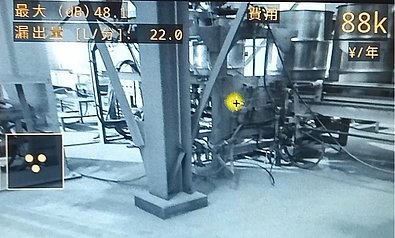
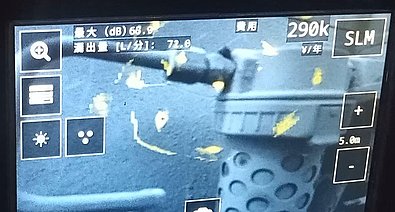
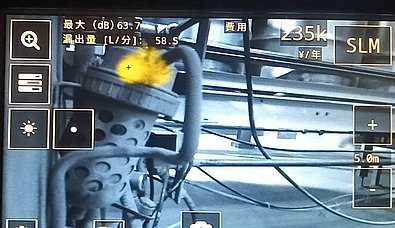
Eventually, managers became aware of the Flir Si124 acoustic imaging camera, which, according to its manufacturer, should be able to identify leaks even in noisy environments. After using the camera, Yagyu was pleased to find that it was very easy to use and operate, requiring no special training or in-depth knowledge. According to Flir, instruction in operation and handling takes about five minutes, and efficient use of the camera is possible in 15 to 30 minutes with on-the-job training. In most cases, about three leaks can already be found. The camera can generally be used for pipelines with overpressure - whether they carry air, steam, nitrogen or other gaseous media is irrelevant. However, the pressure must be above 0.3 Mpa and creeping leaks cannot be detected. "During the inspection, we found air leaks in places we didn't expect and would never have found otherwise," Yagyu said. "That led to a lot of new insights and actions. What's very good about the Flir Si124 is that it shows the number of air leaks and the annual loss costs in real time, which raises awareness of what we're spending at our manufacturing sites." "At our production sites, there are places with loud ambient noise, and this includes burners in particular. I had some doubts about whether we would actually find leaks with a camera that you can operate with one hand," Koji Yamaguchi, general manager of production, recounts his doubts beforehand. "However, when I visited the factory with the Flir Si124, I was surprised to find that leaks could be detected more accurately and easily than expected. Even air leaks from distant pipes on the ceilings were adequately detected."
Locating even well-hidden leaks quickly and effectively
One challenge in detecting leaks on the pressure line pipes was the winding production lines at the plant, creating many hard-to-reach areas. "Since the Si124 is less than half the size of conventional acoustic imaging cameras, this was not a problem," said Tomoyuki Iwade, general manager of operations, explaining the application potential offered by the compact design. "As CO2 neutrality has become very important in recent years, the Flir Si124 can detect leaks with minimal disruption to the production facility, reducing electricity costs and helping to reduce CO2 emissions," Yagyu concludes. "What impressed us most was that we were able to use the Si124 to locate leaks on pipes that we would not have been able to find using conventional methods. Normally, we try to exclude reflected ultrasonic waves, but this time we experienced finding leaks precisely by tracing those very reflections!" The potential savings at Minalco were substantial; based on a preliminary calculation using the size of a single leak of 1.5 mm and a pressure of 0.7 Mpa, the cost of wasted compressed air per year is about 100,000 yen. If the size of a single leak is 12 mm, this amount is already 600,000 yen, or about 4,400 euros. Basically, experience in industry and on construction sites shows that the size of the leakage generally depends on the rigidity of the parts and the position in the system, reports Tomoaki Ishikawa, who works for Flir in Japan as a sales representative. For example, it matters whether leakage occurs in areas of high pipe pressures or at lower pressures. High stiffness or stuck parts such as flanges are usually only the cause of lower leakage. Damage, vibration or even loose fittings have a particularly large influence. But parts with low stiffness or low durability, such as couplings or valves, also often cause major leakage due to aging. Ishikawa reports that in most cases, as few as five or more leaks can be found during a 30-minute tour of a production facility. Flir offers free on-site demonstrations and on-the-job training for interested parties. Simplified diagnosis of electrical equipment with thermal imaging cameras is also available.