

High precision, flexible PVC coating
Auch für schwierige Stellen: Mehrstrahliger Düsenkopf für mehr Präzision bei der Nahtabdichtung
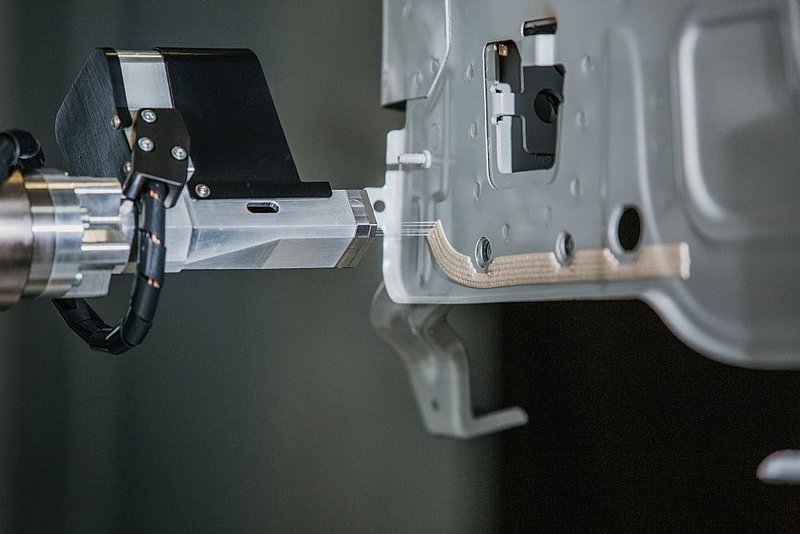
A newly developed PVC applicator offers the potential to automate PVC application even in difficult areas and to significantly reduce manual activities and rework during seam sealing by means of individual, timed jets.
The topic of PVC sealing in automotive manufacturing still offers considerable room for optimization, even though many well-known OEMs already have highly automated seam sealing stations. Overall, reliable PVC seam sealing, which always precedes the painting process in automotive manufacturing, is crucial, especially with regard to the long-term quality and corrosion protection of an automobile. That is why many OEMs rely on robotic application in the line wherever it is feasible. However, in hard-to-reach places or particularly complex geometries of the car body, sealing processes have so far either remained manual work or at least required manual rework. The plant manufacturer Dürr has now developed an application solution which has the potential to take over manual activities in the area of seam sealing and thus further advance the level of automation.
Individually timed jets
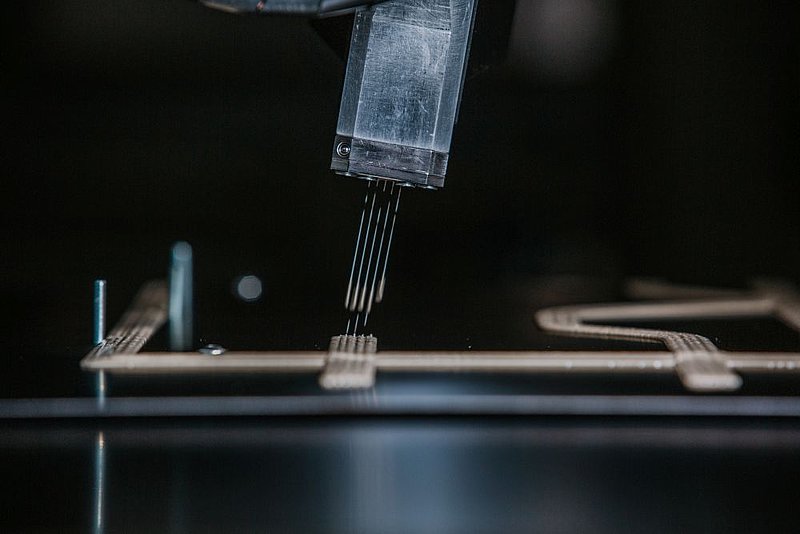
While PVC application is normally carried out using special nozzles whose geometry is not variable, the Bietigheim-based plant manufacturer relies on individually controllable, timed jets for the EcoSealJet Pro, so that both the seam geometry and the application quantity can be flexibly controlled. The new applicator can be used wherever automation has previously reached its limits. These include not only hard-to-reach places, for example in the engine compartment or on lamp pots, but also those where automatic PVC application has so far failed due to special contours, holes, bolts or other obstacles.
Results accurate to the millimeter
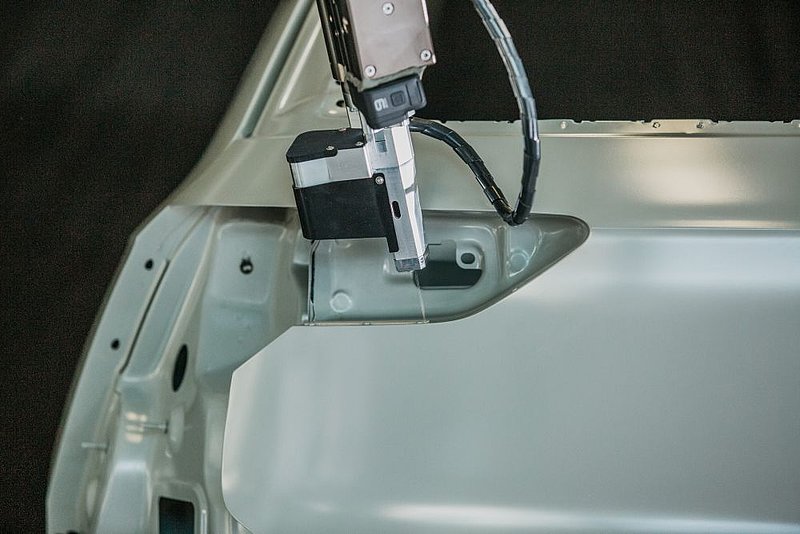
The distance and angle of the robot-guided applicator can be variably adjusted for easy access to difficult body parts. To ensure that it can apply the sealant to the bodywork with consistent precision and quality, each needle can apply the material in a full jet or in metered individual droplets through the application nozzles at an individual rate; the variable and high-frequency switching of the needles thus allows the application rate per time to be precisely adapted to the speed of the robot. This makes the applicator highly flexible, and it can be used for seam geometries of varying densities and widths, which subsequently have a sharp-edged, overspray-free finish. This precision of application and the ability to vary the material thickness as required ensure that no sealing material is wasted. The individual switching of the needles also prevents the material from doubling up at the seam joints. The reduced use of material in this way is an advantage that should not be underestimated, not only for cost reasons: the lower material thickness also results in a lower overall vehicle weight. Because the new applicator can be used to omit add-on parts, bolts or bores, time-consuming and material-intensive masking and cleaning are also a thing of the past. These downstream processes can usually either be reduced or eliminated completely.
First beta site
Together with Dürr, a well-known OEM has already carried out extensive trials in which the applicator properties were tested in practice and compared with the series production status of a fine seal including manual spreading. The results were convincing both in the critical area of door edges and corners, but also, for example, in the area of lamp pots. As a result, the construction of a beta site was initiated. The aim here is to test the suitability of the new applicator for series production. In particular, the OEM sees the prospect of significantly minimizing stencils and spreading volumes and also the consumption of PVC.
Learning algorithms for Overall Equipment Effectiveness
Increasing the degree of automation in sealing is a real benefit both for the ergonomics of the workplaces and for cost efficiency and environmental protection. Process optimization also plays a major role here, which is ensured on the one hand by the permanent monitoring of individual components such as pumps, temperature controllers, feeders or valves. On the other hand, Dürr relies on AI to improve manufacturing processes: the DXQequiment.analytics software package allows machine data to be analyzed, quality problems to be detected in real time and maintenance requirements to be optimized. As a result, future predictions of, say, a product defect or the maintenance needs of a plant component become more accurate over time. The intelligent machine learning algorithms support maintenance and help to achieve the highest possible plant availability. It is important to mention that due to its complexity, the EcoSealJet Pro should not be considered a general replacement for contemporary, sophisticated and proven PVC application methods. It is aimed at applications in which manual work scopes are to be reduced and very high seam precision together with reproducible quality and cost and environmentally friendly material savings are to be achieved.