

The proof of the pudding is in the eating
Applikationstechnologien in der Praxis effektiv vergleichen und den eigenen Prozess einordnen
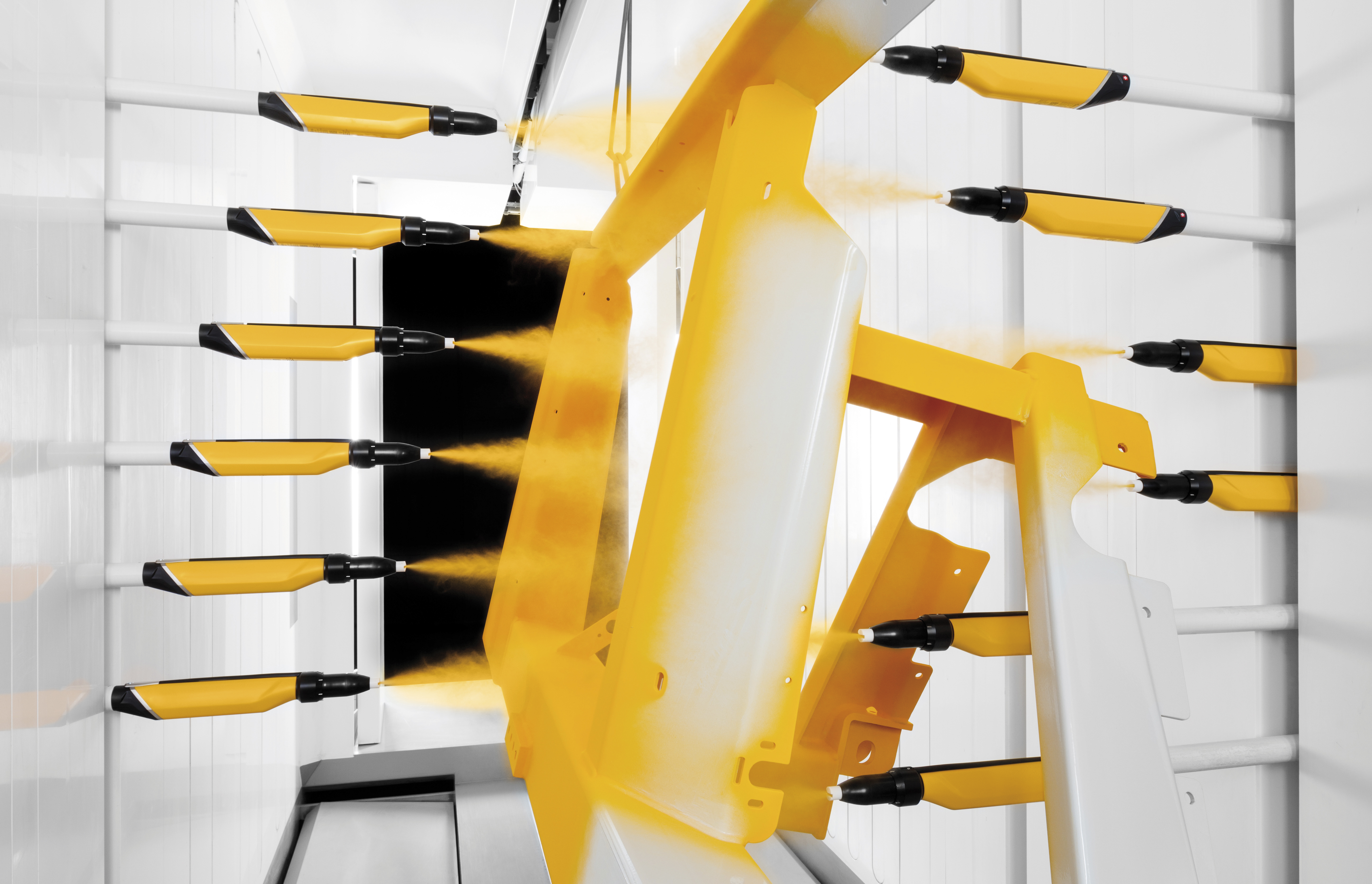
The decision to modernize a powder coating line is all the easier the better you can compare the state of the art with your own process. In this respect, the test laboratories of the major application manufacturers are a helpful starting point.
The right moment to push ahead with the optimization and modernization of a coating line is not always easy to find. Particularly when a coating process is running reasonably stably and is not attracting attention due to unbearably high defect rates, modernization decisions are often postponed. However, especially in the case of somewhat older systems, there is now great potential to improve the processes considerably in terms of reproducibility and cost-effectiveness. At the latest when, despite a great deal of effort in optimization, no satisfactory results are achieved, a visit to the laboratory of an application manufacturer - such as Gema in St. Gallen - is most likely a good idea.
Three options for powder conveying
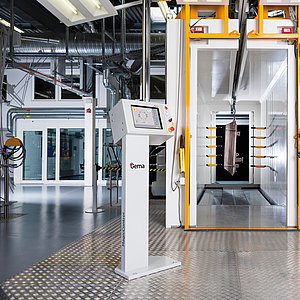
Gema's test laboratory is located in the main building of the company's headquarters. In the customer laboratory, the latest products from the Swiss application technology manufacturer can be tested and tried out in practice. Four powder coating booths are installed in the hall, which is about 50 meters long and 20 meters wide. There are different types of booths in the laboratory, where the coating tests can be carried out optionally with different powder delivery technologies.
In principle, the injector was for many decades the measure of all things when powder coating was to be conveyed from the fluidizing container to the gun. No wonder, the concept is simple and robust. The powder is sucked in via negative pressure, which is generated by the so-called conveying air, then a nozzle system behind it blows in additional air, which controls the movement of the powder-air mixture in the direction of the coating gun.
In the injector, the actual powder quantity conveyed depends on pressure conditions - ultimately, the length of the powder hoses and their counter pressures also play a role here. Furthermore, the pressure conditions inside the injector are strongly dependent on the wear condition of the catch and propellant nozzle, and this in turn on the amount of powder processed, as well as its flow velocity and abrasiveness. Thus, with increasing operating time of an injector, the quantity of powder applied changes - although no settings have been changed on the control unit. Therefore, an injector requires an increasing degree of know-how and maintenance, the higher the qualitative demands on the process result are.
The improved injector
In a classic injector, the nozzles and hose connection are screwed together, so changing nozzles does require effort and a few wrenches. This increases the likelihood that the nozzles will rarely be checked for their actual wear condition and will be changed late in the process. To alleviate this problem, Gema has fundamentally rethought the concept of an injector and launched the IG07 injector. A very central improvement is a combined catch and propellant nozzle as well as a quick-change system. This makes it possible to remove the hose holder at the push of a button and take out the nozzle with one grip. Worn nozzles can thus be replaced literally in the blink of an eye, while at the same time it is effortless to get a picture of nozzle wear in seconds.
Another well thought-out detail is the 135° angle between the injector inlet and outlet, which means that the powder-air mixture has to be deflected less abruptly. Compared to an otherwise usual 90° angle, this reduces wear considerably. At the same time, the properties during color change have been improved by fewer sharp edges inside. Studies by Gema show that time can be saved during maintenance thanks to the fast injector nozzle change, while at the same time fewer errors occur during operation and maintenance thanks to the simpler design. The service life of the central wear component, the nozzle, has also been significantly extended.
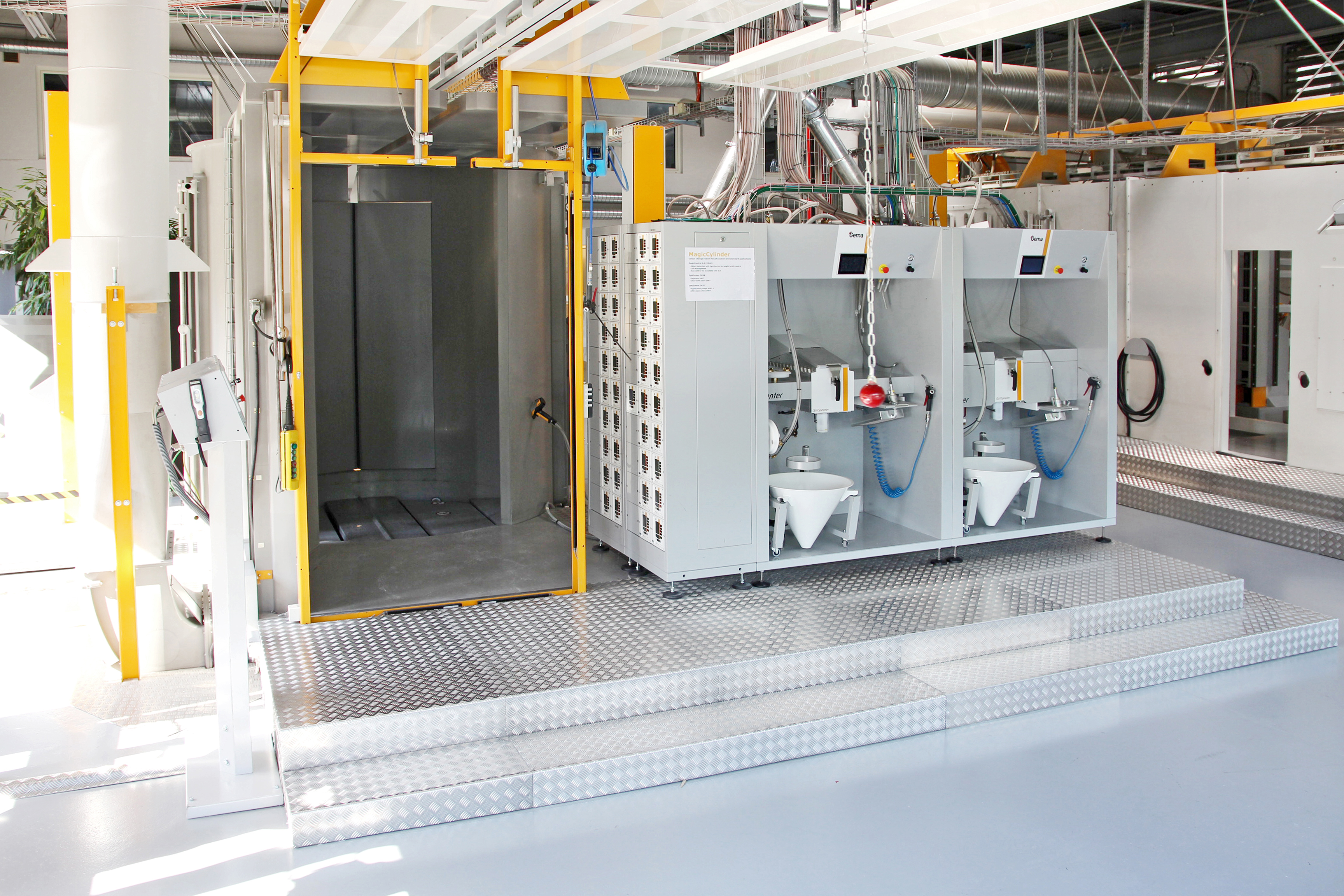
All-in-one concept: control unit and injector in one
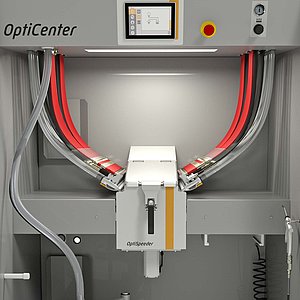
To perfect injector technology, Gema relies on the All-in-One concept. With the OptiStar All-in-One, the injector and control unit are combined in one compact device. In a rinsing process with conventional injectors on the market, the larger part of the rinsing air seeks the path of lower resistance - and this unfortunately does not lead along the long hose to the powder gun. As a result, relatively long rinsing times are necessary. For this reason, Gema has developed an alternative with the OptiStar All-in-One unit, in which active control elements solve this problem. The control unit and injector are combined to save an extremely large amount of space, and are flanged directly onto the powder hopper. Apart from a central compressed air and power connection, no further connections are necessary. The compact design makes it possible to supply up to 36 guns from a single OptiCenter. In addition, an additional control cabinet for the control units is unnecessary, and with it the hoses between the control unit and the injector.
Since air is compressible, every additional meter of hose between the control unit and the injector slows down the injector's response to control inputs, which is particularly noticeable when activating or deactivating a gun. Because all the OptiStar All-in-One controls are located directly on the injector, the powder flow reacts very spontaneously to control inputs. Another great advantage becomes clear during rinsing, because the flow direction of the air through the injector can be controlled specifically. This means that up to three times the air volume is available for rinsing the hose line to the gun, and the rinsing time can be reduced to about a quarter - and thus reaches the level of a dense phase pump. In terms of its properties, the All-in-One thus closes the gap between a classic injector and a dense phase pump.
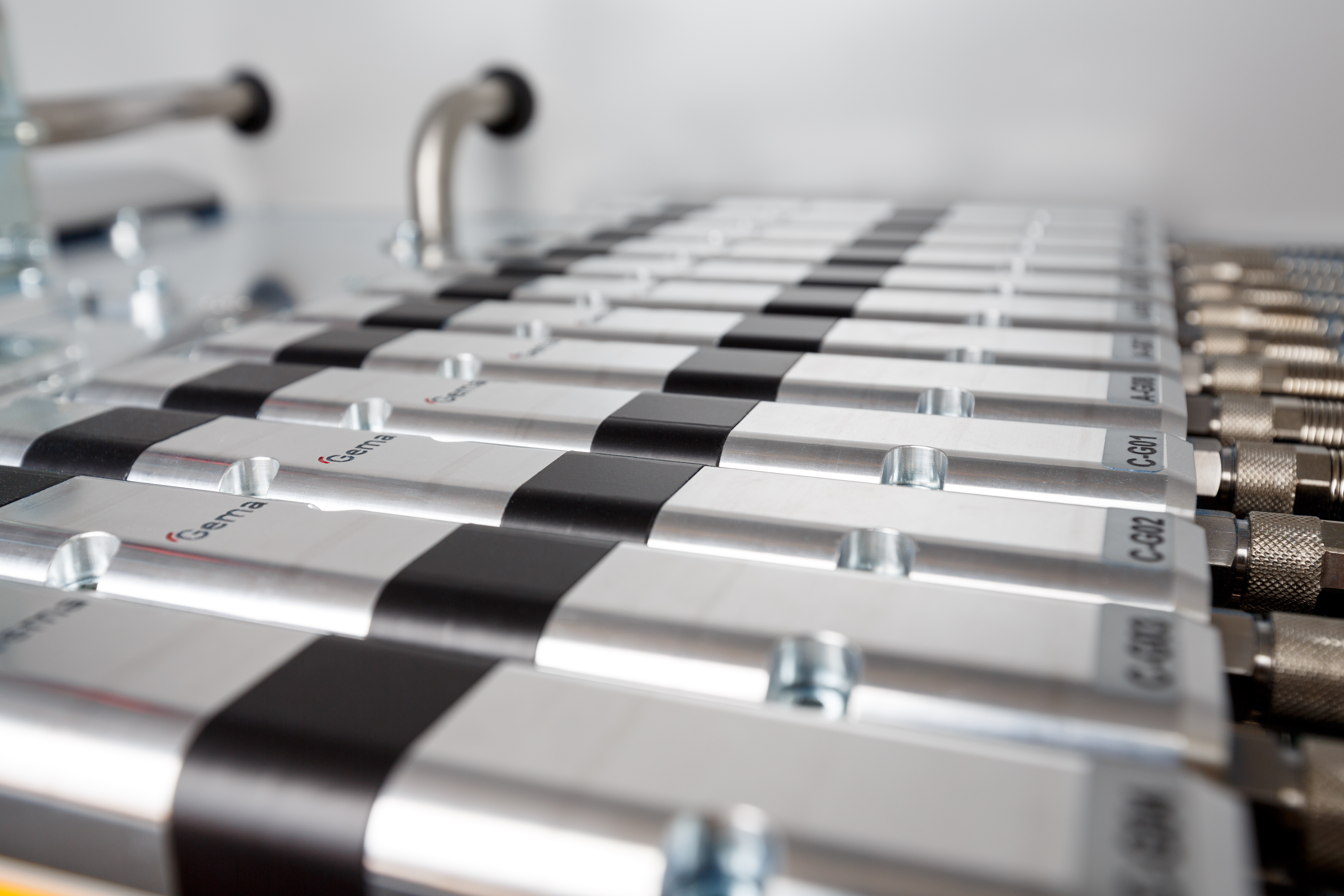
The new measure in powder conveying
Despite all the improvements in injectors, the experience of the last few years shows that the dense phase pump is increasingly becoming the measure of all things when it comes to particularly economical and precise powder conveying. For this reason, all booths in the laboratory are equipped with dense phase technology as standard.
"In the meantime, I see a strong increase in interest in dense phase conveying among our customers. Many of those who carry out tests with us are still working with an old injector system, but are urgently looking for a way to improve the coating quality," reports laboratory manager Paulo Dos Reis.
A special feature of the Gema AP01 dense phase pump is its compactness, which, as with the OptiStar All-in-One, allows the pump to be mounted directly on the fluidizing tank. This means that the suction paths for the fresh powder are extremely short, which facilitates the priming process. This is one of the reasons why the Gema pump only needs one conveying chamber. Incidentally, the pump is even available in a version for the application of enamel powder, where the conveying consistency of dense phase technology has particularly many advantages. Interested parties can test this in St. Gallen in a stainless steel booth for enamel application. "For me, there is no question that our dense phase pump cannot be beaten in terms of conveying consistency, controllability and availability," Dos Reis explains. "Even if the investment for a powder center with dense phase pump is higher than with injectors, the return on investment is achieved relatively quickly in many applications. Especially when the improved coating quality, higher plant availability and less rework are factored into the calculation."
"The advantage in our lab is that we can easily test all application technologies from the injector to the all-in-one to the dense phase pump one after the other and compare the results. Here, everyone can see with their own eyes which application technology produces the optimum result for them."
Dos Reis is confronted daily with working out the optimum coating parameters during customer trials. "With the AP01 pump, if you change the powder feed minimally - even if it is only increased by one percent - there is an immediate effect on the coating," says laboratory manager Paulo Dos Reis, assessing the good dosing capability of dense phase technology. "With the AP01 pump, the time required to run in and optimize the application process can be significantly minimized."

Object-oriented gun movement
The fourth powder booth in the Gema laboratory offers the latest in automation technology. Large-area components with pronounced 3D geometries, in particular, normally present considerable challenges to operators of automated booths. Of course, the possibility of positioning the gun as optimally as possible to a component via the system control and the programming of gun positions using controllable gun axes has existed for some time. But this requires considerable programming effort for each component. This is where Gema's latest variant of dynamic contour recognition offers a significant improvement. Laser scanners in the booth infeed area scan the shape of the incoming components. These signals must be converted into geometrically exact values by the associated control system before control commands for the system can follow. Here, Gema was able to increase the processing speed enormously with the latest software generation.
Combined with the speed of the new UA05 gun axes, the system is now able to move components through the system highly dynamically and without prior programming, with the control system automatically moving the guns to the optimum position. In particular, the detection accuracy for narrow objects of just a few millimeters in width has been significantly improved. According to Gema, conveyor speeds of up to five meters per minute are possible, even with rapid changes in cross-section.
"Interest in our latest generation of contour detection is growing rapidly," Dos Reis reports. "We have already carried out many tests at up to 5 m/min - even though in Europe plants do not normally travel at such speeds. But in America, for example, such conveying speeds are quite commonplace." In addition, another robot is available at this booth, which can carry out fully automated coating processes via dense phase flow.
The wide range of application technology available at Gema is remarkable and very helpful when it comes to assessing the status and potential for improvement of one's own application technology.
Gema Switzerland GmbH www.gemapowdercoating.com