

AI tool from coatingAI optimizes powder coating parameters
Optimum coating results - with minimum time and operator requirements
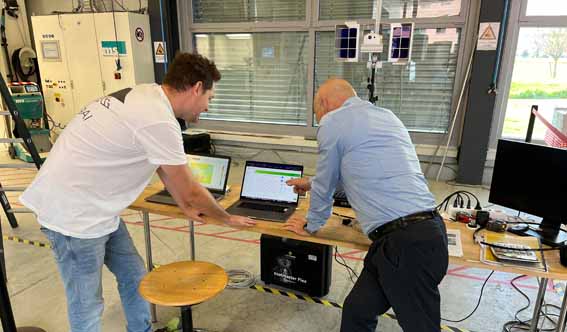
A young startup set out two years ago to develop a comprehensive AI-based optimization tool for powder coating lines. Since the beginning of 2023, an optimization of conveyor speed and gun stroke is now available as the first stage. But the optimization solution of all plant parameters has also already proven its capabilities for flat parts.
Despite digitalization everywhere, the optimization of plant parameters in powder coating is still done traditionally - elaborate tests as well as experienced employees are necessary to achieve good results. That's why the startup coatingAI 2021 stepped up to develop a software solution that uses intelligent algorithms to perform comprehensive parameter optimization in powder coating. The AI experts have identified around 15 parameters that interact with each other and have a significant influence on the coating quality and homogeneity of the coating thicknesses. In addition to the obvious variables such as powder quantity, compressed air and electrostatics, and workpiece distance from the gun, these parameters also include frequently neglected variables such as temperature, humidity and, of course, powder properties.
"The human brain is no longer able to analyze the causalities and interactions in context with such a multi-dimensional and complex linkage of influencing variables," explains Marlon Bondrini, one of the managing directors and founders of coatingAI. "It is possible for an experienced coater to achieve an acceptable result in many cases based on his intuition and experience, but in most cases this has little to do with an actual optimum," Bondrini describes his empirical data. "That's why the optimization of a powder coating is an ideal application field for artificial intelligence. This is able to clearly identify the nonlinear relationships between all the important parameters and then derive the parameters of the system coating from them."
Easy to operate - fast results
What makes this approach interesting is not only the increasing shortage of skilled workers and the fact that quite a few experienced plant operators will be retiring in the next few years. In principle, a program which, with the aid of intelligent algorithms, is able to supply optimum parameters in the shortest possible time when running in new components or to make physically sound suggestions during troubleshooting is undoubtedly a very helpful and time- and cost-saving tool. Although there have been approaches for some years to build up a control loop between the coating thickness and the system parameters via so-called closed-loop control systems, up to now only the powder quantity has been regulated here; inhomogeneous coating thickness distribution or other problems cannot be solved.
During the intensive examination of the prerequisites necessary for such a comprehensive optimization, it became clear to the developers, both in the analytical consideration and in many tests carried out, that the basis for parameter optimization must first be an optimization of conveying speed and gun movement.
Optimize conveying speed and gun stroke
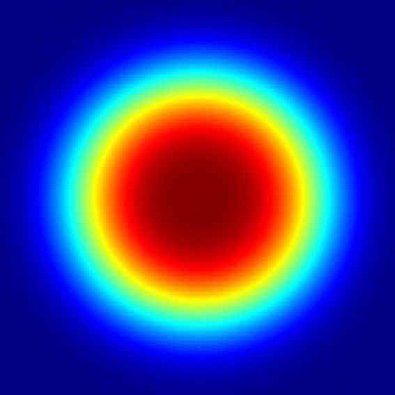
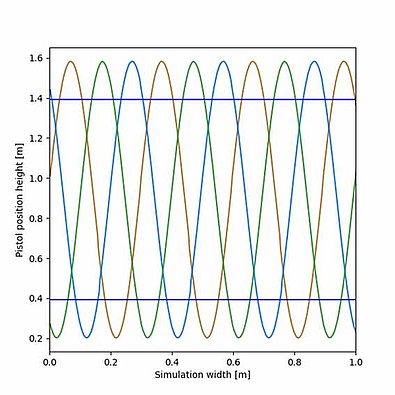
This ratio has a decisive influence on the homogeneity of the coating thickness, because it determines the degree of overlap of the powder webs applied to the component by the individual guns. And because the spray stream of a gun, and especially the powder flow within this spray stream, is not uniform, this web overlap must be determined on the basis of the actual powder distribution in the spray stream. In addition, these ratios change considerably depending on the distance of the gun to the workpiece and the air pressure used. The powder coating used also has a major influence. So any change in these general conditions actually requires a renewed optimization of these parameters. Remarkably, however, this is apparently not common in practice, as coatingAI has found out in discussions with coaters. Conveying speed and gun stroke are often set only once with the equipment manufacturer when a system is commissioned. Continuous adjustment and optimization often does not take place. In addition, the application manufacturers provide methodologies for this adjustment work that simplify the physical realities of the spray jet. Thus, one cannot directly speak of optimization here.
Thus, if the gun stroke and feed ratio remain constant in many installations, then in the event of changes with regard to distance, compressed air or powder, a homogeneous coating can only be achieved if it is possible to adapt the spray jet geometry again under the new conditions for the set ratio of gun stroke and feed. It stands to reason that it would save a lot of time and nerves to first optimize the feed-gun stroke ratio and then tackle the fine-tuning of the other parameters. Based on this insight, coatingAI first developed a tool to operational maturity that can be used to precisely and quickly optimize precisely these basic parameters. The tool has been available to users since the beginning of 2023.
Few input parameters and one calibration
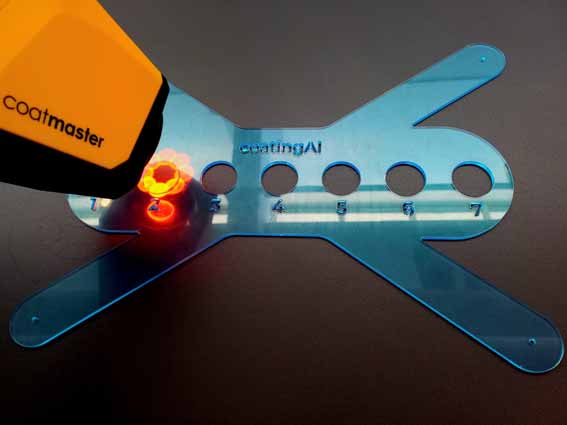
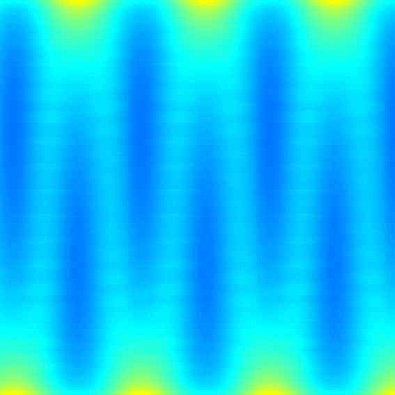
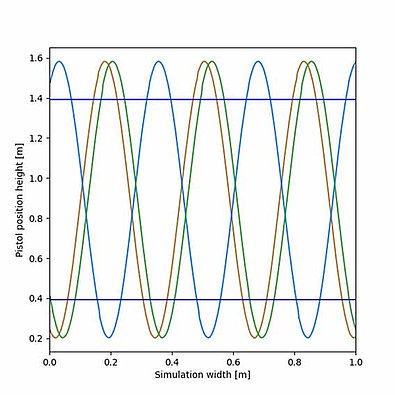
For the calculation, some basic data are necessary, first of all the definition of the plant, for example whether it is a horizontal or vertical plant and how many guns are available. Also very important is the distance between the guns and also the maximum deflection and speed of the vertical movement. Before a first optimization calculation is possible, the gun spray jet must be measured, because the algorithms need the real powder distribution on the workpiece. For this purpose, a test sheet is suspended, a single gun is started, which performs a single up and down cycle while the sheet is statically in front of the gun. For a second test coating, the gun remains static in its position and the sheet passes horizontally. For evaluation of the measurements - assuming a non-contact coating thickness measurement - the sheet does not even have to be baked. Using a special template, the applied coating thickness is measured at seven defined points - for example, using a photothermal process such as the Coatmaster Flex or Coatmaster 3D - and transferred to the software. This calibration thus takes only about five minutes and is sufficient if distances and component sizes change only minimally.
If optimum precision is to be achieved even with larger changes in distances and air quantities, the calibration process can be carried out a total of four times with different distances and air quantities; the parameters to be used here are specified by the software and are oriented to the process parameter frame in which coating is to be carried out. Particularly when several powder types are used, it makes sense to carry out separate calibrations for certain powder groups, in order to take their specific properties into account with sufficient precision. This is because both the material and the particle size distribution have a considerable influence on the application properties.
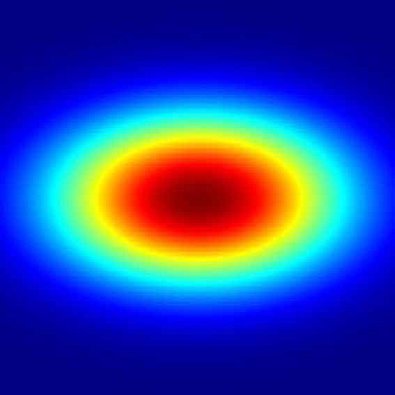
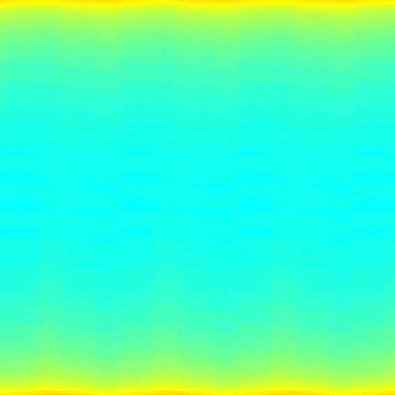
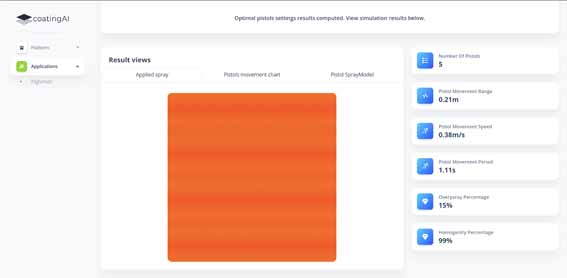
After entering all the necessary data and a few seconds of calculation time, the user receives a false-color graphic that visually illustrates the homogeneity of the expected coatings. In particular, if the number of guns is too low or feed rate too high, clear stripe patterns become visible. In contrast, an optimum is shown when the surface has a uniform color with minor deviations, often only in the edge area.
"In our tests, we have regularly achieved homogeneities at the layer thickness of 99 percent - without including other parameters such as air or electrostatics in the optimization," reports Boldrini. "Only when this basic optimization has been carried out does it make any sense at all to tackle the other parameters. In terms of parameters that can be directly influenced, what then essentially remains is the air volume and electrostatics - these are two control variables that an experienced coater can work with very well." The software tool can also set a weighting with regard to optimizing the coating efficiency or homogeneity. So when running on loss, the algorithms prioritize improving coating efficiency, whereas when coating with recovery, homogeneity is prioritized.
Man vs. machine
So how good is the optimization tool that has recently become available? For this, coatingAI has already conducted tests in the laboratories of several application manufacturers. "In two cases, we were able to improve the manually optimized system settings by around 20 percent in terms of homogeneity, and in one case our software was able to achieve the same result as an extremely experienced service technician," Boldrini tells us. "However, this person also told us that he had a lot of experience with the powder used. With an unknown powder with significantly different properties, the AI would probably have performed better in this case as well, since it does take into account the real spray jet properties via calibration."
In another experiment, a service technician's parameters were entered in advance into the AI, which then predicted slight streaking. Then, after coating with those same parameters, systematic coating thickness measurements actually showed streaking. "After an optimization run, we were able to reduce streaking by about 31 percent within the available system constellation," says Boldrini.
(Kopie 14)
Comprehensive optimization for flat parts
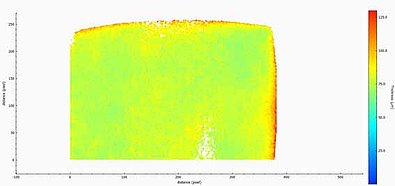
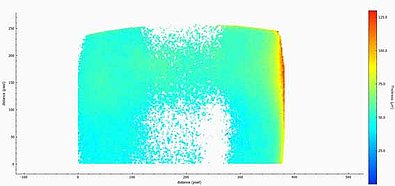
With regard to the original goal of developing a comprehensive parameter optimization for powder coating, coatingAI can also report considerable progress only about two years after its foundation. For example, the large optimization tool has already been tested and trained on flat parts in several test laboratories of application manufacturers. "We were in a pilot plant just a few weeks ago, where we were able to test our software with dense phase technology for the first time - and we were very positively surprised. It only took 3 hours to record the training data," Boldrini is pleased to report. "Indirectly, this is an indicator of the very high process stability of dense phase conveying technology. With injector systems, we usually need at least twice the time for the teach-in process. Also, the fluctuations during ongoing coating operation are naturally greater with an injector system." In the tests carried out with dense phase technology, a coating thickness of 70 µm to be achieved was initially set, and the software calculated this within a few seconds.
The measurement after coating showed coating thicknesses between 68 and 75 µm over the entire sheet with minimal edge buildup. A very good result. Then 50 µm coating thickness was targeted, a thickness that is a challenge even for experienced coaters. After determining the parameters and coating, the measurement with the Coatmaster 3D showed a decidedly homogeneous coating thickness distribution. The head of the technical center was quite impressed here, as he said that he would be confident of achieving such a coating result without AI assistance, but that he would need several days in the technical center for optimization.
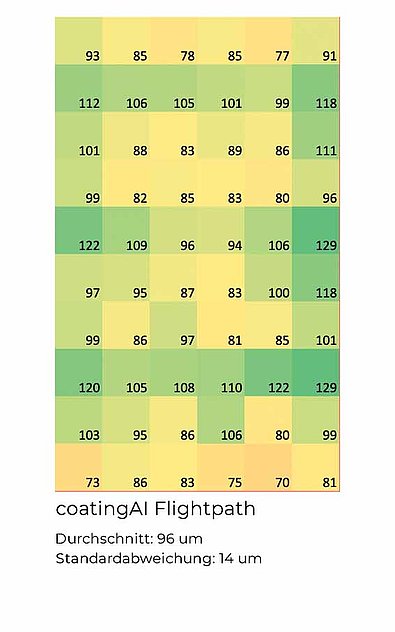

(Kopie 17)
AI development on track
This means coatingAI is well on its way to realizing its goal of comprehensive parameter optimization through AI for powder coating. With its software solutions, the young startup company is already in a position to provide the coating industry with tools that have the potential to fundamentally change the way coating parameters are developed. Not least, massive time savings and at the same time significantly improved surface qualities through AI optimization could save plant operators a lot of headaches in the future.
CB
coatingAI AG www.coatingai.com