
Plasmatreat: Plasma instead of primer
Not only energy prices, but also political constraints make saving CO2 the order of the day. Companies are thus faced with major challenges. In the pretreatment of surfaces, plasma surface technology processes represent a real alternative for meeting these requirements.
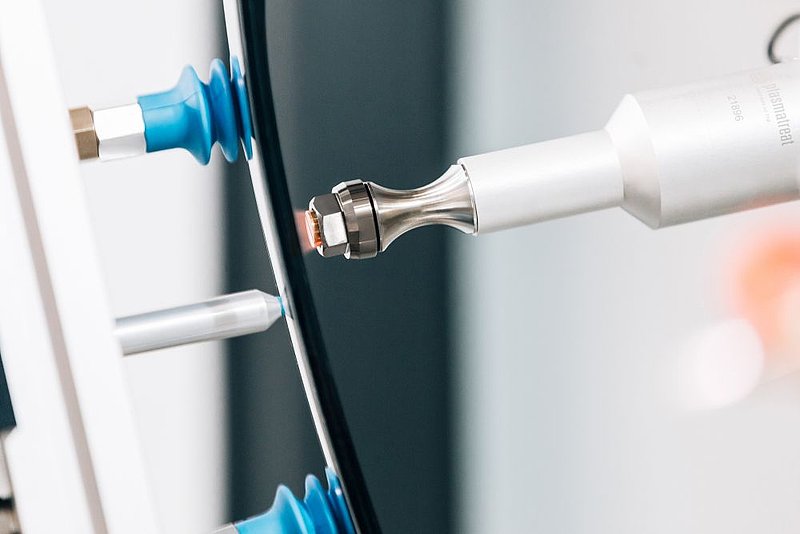
Chemical adhesion promoters or primers are often used to improve the adhesion of various materials in industrial processes. They consist of 90 to 98 percent solvents containing highly volatile hydrocarbon compounds. In addition, their production is very energy-intensive. As an alternative to pretreatment with solvent-based primers, Plasmatreat GmbH offers dry surface treatment with open-air plasma, which can be automated. Here, pre-treatment with primers can be dispensed with for the activation and fine cleaning of surfaces prior to bonding, coating, painting or sealing. Subsequently, the use of solvent-free or even water-based adhesives, paints and varnishes is possible. This significantly reduces VOC emissions during production. Energy consumption is also lower with open-air plasma: a rotating nozzle for plasma application requires hardly any electrical energy and, operated with green electricity, causes no CO2 emissions. Surface pretreatment by flaming is also usually carried out with propane or even methane gas, which causes CO2 emissions to a large extent. In contrast to flame treatment, the nozzles for open-air plasma application are operated with electricity and compressed air. If renewable energy is used for this purpose, it takes place in a completely CO2-neutral manner. Plasma also enables completely new production processes.
Saving chemistry and energy
A plasma-activated surface provides the necessary adhesion for UV-based inks, enabling users to dispense with energy-intensive ink drying sections. Another point is the substitution of expensive and energy-intensive plastics. Their production consumes many resources. Here, too, the plasma process has clear advantages. Open-air plasma can be used to modify the surface of plastics in order to improve the adhesive strength of adhesives and coatings in industrial applications, and even to bond together materials that were originally incompatible.
Users thus benefit from an expanded choice of materials. Applications from the Plasmatreat portfolio show, for example, that polypropylene (PP) as a substitute for acrylonitrile butadine styrene (ABS) not only reduces material costs, but also energy consumption during production.
Plasmatreat GmbH www.plasmatreat.de