

Researchers at IOT of RWTH Aachen University show advantages of pulsed arc evaporation

Arc PVD technology is widely used in the production of tribological and decorative coatings. By using pulsed power supply, the roughness and hardness of the coatings can be improved. Experiments show that target utilization, coating quality, and also evaporation of target materials with poor electrical conductivity are improved.
In the field of physical vapor deposition (PVD), arc PVD is one of the most widely used technologies. In addition, magnetron sputtering (MS)-PVD technology is still mainly used. In MS-PVD, the use of pulsed power supplies has long been state of the art, for example for the production of coatings for cutting tools. The advantages are a denser and finer structure of the coating, which also leads to reduced surface roughness. Furthermore, the degree of ionization is increased. In arc PVD, however, direct current (dc) technology is still the status quo, yet research has been underway for some time on pulsed arc PVD technology. Initially, the approach was to re-ignite the arc for each pulse through a trigger unit [1]. The current advancement involves superposition of base and pulse current [2] to avoid repeated ignition of the arc. In this case, the base current stabilizes the arc and the pulse current achieves a positive influence on the process and coating.
Pulsed arc evaporation at IOT
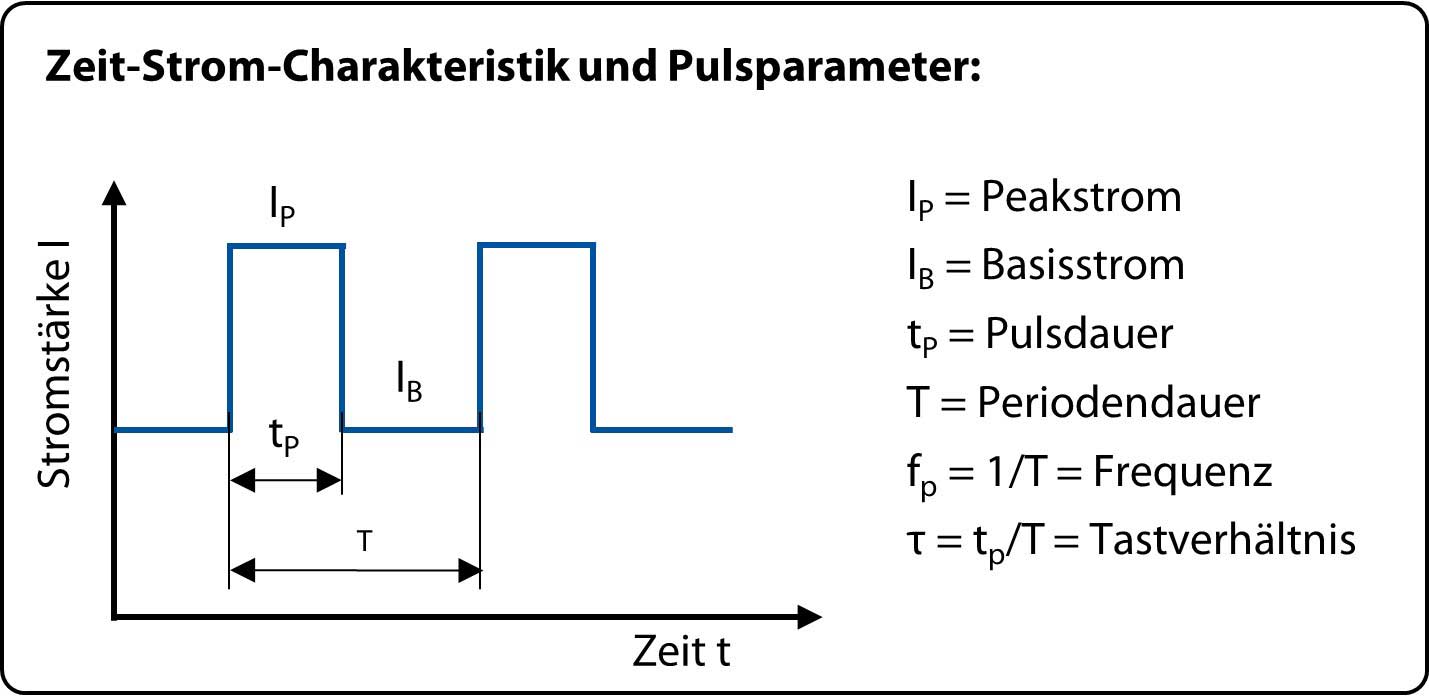
At the Institute for Surface Technology (IOT) of the RTWH Aachen under the direction of Prof. Dr.-Ing. Kirsten Bobzin, the research project TRISTAN (AiF/ 20431 N) funded by the German Federation of Industrial Research Associations "Otto von Guericke" e.V. (AiF) was carried out. One of the objectives was the further development of pulsed arc PVD technology. To this end, the pulsed power supply Plasmatec from J.Schneider Elektrotechnik GmbH was installed at the IOT in the industrial arc PVD system Flexicoat 850 from the Dutch company IHI Hauzer Techno Coating B.V. (see Figure 1). This pulsed arc power supply technology was introduced in the mid-2000s for arc evaporation of large area targets, modular for target currents from I = 200 A to 400 A and highly scalable up to I = 1600 A if required. Later, this technology was further developed by J.Schneider Elektrotechnik and 4A Plasma, Holzgerlingen. Higher frequencies, improved response characteristics and a large number of freely selectable parameters were added. Special emphasis was placed on a controlled switch-on process during ignition. In most cases, the power supplies used up to that point exhibited the usual overshoot behavior during ignition of the arc, which is increased by a multiple of the set current value. With an uncontrolled current increase during the ignition process, most droplets and usually deep arc explosion trenches are formed on the target surface, which can contribute to the formation of further droplets on the substrate. Another feature of this pulsed arc current delivery technology is the steep current rises and rapid decay from maximum current to base current, Figure 2. This fundamentally contributes to higher ionization. The advantages of the pulsed arc current supply technology can be complemented and optimized by pulsed bias voltages (Uni-Polar as well as Bi-Polar). Figure 3 shows the time-current characteristics of the Plasmatec power supply as it was used in the TRISTAN research project.
Advantages of pulsed arc PVD for CrAlN coatings
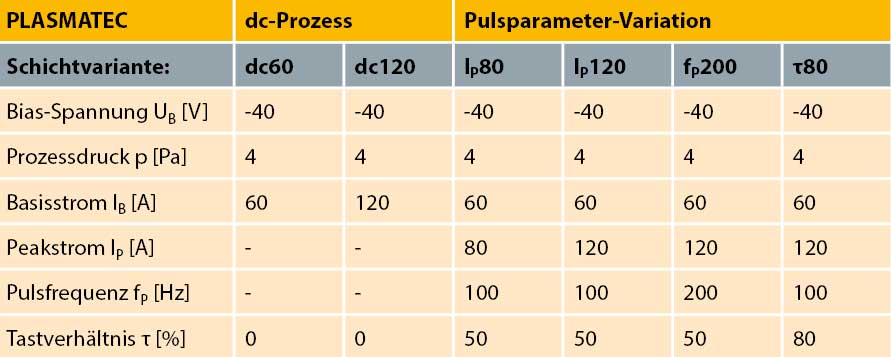
In order to investigate the influence of the pulsed technology on the properties of the coatings, a series of tests on CrAlN coatings was carried out. This coating system represents a hard material coating, which originates from the field of tool coatings and is also promising for use on highly stressed machine elements such as rolling bearings [3]. First, two dc reference coatings were prepared using the Plasmatec power supply in dc mode. That is, the pulse parameters were set to produce a dc pattern and thus no pulses were present. The base current was varied at the IB = 60 and 120 A levels. Subsequently, four CrAlN coatings were fabricated with pulsed power supply. The peak current IP, frequency fP and duty cycle τ were varied compared to the reference coating "IP120". Table 1 lists all pulse parameters of the coating variants.
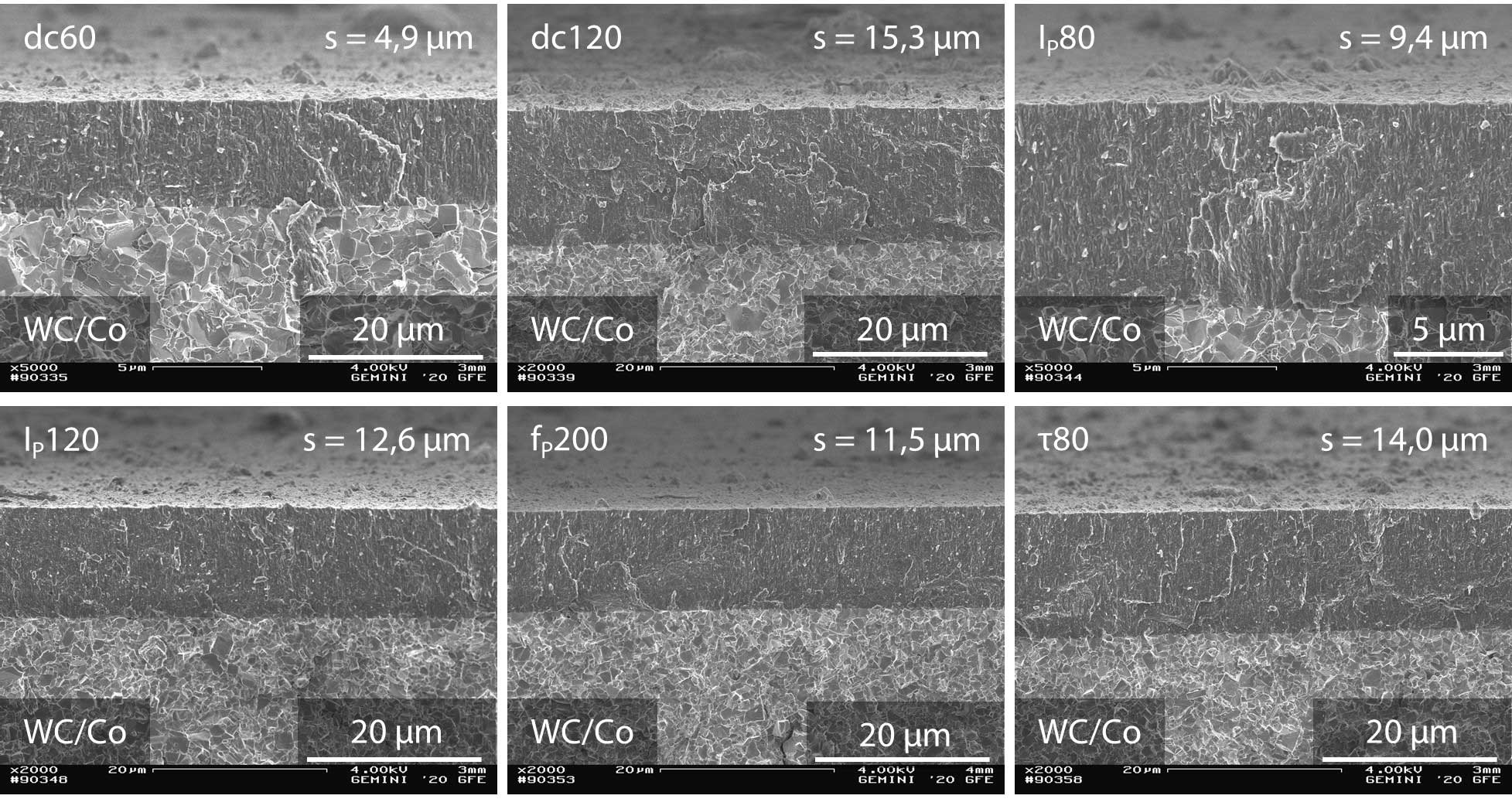
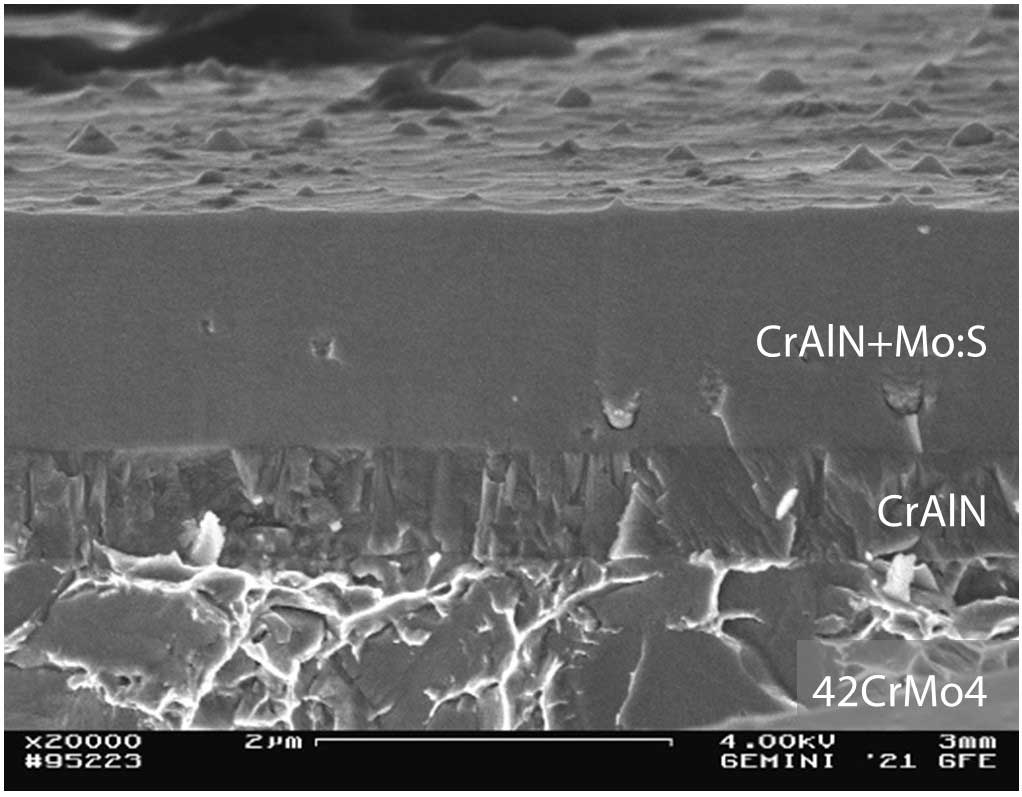
Figure 4 shows transverse fracture images of the coatings from Table 1. The images were taken by scanning electron microscopy (SEM). The comparison between the dc60 and IP80 coatings is worth highlighting. By superimposing a peak current of IP = 80 A on the base current of IB = 60 A, the deposition rate was significantly increased. The roughness of the coatings was determined according to DIN EN ISO 25178 using a confocal laser scanning microscope (KLM). Despite a higher energy input during the process, the measured surface roughness of the IP80 coating is Sa = 0.08 µm while the dc60 coating is Sa = 0.13 µm.
(Kopie 6)
(Kopie 8)
Acknowledgements
The authors would like to thank the German Federation of Industrial Research Associations (AiF) and the European Thin Films Research Association (EFDS) for financial support of the TRISTAN research project. (EFDS) for the financial support of the TRISTAN research project (AiF/ 20431 N) and to all members of the project advisory committee: 4A-Plasma, Holzgerlingen; Avaluxe International GmbH, Fürth; CemeCon AG, Würselen; Evochem Advanced Materials GmbH, Offenbach am Main; FHR Anlagenbau GmbH, Ottendorf-Okrilla; Plansee Composite Materilas GmbH, Lechbruck am See; GKN-Driveline International GmbH, Lohmar; Güdel Group AG, Langenthal; IHI Hauzer Tecno Coating B.V., Venlo, Netherlands; J. Schneider Elektrotechnik GmbH, Offenburg; Robeko GmbH & Co. KG, Mehlingen; Schaeffler Technologies AG & Co. KG, Herzogenaurach.

Bibliography
[1] Boxman, R. L.; Goldsmith, s.; Shalev, s.; et. al: Fast deposition of metallurgical coatings and production of surface alloys using a pulsed high current vacuum arc, Thin Solid Films (1986). doi.org/10.1016/0040-6090(86)90046-5 [2] Hettkamp, E.: Magnetic influence of pulsed processes in vacuum arc discharges, PhD thesis, Otto-von-Guericke-University Magdeburg (2006) [3] Bobzin, K.; Gold, P. W.; Nickel, R.; et. al.: PVD coatings for dry-running hybrid antifriction bearings, Vacuum in Research and Practice (2007),
https://doi.org/10.1002/vipr.200700313
IOT - Institute for Surface Technology www.iot.rwth-aachen.de