


Vehicle coatings cleverly metered
Pumpen von Timmer sorgen für Prozesssicherheit im Labor
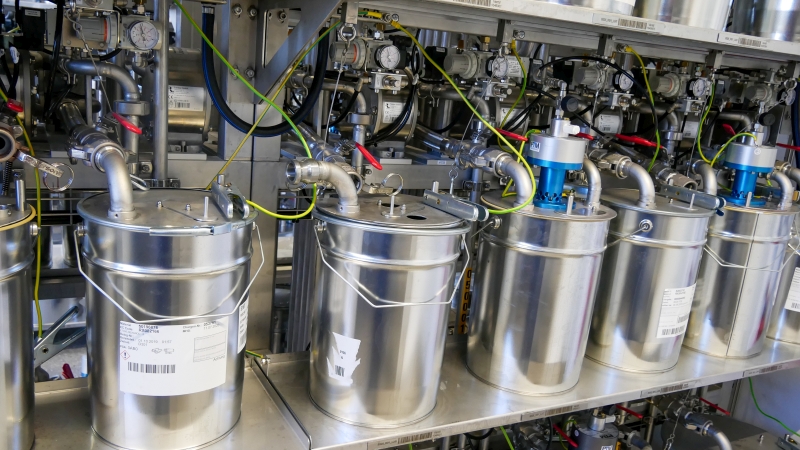
At 300 dosing points, the central raw material supply of the dosing machines in the modern BASF Lean Lab is carried out by means of double diaphragm pumps. The pumps from Timmer play a significant role in process reliability in the laboratory.
The market for automotive coatings has developed dynamically in recent years. Technological advances and customer demands have led to a growing variety of coating options. In the course of this development, the complexity of the production processes increased. High flexibility is expected from the series paint manufacturer. "The coating must match the requirements of the coating lines - not the other way around," emphasizes Susanne Richert, Project Manager Site Development at BASF. "Suppliers must therefore demonstrate comprehensive knowledge and also be able to supply as many vehicle series paint products as possible." For these reasons, BASF launched the Lean Lab modular laboratory concept. "With the help of the Lean Lab, we were able to implement work-sharing process structures within paint laboratories as well as the digital recording and control of all manufacturing processes," says Richert. Using special software, BASF networks all the integrated work areas with each other and can thus centrally coordinate and control the entire supply of raw materials. This speeds up the work processes considerably, as the raw materials are always available at the right time and in the right place.
In the past, the development of coatings consisted largely of manual labor. Laboratory staff added specific quantities of raw materials to the overall mixture by pipette. Today, this happens to a large degree automatically. "In the Lean Lab, a laboratory dosing machine specially developed for this purpose is used to automate recurring work steps," explains Alexander Blaser, responsible for automation and digitalization in the Lean Lab at BASF. In concrete terms, this means that employees select a specific stored product at the system, the system calls up the corresponding recipe and mixes the raw materials together in a precise ratio. This ensures that the quality of the initial mixture is consistently high.
(Kopie 3)
Konsequente Pumpenleistung
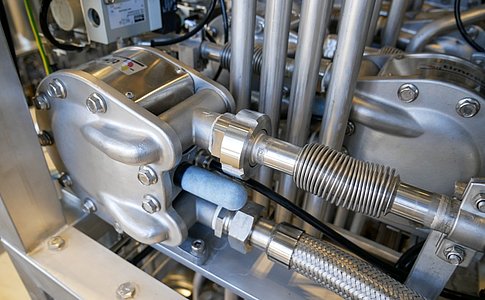
Efficient double diaphragm pumps from Timmer GmbH make this automation possible - they are the heart of the plant and elementary for its functionality. This is because the central raw material supply of the more than 300 dosing points available via the automatic dosing system takes place by means of the Timmer pumps. The materials are conveyed, metered and regularly recirculated via these pumps. BASF works with several hundred raw materials for the development of the coatings, which have different properties. "The raw materials to be metered differed greatly in their flow behavior and the high range of viscosities. Without constant pump performance, metering accurate to the gram is not feasible," Blaser says.
With the Timmer pumps, BASF can convey almost all materials. One advantage of the Timmer pumps is their compact design and ease of operation. Compared to conventional versions, the double-diaphragm pumps are only about half the size. Since BASF has several hundred pumps in use, this saves the company considerable space.
At the same time, the Timmer solution allows for simplified access. If certain pumps need to be inspected, they can be removed without complication. The pumps have a low starting pressure. While conventional variants require around 1.5 to 2 bar of starting pressure, only 0.5 bar is sufficient with the Timmer solution; one bar is enough to operate reliably. This leads to significant energy savings in the medium and long term, as less compressed air is required. "A high start-up pressure is basically like driving a car with the handbrake on - the consequences are high energy consumption and wear. That's why it should be as low as possible," explains Stefan Anstöter, market development at Timmer. This also has a positive effect on the flushing of the lines. BASF is able to flush the entire system completely with low pressure. This process is necessary to remove even the finest residues, such as small paint pigments, from the pipelines. Because the pumps are so small and compact, less residue is deposited. The loss of raw materials due to residual emptying during the flushing process is also correspondingly low. BASF thus saves costs, as some raw materials are extremely expensive to procure.
In addition, a standstill of the pump is impossible. This is ensured by a ceramic snap-action valve, which is particularly low-wear. All parts that move in the heart of the Timmer pump are made of ceramic in combination with finely ground high-performance plastics. This results in minimal wear in the valve itself. Added to this is the use of a short-stroke principle that is gentle on the diaphragm. This also results in lower pulsation - i.e. fewer pressure surges in the line. High pulsation can lead to distortions in the measurement of the raw material quantity. On the other hand, the Timmer solution has a so-called latching function. If the flow rate is too low, conventional pumps often stop and then do not restart on their own. With the Timmer pumps, on the other hand, BASF can pump raw materials even in minimal quantities without any problems. BASF was able to optimize the quality of the paint samples and use the efficiencies to increase the speed for the customer.
Timmer GmbH www.timmer.de
(Kopie 5)