


How paint drops get onto surfaces
Ein Forschungsprojekt untersucht die Vorgänge beim Auftreffen von Lacktropfen auf Lackoberflächen
Oliver Tiedje, Qiaoyan Ye, Philipp Knee, Fabian Seeler, Joachim Domnick, Bo Shen
In spray painting, the paint droplets have an impact velocity of about 20 to 30 meters per second - surprisingly low, considering how fast they start at the atomizer. Fraunhofer IPA and Esslingen University of Applied Sciences are researching the underlying processes.

(Kopie 2)
The spray painting process consists of material supply, paint application, flash-off and baking. Paint application is the most dynamic part of the process, as a lot happens in a very short time: It starts with the generation of small paint droplets, which then fly to the object to be painted under evaporation, and finally hit the substrate. While many studies are concerned with atomization and droplet flight, only a few fundamental studies are devoted to droplet impact in the case of coating applications. Yet it is precisely the moment of drop impact that is decisive for important quality properties of the painted surfaces such as color effect, appearance or air inclusions. This situation should be improved by a project at Fraunhofer IPA and Esslingen University of Applied Sciences, which was completed this April.

Abgebremst und abgelenkt
Spray painting produces droplets of different sizes and speeds, depending on the application technique used(see table below and Figure 3 on page 34). Interestingly, in most cases the droplets are relatively slow, considering that the droplets start at the atomizer at 100 to 200 m/s - as fast as an airplane. This is due to the dynamic pressure field of air in front of the paint object, which slows down and also deflects the drops, causing many drops to hit at a shallow angle. When the drops hit the substrate, the superposition of the individual drops creates a so-called initial mountain. At the same time, existing effect pigments will align and entrapment of air may occur. This was considered in the project by experimental investigations using a high-speed camera and numerical calculations using computational fluid dynamics, or CFD.
The aim of the investigations is to develop optimizations both for the coating material and for the process conditions. The aim is to avoid rejects due to coating defects - such as air inclusions - and to achieve a good appearance. In addition to the gloss level, this also includes a low level of waviness, also known as orange peel, and, depending on the coating, a strong pearl or metallic effect. It is also important to avoid coating accumulations such as runners and greasy edges, as well as lean areas on edges with resulting functional defects - for example in the form of edge corrosion.

Methoden
The numerical simulations used here are based on fluid dynamics, in particular the volume-of-fluid or VOF method: The simulation area is divided into small volume elements, with the percentage of the volume filled with paint being calculated for each element and each time step. In particular, the real rheology - especially the shear-thinning behavior - of coatings must be taken into account. A general challenge in simulations arises when different time scales play a role: Drop impact dynamics in a few milliseconds and paint film progression in several minutes. This is solved by performing the impact dynamics with the CFD simulation described above, but the slower progression with the "PaintVisco" model, which incorporates the complex visco-elastic properties of paints.
In the experimental methods, the precise determination of the material properties is crucial. In addition to the determination of surface tension and rheology measurements using rotational viscometers, the use of the capillary viscometer is particularly relevant here. This can also be used to achieve the high shear rates that occur during atomization and droplet impact. At typical shear rates of more than 1/s-1, the viscosity of many coatings is reduced to less than 20 mPas, which then has a favorable effect on the flow behavior and also on the deaeration of the coating droplets and coating layer.
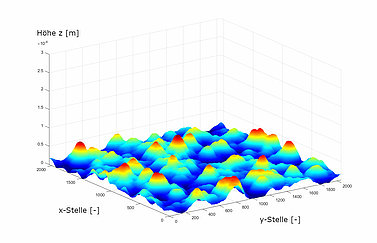
Furthermore, in this project Fraunhofer IPA uses laser diffraction to determine the size of the droplets, laser Doppler measurements for velocity measurement and a high-speed camera to visualize the impact dynamics. The latter method requires a very fast camera - for example 32,000 frames per second - on the one hand and a very high resolution of a few micrometers per pixel on the other. This method was used to investigate, on the one hand, the defined impact of a single droplet - as in overspray-free coating - and, on the other hand, paint sprays using commercial atomizers. On impact, the individual droplets form a "mountain range" (see Fig. 2), which then gradually becomes more or less well structured during the flash-off time and in the oven. The more structured the "mountain range" is, the more orange peel the paint surface may then have at the end.
Paint film structure
It usually results, for example, that finer atomization leads to a lower "mountain" and thus to a better paint film structure, especially in the long-wave range. Unlike the mountain range, the mountains here are not particularly high, namely only a few micrometers.
However, the project brought other details to light, showing that an impacting droplet can create a crater when it strikes an existing wet paint film (see Figure 1). The size of the crater is then a factor for the occurring wavelengths of the orange peel, i.e. , whether rather a short wavelength or long wavelength is produced. In the simulations, different phenomena appear when the coating drop hits the coating film: very slow drops simply settle gently on the film, faster ones make a crater, and very fast ones at low viscosity show a crown as known from control drops in a puddle. Splashes only occur in extremely rare situations during painting.
Air pockets
When a large drop hits, air can be trapped underneath in the form of small bubbles (see Figure 5). If these bubbles cannot escape - which is where the defoamers in the coating are supposed to help - but poke through the almost solid coating very late in the coating dryer, coating defects called pinholes form. The simulations showed that large, fast and highly viscous drops in particular contribute to strong air entrainment. The air escapes slowly, especially when the bubbles touch the substrate. Due to the surface tension, the bubbles "stick" to the interface and at the same time can only move well parallel to the interface, resulting in larger bubbles as a result of coalescence.
Practical process optimization can thus be achieved by controlling the coating rheology so that at extremely high shear rates of 100,000 s-1 the viscosity falls below 20 mPas and large drops are avoided. In the case of high-rotation atomization, the latter can be achieved, for example, by using a suitable - knurled - bell disk, or by adjusting parameters such as the ratio of ink volume to rotational speed.
Pigment orientation
The final topic addressed by the project was the orientation of effect pigments. It was possible to integrate flat pigments into the simulation model, as used for metallic or pearl effects (see Figure 4). Together with the orientation during film shrinkage, the orientation of the pigments is decisive for the strength of the desired effect. Again, the size and impact velocity of the droplets determine whether the pigment has an initial orientation before subsequent drying, or becomes completely randomly oriented at the moment of impact.
For all the issues addressed, viscosity is the decisive property of the coating, along with surface tension. In this context, the determination of the relevant viscosity is quite complex. First, droplet flight leads to evaporation of solvents or water, which increases the viscosity. Then, in the first milliseconds of impact, a strong flow with high shear rates occurs, causing the viscosity to drop massively again in the case of structurally viscous coatings. In addition, so-called extensional currents also become effective, which also affect the flow behavior (extensional viscosity). Depending on the thixotropy of the coating, the viscosity then recovers again in seconds or minutes.
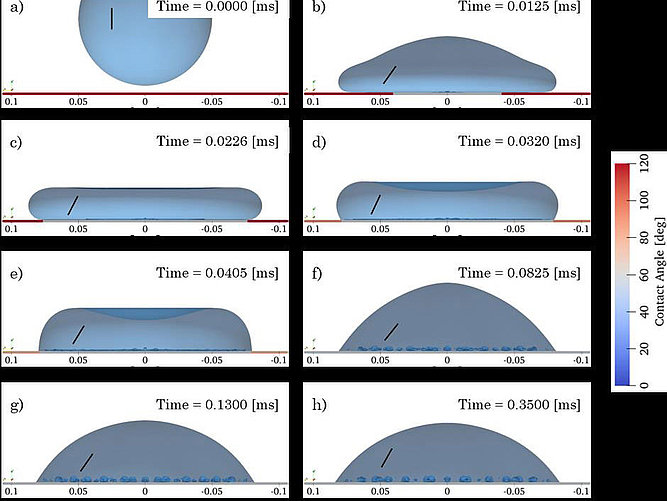
Another control lever is the dynamic contact angle, i.e. the way the contact line between the coating and the substrate advances: It can be seen (see Figure 4) that the angle between the coating and substrate is different during spreading than during contraction, which is usually observed shortly after impact.
Conclusion
In the spray painting process, fractions of seconds are decisive for many properties of a paint film. Depending on the size and speed of the droplets, the cornerstone for color, appearance and paint defects can be laid at the moment of droplet impact. Application parameters such as the fineness of atomization and paint properties as well as the complex rheology settings are levers for controlling the quality in the best possible way.
Fraunhofer Institute for Manufacturing Engineering and Automation IPA
www.ipa.fraunhofer.de