

Clear coatings with good looks
Realizing extravagant designs with stratifying effect pigments

Fraunhofer IPA incorporates effect pigments into the clear coat layer rather than the base coat layer. This makes it possible to create new stylings and significantly increase the intensity of the effect.
Effect colors bring surfaces to life in a special way. They are therefore very important in the automotive industry. Traditionally, effect colors are achieved by pigmenting the basecoat. However, the disadvantage of this is that only a fraction of the effect pigments are visible, especially in the case of well-covering basecoats. The majority of the remaining color pigments are covered. Particularly in the case of white color shades, the titanium dioxide contained weakens the effects considerably or even prevents them completely due to diffuse light scattering. This problem can be solved by so-called stratifying clearcoat systems. These clearcoats contain the effect pigments in areas close to the basecoat. In this way, the desired pearlescent effect is also achieved, so that with stratifying clearcoats, the pearlescent shine appears to come from the depths. In the clearcoat, the incident light beam hits the effect pigments much more intensively than in highly pigmented basecoats. As a result, particularly brilliant, robust and also very pronounced effects can then be achieved, although the pigmentation level is often only a fraction of that of a basecoat with similar effect characteristics.
Efficient and robust effect designs
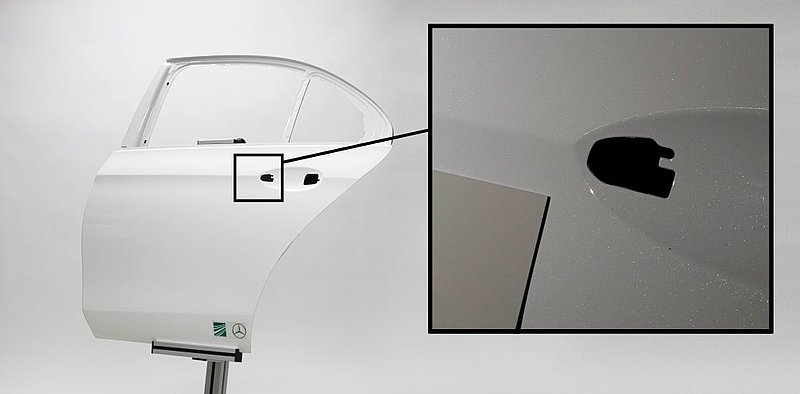
The color effects that can be achieved with clearcoats also prove to be much more robust during application than effects from basecoats. This is because in clearcoats, the entirety of the effect pigments always plays a role in determining the effect, whereas in basecoats, only the upper areas accessible to incident light have an intensive effect. Deviations in the orientation or vertical distribution of the effect pigments are therefore hardly or not at all visually apparent. However, the aspects mentioned above can only be realized if the effect pigments accumulate in the lower areas of the clearcoat layer during or after application, i.e. stratify towards the basecoat layer. Only in this case does an essentially pigment-free upper clearcoat layer form, which ensures that there are no negative effects on surface gloss, performance and weather resistance. No adverse aspects are then to be expected either with regard to the polishability and reparability of the topcoat. This is because, in the event of damage, the damaged area is polished up and, if necessary, touched up with an established, conventional repair paint. If the damage should be deeper and rather extensive, it can be repaired with a stratifying repair topcoat system. For some time now, the Fraunhofer IPA has been working on stratifying paint systems in which the pigments themselves, rather than the usual binder components, stratify. Pigments have the advantage that already established paint structures do not have to be changed, or only slightly, by adding small amounts of the stratifying pigments.
Surface modification controlled pigment stratification
Since the components of the coating material only need to be adjusted slightly, paint shops can continue to operate with the original settings. In addition, the risk that the tests required for release will fail is reduced. A special surface modification for pigments and particles developed at Fraunhofer IPA is used for pigment stratification. According to this method, the driving force for stratification is based on thermodynamic effects, which are caused by a targeted control of surface energies at the respective pigment surfaces. In this way, the desired effects can be brought about in a controlled manner by the pigments treated in this way in the clear coat.
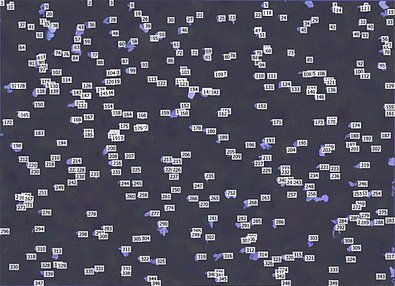
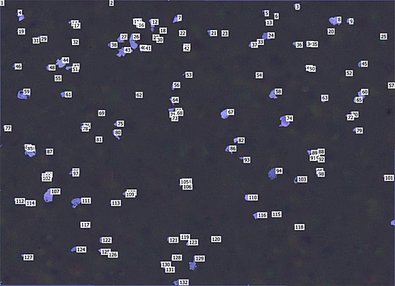
Figure 1 and 2 (top): Evidence of pigment stratification by laser scanning microscopy by evaluating the number of particles in the upper quarter of a clearcoat layer for a commercial effect pigment (top) and the corresponding additionally surface-modified effect pigment (bottom). Figure 1 clearly illustrates the stratification of effect pigments achievable in automotive clearcoats by means of laser scanning microscopy. If the pigment content in the upper quarter of the coating layer is compared for a non-modified and for the corresponding surface-modified pigment, it can be seen that the surface-modified pigment is significantly depleted in the upper quarter of the coating layer compared to the statistical value of 25 % pigment content, while the non-modified pigment actually accumulates on the surface, presumably as a result of reduced wetting.
Fraunhofer Institute for Manufacturing Engineering and Automation IPA www.ipa.fraunhofer.de