

Clear conditions thanks to cone hat
Process water faster: A clear water drain significantly reduces the processing time
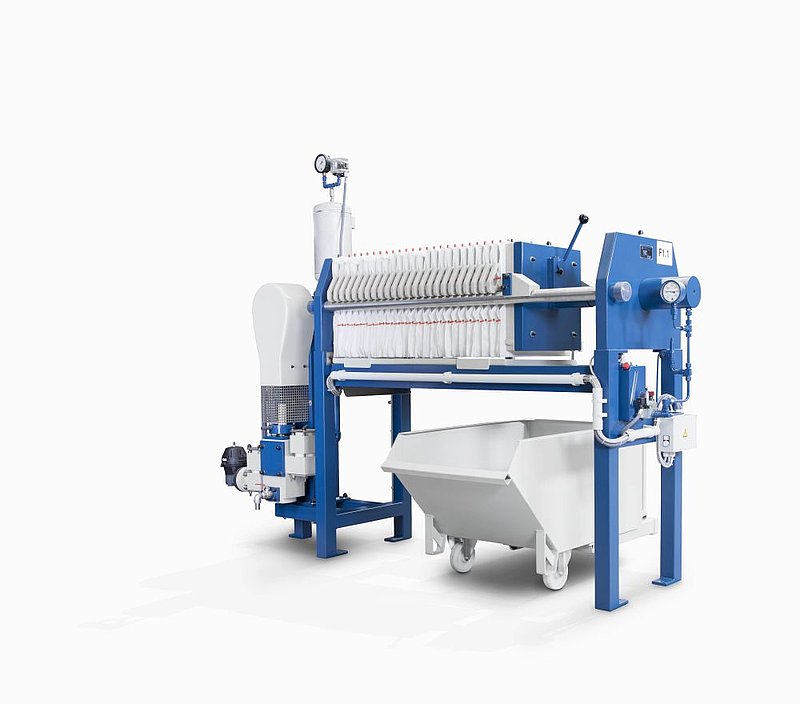
For the treatment of process water after vibratory finishing, an automotive supplier has commissioned a new flocculation plant. Since only part of the process water passes through the filter press, it achieves high efficiency.
Coprotec, a medium-sized company with one site each in Germany and Bosnia and Herzegovina, supplies precision parts made of steel and non-ferrous metals to customers in the automotive supply industry, mechanical engineering and other sectors. For vibratory finishing Coprotec operates more than 20 systems at both locations. These include trough vibrators, round vibrators and several centrifugal machines of various sizes as well as smaller test facilities for prototypes. The systems are interlinked with part feeders, part dischargers and dryers to enable economical processing. Customers from the automotive industry in particular, but also from the mechanical engineering sector, place high demands on the surface quality and cleanliness of components. This applies, for example, to components of transmissions, injection systems or vehicle interiors, but also to bearings and guide systems in linear technology. Customers expect finished components which they can process, assemble or install directly. For this reason, Coprotec has been using fresh water in its vibratory finishing systems for years. This eliminates the need for subsequent cleaning and preservation, and thus a further cost-intensive work step.
Investment in a new plant was necessary
For 20 years, Coprotec had been using a GA 20 treatment plant from Walther Trowal to treat its process water, without ever experiencing a malfunction in the wastewater discharge or even exceeding the official limits. However, as the company has grown steadily over the years, the capacity of this plant was no longer sufficient. Also, after this long period of operation, the pump and control technology was no longer state of the art. In addition, the extension of the official permit was pending. A decision had to be made: Should the operation of the existing plant be applied for again for a few years? Or would it be better to invest in a new plant? Since Coprotec's planning horizon for processes of this kind is at least ten years, the task was to find a long-term and future-proof solution. One argument against retrofitting the old plant was that it would have been very expensive to bring it up to a level that would have been approvable for the next two decades. In addition, its capacity would not have been sufficient for the increasing demand. For this reason, the joint project team of Coprotec and Walther Trowal considered a new plant. In addition to a significantly higher capacity, this was to be equipped with an improved control system and a clearer visualization of the plant status. And it was to be easier to operate than the old plant. The decisive factor, however, was that the new plant guaranteed both improved process safety and higher availability and reliability. This is because the new GA flocculation plant processes the water from currently twelve production plants. If a malfunction occurred, all vibratory finishing systems in the plant would have to be shut down.
The cone hat separates the sludge from the water
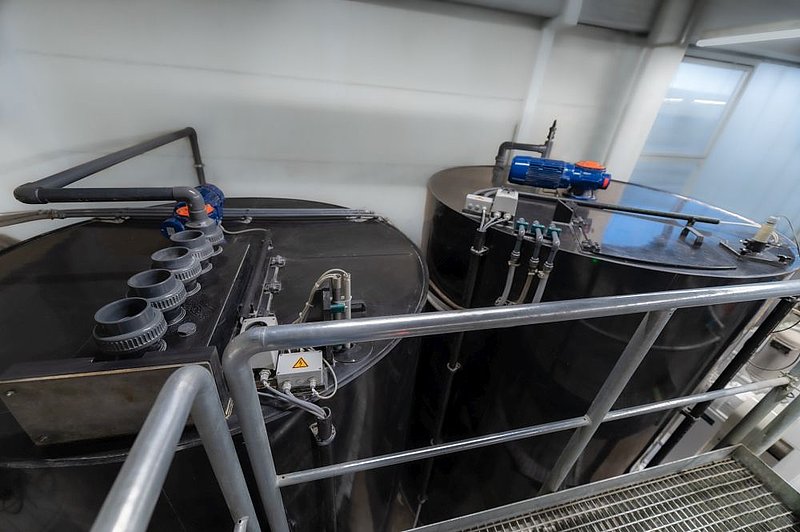
Walther Trowal proposed to install a GA 30 flocculation plant with a technical maximum capacity of up to about 70 cubic meters per day, in which the process water is flocculated in batches. Coprotec currently uses a capacity of 40 cubic meters per day, so as planned there are corresponding reserves. An expansion of capacity to the technical maximum is possible at any time - subject to official approval. The new buffer tank, in which the process water is collected before flocculation, should have a volume of eight cubic meters instead of the five cubic meters of the old plant. A key feature of the GA 30 is the clear water drain. It significantly reduces the processing time compared with conventional plants, because only part of the process water has to pass through the chamber filter press. Once the flakes have settled, the sludge accumulated at the bottom of the tank is dewatered in the filter press. The filtered water is discharged into the sewer system, and the sludge is disposed of. The crystal-clear water that has collected in the upper part of the tank at the end of the process is so clean that - after a check of the pH value - it can also be discharged. The design element that makes this possible is the so-called cone hat. This is a cone that separates the zone where the sludge collects from the clear water zone. When the pump is working, the cone hat prevents the sludge and clear water from mixing again. The wastewater treatment is fully automatic. In this way, a batch can also be treated at night if required.
Rapid implementation, no downtime during operation
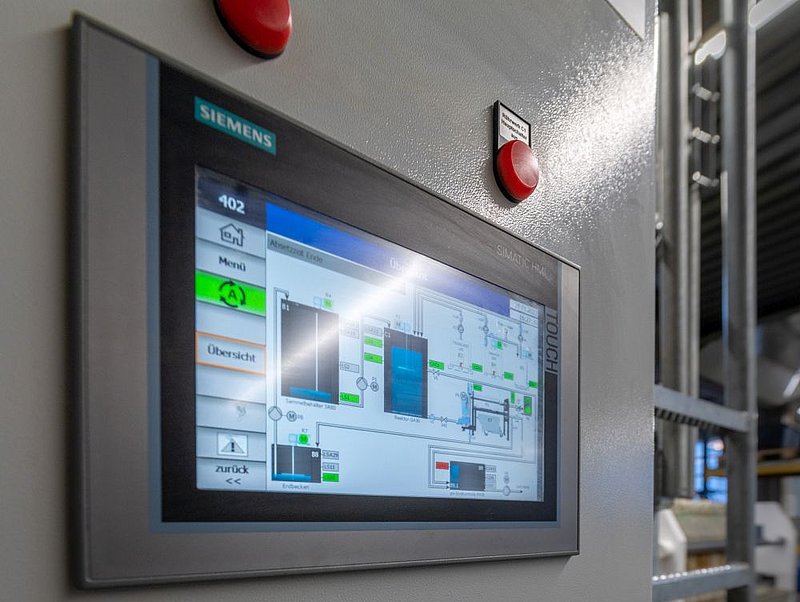
The Coprotec team worked together with Walther Trowal to develop a new concept that incorporated the many years of experience gained in operation with the previous plant and whose control system meets individual requirements. One example: While the old plant only had a two-line display, the entire process is now shown graphically. Specific requirements of Coprotec, such as an extended capacity of the filter press, additional monitoring sensors, or special containers for the treatment media, were discussed together in the team and adapted accordingly by Walther Trowal in the course of the project. For the water law request, Walther Trowal Coprotec provided extensive technical documentation. The project team then actively sought talks with the water authority. The result was that the office granted the discharge permit for the requested 20 years without imposing any new conditions. As the previous plant ran for many years without exceeding any limit values, the authority was also able to significantly extend the intervals for the legally required self-monitoring with regular sampling, which significantly reduces the costs for Coprotec for external laboratory analyses. The preliminary plant acceptance test in Haan went off without a hitch, and following fine-tuning of the process by Walther Trowal specialists on site, the plant has been in operation since the beginning of 2020. The new GA 30 fully meets the requirements for quality and process reliability as well as component cleanliness. The evaluations of the annual reports from 2020 and 2021 show operation without exceeding the limit values. There have been no failures to date and the desired availability has been achieved. An essential element of the project's success was the good cooperation of the contact persons, who had already successfully implemented several projects over 25 years, as well as the extensive experience of the operators with the old plant.
Everything in view thanks to the graphic touch panel
The new, graphic touch panel with its tidy, clean user interface shows the current P&I flow diagram, for example the water levels in the tanks, and also the switching status of various valves and sensors. In this way, operators recognize irregularities immediately and can act quickly. The larger buffer tanks, which now hold a volume of eight cubic meters instead of five cubic meters, have also proven their worth. In this way, the maintenance teams have more time and the vibratory finishing systems can run longer. The chamber filter presses come from a supplier with whom Walther Trowal has been working for decades. They are extremely durable and, with good care, will run virtually indefinitely. The new plant provides sufficient capacity for the company's further expansion in the future. However, the old plant also continues to do its job. It has since been given a general overhaul and is now operating at the plant in Bosnia and Herzegovina, where it is very well suited to the product range there - a convincing example of sustainability in production, because a plant that is given a second life does not consume any resources for production.
Circulation or throughfeed
Coprotec initially used vibratory finishing systems with a circulation system. However, due to the high variety of products to be processed and the high cleanliness requirements, the continuous flow system with fresh water proved to be more advantageous and flexible over time. It enables each individual vibratory finishing system to be supplied with the appropriate process medium at any time. This means that they can be operated with the most suitable medium in the various phases of processing. During degreasing, for example, it is now possible to start with a high dosage and switch to a lower dosage in the second step. In the final minutes of processing, a process medium is then used that ensures high corrosion protection. The continuous system is also more suitable for Coprotec in terms of process reliability, because vibratory finishing should be carried out under consistent conditions at all times. This is best achieved with water that is taken from the drinking water network day in, day out at the same quality and temperature. This ensures that there are no fluctuations in the process. Since the process water only runs through the system once, its properties - for example, foam formation or cleaning performance - can be individually controlled for each vibratory finishing system. In addition, the consumption of process media and additives is low. In addition, there is no need to install cooling units, which are required in recirculating systems for high plant throughputs in three-shift operation. Concerns about the environmental friendliness of the continuous flow process have also been dispelled, because the incoming water is not actually consumed: it is merely used and returned to the water cycle at the end of the process with almost drinking water quality.