
Paint inspection with terahertz waves
Mehrschichtlackierungen zerstörungsfrei analysieren
Precise adherence to coating thicknesses is an important quality parameter in modern automotive coatings. The problem here is that the non-destructive methods commonly used today often fail with multi-layer systems. A new type of paint inspection system based on terahertz waves promises an industrial solution.
Modern car paintwork should not only shine, but also protect the car body from corrosion, scratches and the effects of the weather. That is why the structure of a car paint job has become quite complex. Various technologies are used in series production painting, and only when they interact do they make a car paint job perfect. But also rotor and turbine blades, ship hulls or even tablets are refined by multi-layer coatings and paints.
In quality inspection, it is not enough to record the total thickness of a coating. Increasingly, thickness control of the individual layers within a multilayer system is required. In terms of resource conservation and quality control, the industry is very interested in measurement technology that can detect single layer thicknesses in multi-layer systems. Multilayer analysis on plastic substrates in particular is coming into focus as these are increasingly used to reduce weight and costs. Car manufacturers, for example, are increasingly processing CFRP to build lighter and more efficient cars. Here, too, each individual coating layer determines the functionality of the entire coating.
Thickness of the wet layer is crucial
The required thickness of the dry film is often determined from the thickness of the wet film and the solids content of the coating. If a layer is applied too thinly, neither protection nor hiding power will be sufficient. Further coating costs energy, time and money. However, if the coating film is applied too thickly, defects such as cracking and peeling are imminent, and drying times also increase significantly. Traditionally, measuring combs or measuring wheels are used to measure coating thickness on wet films. These are immersed in the wet film, and its thickness is determined from the wetted teeth. A newer method is based on eddy current technology: Here, a sensor is equipped with spacer pins that are immersed in the wet film. Neither method is suitable for automated non-contact online process control.
In order to control the coating process during application, it is necessary to determine the thickness of the wet film online. The particular challenge here is that the composition of the material changes during drying, because solvents and water evaporate. The material composition therefore changes continuously.
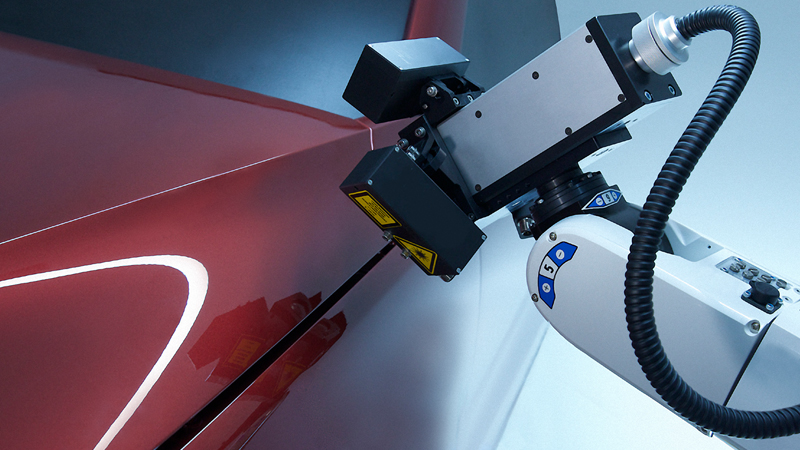
Currently, only terahertz measurement technology can examine wet films in the industrially relevant thickness range of 10 to 500 µm per individual layer non-destructively and without contact. This has been demonstrated by the Fraunhofer Institute for Industrial Mathematics ITWM in Kaiserslautern in cooperation with industrial partners. The compact and long-term stable measuring system designed for industrial use is based on terahertz time-domain spectroscopy. A measuring module connected to the base unit via optical fibers allows easy integration into existing production processes.
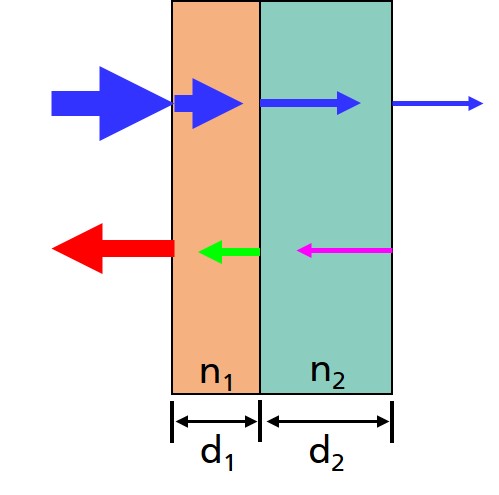
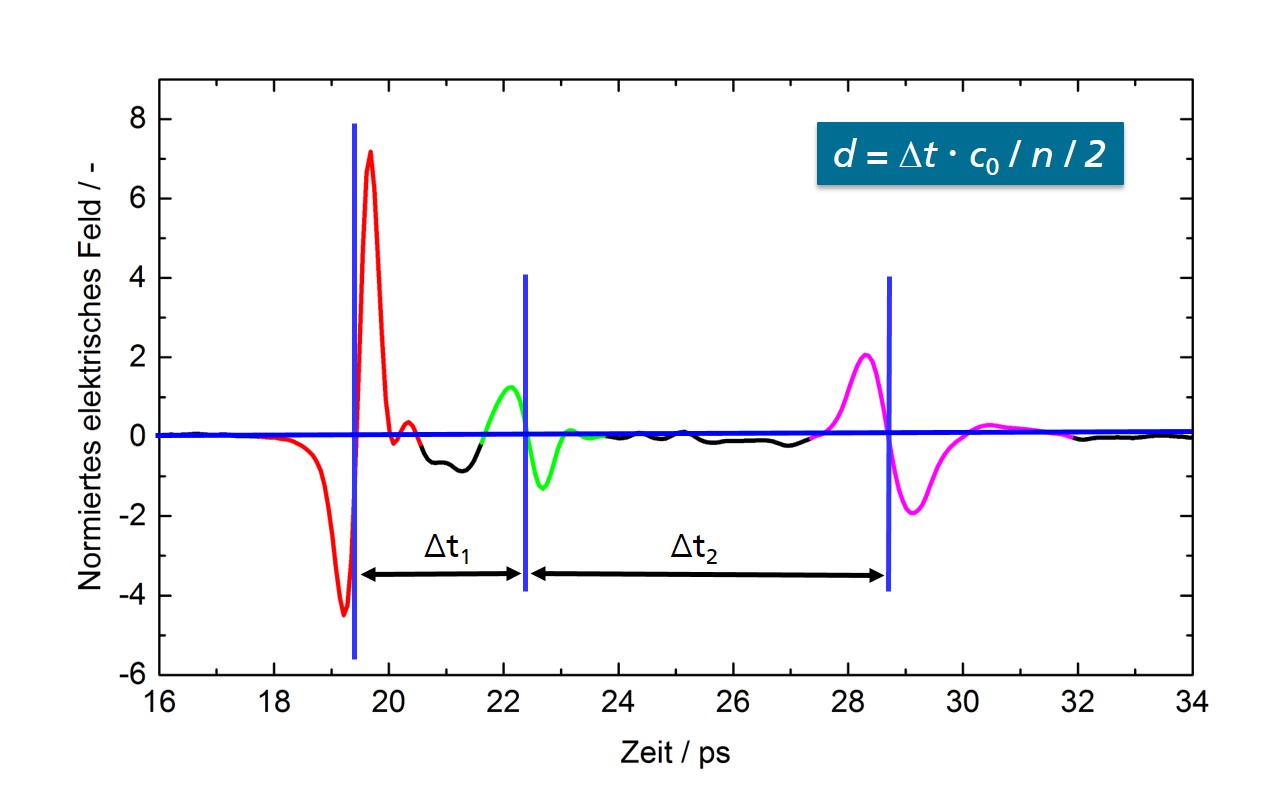
Layer thickness measurement with terahertz time-domain spectroscopy takes advantage of the fact that the incident terahertz beam is partially reflected at material transitions. In the simplest case, two reflections are obtained: one from the air/coating transition and a second from the coating/substrate transition. From the time difference between the two reflections and with knowledge of the refractive index, the coating thickness can be determined. If the coating consists of several coating layers, further reflections appear between the two described reflections, which also allow the analysis of complicated multilayer coatings.
Proof of capability provided
The Fraunhofer ITWM investigated the suitability of coating thickness measurement on wet films on metal sheets. These were painted in a controlled manner, dried in between, and finally completely cured. After each of these steps, the researchers determined the film thickness of the paint using terahertz measurement technology.
In the next series of measurements, they examined the correlation between paint weight and coating thickness. For this purpose, the sheet including the wet film was weighed several times during the curing process and the film thickness was measured directly afterwards using terahertz technology. The result: an excellent correlation between the decrease in weight and film thickness was observed.
With terahertz measurement technology, wet films can be analyzed in a non-contact and non-destructive manner - and even during the coating process! This applies to both the wet film and the dried layer underneath. Metals as well as plastics and composites such as CFRP are suitable as substrate materials. Coating thicknesses in the range from 10 to 500 µm can be determined - with an accuracy of ± 1 µm.
Use is harmless and uncomplicated
The use of the terahertz paint inspection system is straightforward. In addition, no radiation shielding is required because it is non-ionizing. Even on curved surfaces, terahertz systems can be used to reliably determine the individual layer thicknesses of complex coatings.
► Fraunhofer Institute for Industrial Mathematics
► www.itwm.fraunhofer.de