


Salomon leads through the mysterious world of sliding boards
Die Oberflächentechnik beim Skifahren birgt noch manches Rätsel
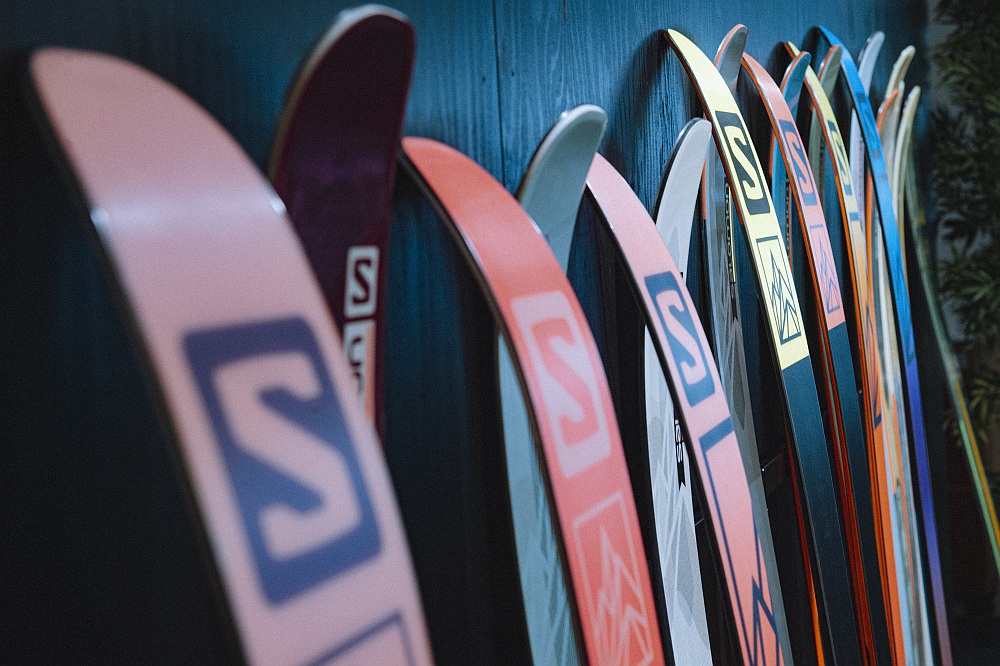
Skiing has gained a firm foothold as a winter pastime. But to ensure that the boards glide optimally through the snow, a lot of know-how is required in terms of surfaces and tribology.
Those who speak colloquially of their boards are actually still largely right: Modern skis are glued together from several layers of wood and, depending on the price range, filled with polyurethane (PU) foam or other plastics. It is different, however, with the running surface, also called the ski base. This layer has to meet three requirements at once: It should be elastic like the entire ski, but at the same time wear as little as possible and glide excellently through the snow.
Ski manufacturers are largely in agreement: The ski base of practically all producers consists almost entirely of high-density polyethylene (HDPE), i.e. polyethylene with a high density of between 0.94 and 0.97 g/cm³. This plastic is not only highly hydrophobic - which improves the gliding properties - but is also easy to machine. Whether milling,grinding, cutting, decorating, handling or bonding, this material can easily handle all processes.
Extruded or sintered HDPE
The running surface itself can be produced in two ways, by extrusion or by sintering.Extruded ski bases are suitable for entry-level skis because the gliding properties are at an average level, but the production process is very efficient and economical. They glide well over the snow even with little or no wax and absorb little wax because the structure of the base is very dense. Sintering is a bit more complex, but results in higher quality products. "The HDPE powder is first heated and pressed into a large cylindrical mold to create something similar to a full Gruyère or Parmiggiano cheese, depending on the desired width," explains Arnaud de Mondenard, who works for French ski manufacturer Salomon at its R&D headquarters in Annecy.
This cylinder is then mounted on a lathe so that the ski base can be cut from the outside to the desired thickness. Some sintered bases allow for high-speed skiing because they have a higher wax absorption rate, allowing them to release more wax as they glide. This reduces the sliding friction.
For top class skis, fine silicate particles are incorporated into the bases. The fineness of these particles and the homogeneous distribution in the base result in improved wear and sliding behavior. Waxing the base also prevents graying, which is an oxidation process. If minimal sliding resistance is desired, the ski base must be regularly re-waxed.
In ski factories, the bases are then shaped by milling or cutting. Although they expand, they can be easily and precisely cut and assembled to create different designs and branding. For recycling, the common material HDPE also offers the advantage that cut material can be recycled and made into new ski bases. The plastic can also be transparent, allowing the bases to be designed on the reverse side using screen printing, sublimation or digital printing. In ski construction, the coverings are usually bonded to various fibers with epoxy resin and must also be firmly bonded to the steel edges.

Tribology in skiing not yet fully researched
The tribology of ski-snow contact is difficult to document scientifically and is not yet fully understood. However, according to de Mondenard, researchers agree on the following: the pressure and friction between the base and the snowflakes generates heat, which causes the snowflakes to melt locally into water droplets. Since surfaces are not perfectly flat, there are a variety of contact points related to the roughness of the base. There is not one long contact area, but a multitude of small contact points around 0.15 µm in size. "We assume that gliding becomes good when water droplets immediately melt and freeze at the contact points between the base and the snow," says the French ski expert. So the ski glides on an interrupted film of water droplets called lenses.
However, if a continuous film of water develops in the contact area due to a high amount of water, the gliding properties deteriorate. The reason is that a shear force is required to split the water film. "Therefore, the sliding properties of a surface depend on its roughness, which we try to control by suitable microscopic structuring," explains de Mondenard.
Depending on snow conditions, the snow may contain more or less liquid water - whether on the surface or between the flakes. The higher the temperature and moisture in the snow, the greater the structuring needs to be. Coarse structuring with a larger step reduces the number of contact points and the amount of water between the snow and the ground. On the other hand, in cold and dry conditions, there is very little water in the snow, so a very fine structuring is required to multiply the number of water lenses and to glide on them.
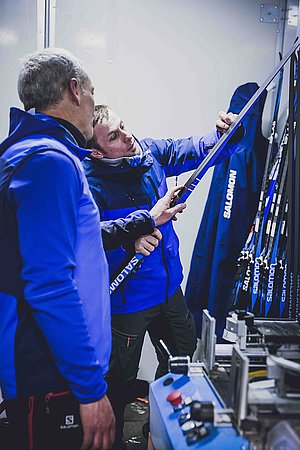
Professional skiers sometimes have more than 40 pairs of skis with them
Depending on the snow temperature, some additives such as carbon, zeolite or fluorine in the ski base can improve the gliding properties. The density and hardness of the base also have an influence on the gliding properties. When the skis are waxed, the pores of the HDPE are also filled with wax, which makes the base even more hydrophobic. The wax used for maximum efficiency depends on the base material and structure.
"This is why our service teams are at every World Cup race to help racers choose the right ski, base and structure," reports de Mondenard. National teams also follow World Cup races with grinding and structuring machines to adjust bases up to the last minute. A cross-country World Cup racer can travel from race to race with more than 40 pairs of skis to have the right choice at every moment and maximize his chances.