

DFO: Optical versus technical defects
Abstract
For coatings with antibacterial agents based on silver ions in medical technology, silver-containing additives are added during lacquer production, which kill the microorganisms in the form of dissolved ions.
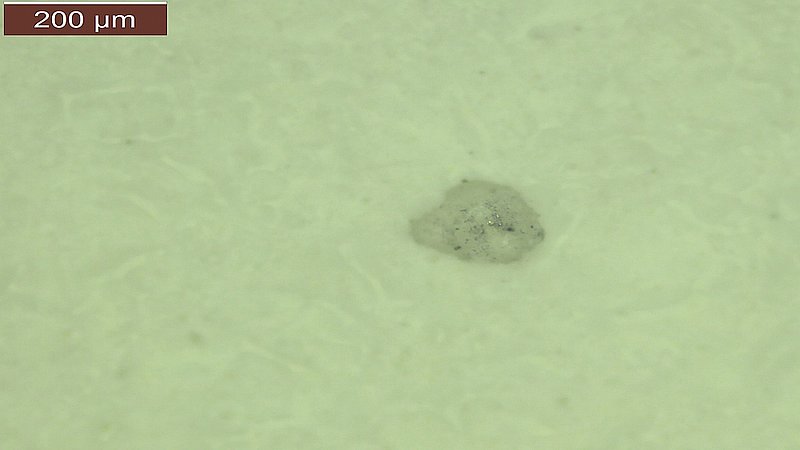
Coatings with antibacterial agents based on silver ions are state of the art in medical technology. However, the following case of damage, which was submitted to DFO Service GmbH for investigation, shows that mistakes can also be made in paint production which can impair the antibacterial effect of such coatings. In the case of powder-coated steel components for medical technology, there were visually conspicuous defects in the form of small greyish inclusions in the coating. The coating system was a polyester-based antibacterial powder coating. The antibacterial effect was based on the admixture of a silver-containing additive.
A light microscope view of a defect in the steel component showed that these were inclusions and not a purely optical defect: Dark, roundish and crystalline inclusions could be detected in all defect locations. In the next step, these inclusions were examined in top view by scanning electron microscopy (SEM) and energy dispersive X-ray spectroscopy (EDX). The roundish inclusions contained high levels of oxygen, phosphorus and magnesium and traces of silver. Since it could be assumed that local concentrations of the antibacterial additive in the form of these large silver-containing magnesium phosphate particles would lead to a reduced concentration in the other coating areas, resulting in a correspondingly reduced antibacterial effect there, the DFO was able to determine the presence of technical defects on the basis of the defects.
back to list